

If you have kidney disease, it is normal to wonder whether exercise is helpful, risky, or something you should avoid altogether. In most cases, the answer is encouraging: many people with kidney disease can and should stay active, but the safest type and amount of exercise depends on the person’s CKD stage, symptoms, other health conditions, and whether dialysis or transplant care is part of the picture. NIDDK says physical activity should be part of CKD care, and NKF says regular exercise is important at all stages of kidney disease, including for people on dialysis and after transplant.
For many people in Angleton and across Brazoria County, this question is not really about becoming an athlete. It is about being able to walk, move, build strength, protect the heart, manage blood pressure, and feel more in control without making symptoms worse. That is the right way to think about it. A safe exercise plan for CKD is usually built around consistency, lower-impact options, gradual progress, and knowing when to slow down or ask for medical guidance.
Medical disclaimer: This article is for educational purposes only. It is not medical advice, diagnosis, or a substitute for care from a licensed healthcare professional. Exercise with kidney disease should be individualized, especially if you have advanced CKD, dialysis, diabetes, heart disease, or severe symptoms.
Can people with kidney disease work out?
Yes — in many cases, they can. NIDDK tells people with CKD to make physical activity part of their routine and says to aim for 30 minutes or more on most days. NKF also says a consistent exercise routine helps people with CKD feel better and improve conditions like diabetes and heart disease.
Exercise matters in CKD because it supports more than fitness. NKF lists benefits such as better heart function, better blood pressure control, improved blood sugar if you have diabetes, improved muscle strength, improved weight management, and lower anxiety and depression. NIDDK similarly notes that physical activity can help with blood pressure, blood glucose goals, weight, and stress.
At the same time, not every person with CKD should exercise in the same way. The safest answer depends on things like stage of kidney disease, swelling, fatigue, shortness of breath, dizziness, heart disease, diabetes, dialysis access, transplant recovery, and overall mobility. That is why NIDDK says people who are not active now should ask their provider what types and amounts of physical activity are right for them.
What kinds of exercise are usually safest with kidney disease?
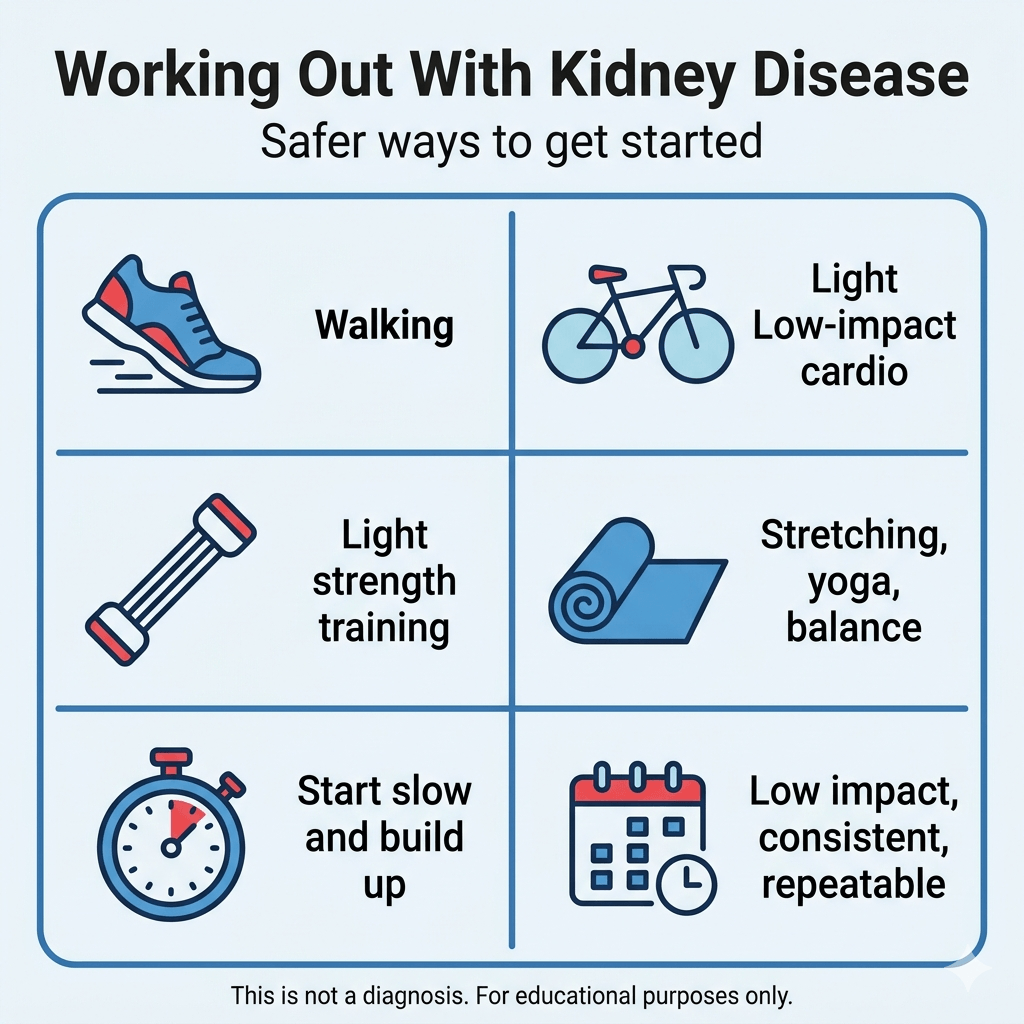
For many people, low-impact cardio is the safest place to start. Walking is especially practical because it is easy to scale up or down. NIDDK’s general activity guidance also points to walking, biking, dancing, and water workouts as accessible ways to begin moving more safely. NKF says aerobic exercise is helpful for CKD because it improves heart and lung function and blood vessel health.
Light to moderate strength training can also be useful. NKF says weight-bearing exercise and resistance work can help build and maintain bones and muscles, and NIDDK’s activity guidance includes strength training among standard healthy movement types. In practical terms, that can mean resistance bands, light dumbbells, bodyweight exercises, or chair-based strength work instead of heavy lifting right away.
Flexibility and balance work can also fit well. NIDDK’s general activity guidance includes yoga, tai chi, and similar movement as ways to improve strength, flexibility, posture, and balance. These can be especially useful for people who feel deconditioned, older adults, or people who are rebuilding movement confidence after illness.
The reason low-impact exercise often works best as a starting point is simple: it is easier to control. You can start slower, recover more easily, and build consistency before intensity. That matches NIDDK’s advice to start slowly and gradually increase activity over time.
What makes exercise safer or riskier in CKD?
One big factor is CKD stage and symptom burden. People with more advanced kidney disease are more likely to have fatigue, swelling, nausea, shortness of breath, cramping, and weakness, all of which can change what activity feels safe on a given day. NKF’s stage 4 CKD guidance specifically lists symptoms like swelling, fatigue, shortness of breath, nausea, vomiting, and trouble concentrating as common in advanced disease.
Another factor is blood pressure and heart health. Exercise is helpful for blood pressure control, but people who already have heart disease, difficult-to-control blood pressure, or very poor exercise tolerance may need a more customized plan. NIDDK’s activity safety guidance says people with chronic diseases such as diabetes, high blood pressure, or heart disease should talk with a health professional before starting or changing activity.
Diabetes changes the safety question too. NIDDK says physical activity often lowers blood glucose and can trigger low blood sugar during activity and for hours afterward, especially if a person uses insulin or certain diabetes medicines such as sulfonylureas. That means exercise timing, meals, snacks, and glucose monitoring matter more for people managing both CKD and diabetes.
Dialysis and transplant status also change the answer. NKF says exercise remains important for people on dialysis and after transplant, but it specifically tells dialysis patients to ask what types of exercise are safe with their type of dialysis access and to ask about food and fluid before, during, and after activity.
How to start working out safely with kidney disease
The safest starting point is usually to begin slower than you think you need to. NIDDK recommends starting slowly with activities you enjoy and then building up. That might mean short walks, light cycling, or chair exercises before trying longer or more demanding workouts.
It also helps to build time before intensity. A person who can walk for 10 or 15 minutes comfortably and consistently is often in a better place than someone who tries to do too much all at once and then stops for a week. NIDDK’s activity guidance emphasizes gradually increasing how long and how often you are active.
Choose activities you can realistically repeat. NKF explicitly says to find activities you enjoy so you can stay consistent, and NIDDK makes a similar point. A manageable routine is safer and more effective than an ambitious routine you cannot sustain.
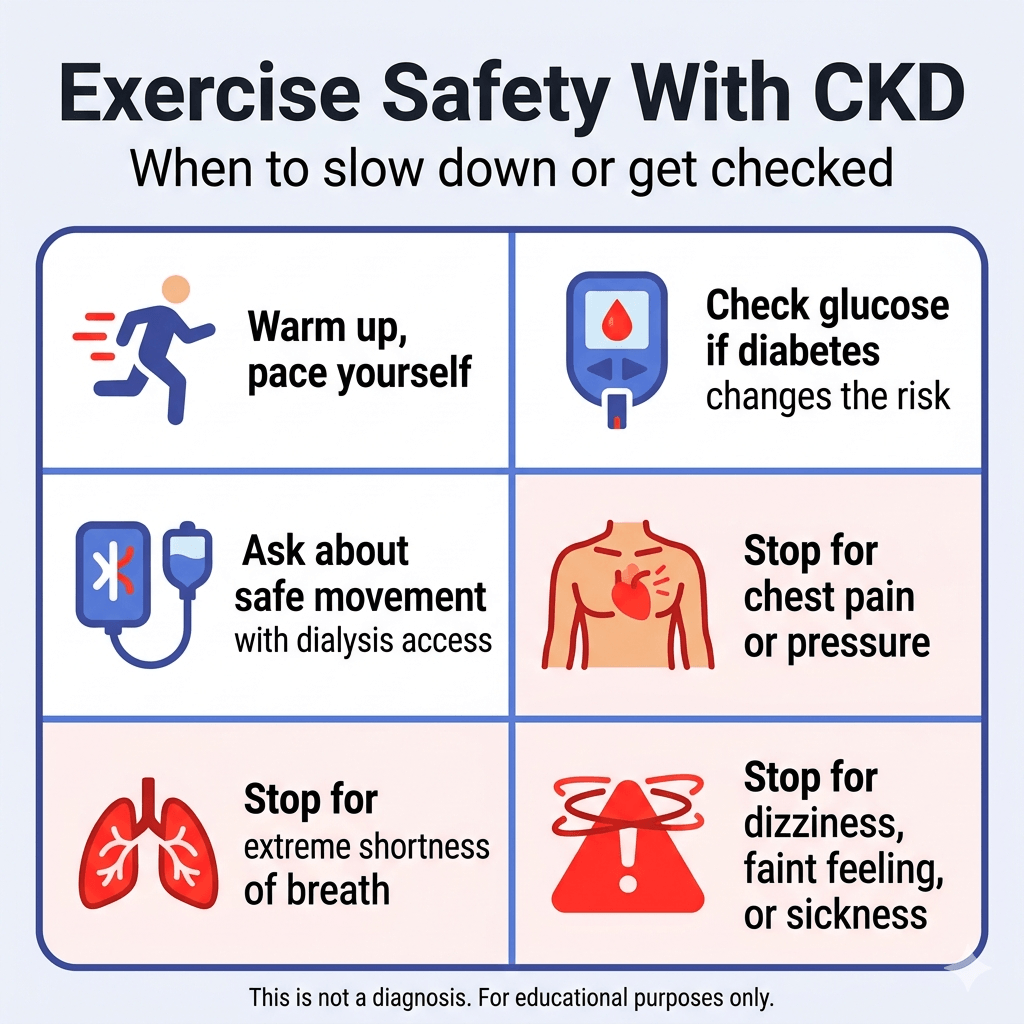
It is also worth treating warm-up, breathing, pacing, and cool-down as part of the workout, not optional extras. NKF’s practical points include starting slow, warming up, and breathing well, which is especially sensible for people with CKD, anemia, or deconditioning.
Signs you may need to slow down or stop exercise
Some warning signs should not be pushed through. NIDDK’s safety guidance says to stop activity and seek help right away for pain, tightness, or pressure in the chest or neck, shoulder, or arm, extreme shortness of breath, dizziness, or sickness.
You should also be more cautious if exercise is followed by unusual weakness, worsening swelling, poor recovery, or symptoms that are clearly worse than your normal baseline. That is partly an inference from CKD symptom guidance and general exercise safety guidance: if advanced CKD already causes swelling, fatigue, nausea, or breathing difficulty, exercise should not be making those problems escalate sharply.
For many CKD patients, the practical rule is this: normal workout fatigue is one thing; feeling sick, faint, chest pressure, or much more breathless than expected is different. Those signs deserve respect, not stubbornness.
Working out with CKD and diabetes
Exercise can help people with diabetes, including people who also have CKD. NIDDK says physical activity may lower blood glucose, blood pressure, and cholesterol, improve heart health, help with weight management, and improve mood and sleep.
But diabetes also adds safety details. NIDDK says physical activity can lower blood glucose during the activity and for hours or days afterward, and people who use insulin or some other glucose-lowering medicines are most likely to have low blood sugar. It recommends checking glucose before, during, and after activity when appropriate and adjusting food or medicine with medical guidance.
That is why the overlap between CKD and diabetes often makes exercise planning more individualized. NKF specifically suggests asking your care team what food and fluids you should have before, during, and after exercise, especially if you have diabetes and are at risk of low blood sugar.
Working out on dialysis or with more advanced kidney disease
People on dialysis can still benefit from exercise. NKF says regular exercise is important even for people on dialysis and that people on dialysis who exercise regularly often report better sleep, more energy, greater muscle strength, and better ability to do daily tasks. It also notes that some dialysis units offer exercise options during hemodialysis.
At the same time, dialysis changes what is safe. NKF specifically advises asking what types of exercise are safe for your type of dialysis access. That is important because a fistula, graft, or catheter can change what movements, pressure, or upper-body exercises are appropriate.
People with more advanced kidney disease may also notice that energy and exercise tolerance vary day to day. On some days the safest plan may be a normal walk or light strength work. On other days, especially if symptoms are worse, the safer choice may be lighter movement, stretching, or calling the care team before pushing through. That is a cautious inference based on the symptom burden described in advanced CKD and the individualized exercise guidance from NKF and NIDDK.
Questions to ask before starting a workout routine with kidney disease
NKF gives especially useful exercise questions for kidney patients. These include:
- What types of exercise are appropriate for me?
- If I am on dialysis, what types of exercise are safe with my access?
- How much fluid should I have before, during, and after I exercise?
- What food and fluids should I have before, during, or after exercise?
Those questions matter because safe exercise in CKD is rarely just about the workout itself. It is also about symptoms, medications, diabetes, fluids, and what your kidneys can tolerate in the context of your overall health.
When exercise questions should lead to medical follow-up sooner
It is worth checking in with a clinician sooner if you develop new chest pain, worsening breathing trouble, dizziness, faint feelings, major weakness with activity, or a sharp drop in exercise tolerance. NIDDK specifically says people with chronic disease or people who get out of breath easily should talk with a health professional before or as they increase activity, and it tells people to stop and get help for chest symptoms, extreme shortness of breath, dizziness, or sickness during activity.
It is also reasonable to ask for earlier guidance if your CKD symptoms have changed, your labs have worsened, you recently started dialysis, or you are unsure whether what you are feeling is from CKD, anemia, diabetes, heart strain, or medication effects. That is an inference based on the way CKD, anemia, diabetes, and exercise safety intersect in the official guidance.
For people in Angleton and Brazoria County, this often comes down to one practical question: Is this normal exertion, or is something medically wrong? If exercise or activity is followed by chest pressure, breathing problems, near-fainting, severe weakness, or a fast decline in how you feel, Angleton ER can evaluate urgent symptoms and help determine what kind of kidney or general medical follow-up is needed next.
Frequently Asked Questions
Is exercise safe with chronic kidney disease?
Usually, yes. NIDDK and NKF both support physical activity in CKD, but they also say it should be individualized based on your health and symptoms.
What is the best exercise for kidney disease?
There is no single best exercise for everyone, but low-impact options like walking, light cycling, and gentle strength or flexibility work are often practical starting points.
Can walking help if you have CKD?
Yes. Walking is one of the easiest and safest starting options for many people because it is simple to scale and supports heart health, blood pressure, and general conditioning.
Is weight lifting safe with kidney disease?
Sometimes. Light to moderate resistance work can be helpful, but not every person with CKD should jump into heavy lifting. The safest level depends on symptoms, overall health, and sometimes dialysis access.
Can people on dialysis still exercise?
Yes. NKF says exercise remains important for people on dialysis, though dialysis access and day-to-day symptoms may change what is safest.
Should people with CKD avoid intense exercise?
Not everyone must avoid it, but people with CKD should not assume intense training is automatically safe. Starting slowly and talking with the care team is especially important if symptoms, dialysis, heart disease, or diabetes are involved.
What symptoms mean I should stop exercising?
Chest pain or pressure, extreme shortness of breath, dizziness, or feeling sick are warning signs NIDDK says should make you stop and seek help.
Does exercise help slow kidney disease?
Official patient guidance strongly supports exercise as part of CKD management and overall health. NKF also says some research suggests exercise may help improve kidney function and anemia, though that should be understood as supportive benefit rather than a stand-alone treatment.
How often should someone with CKD work out?
NIDDK says to be active for 30 minutes or more on most days, and general adult diabetes guidance supports 150 minutes of moderate-intensity activity per week when appropriate.
When should someone ask a doctor before exercising?
Before starting or changing activity if they have chronic disease, get out of breath easily, have health concerns about safety, use glucose-lowering diabetes medicines, are on dialysis, or are unsure what activity is appropriate.