
When people hear that kidney disease is getting worse, one of the first questions is usually, “At what stage do you need dialysis?” The clearest answer is this: dialysis is usually considered in stage 5 CKD, which is kidney failure, but the decision is not made from the stage label alone. Doctors also look at symptoms, lab trends, waste buildup, fluid overload, and how the person is functioning overall.
For many families in Angleton and across Brazoria County, this question is really about timing: Is dialysis something to prepare for later, something to start now, or something that may not be chosen at all? NIDDK explains that kidney failure means less than 15% of normal kidney function, while its CKD testing guidance says a GFR of 15 or lower is called kidney failure and that most people below this level need dialysis or a transplant. At the same time, NIDDK also says many people actually start dialysis when kidney function is between 5 and 10, which shows why symptoms and clinical condition matter as much as the number itself.
Medical disclaimer: This article is for educational purposes only. It is not medical advice, diagnosis, or a substitute for care from a licensed healthcare professional.
What stage of CKD usually leads to dialysis?
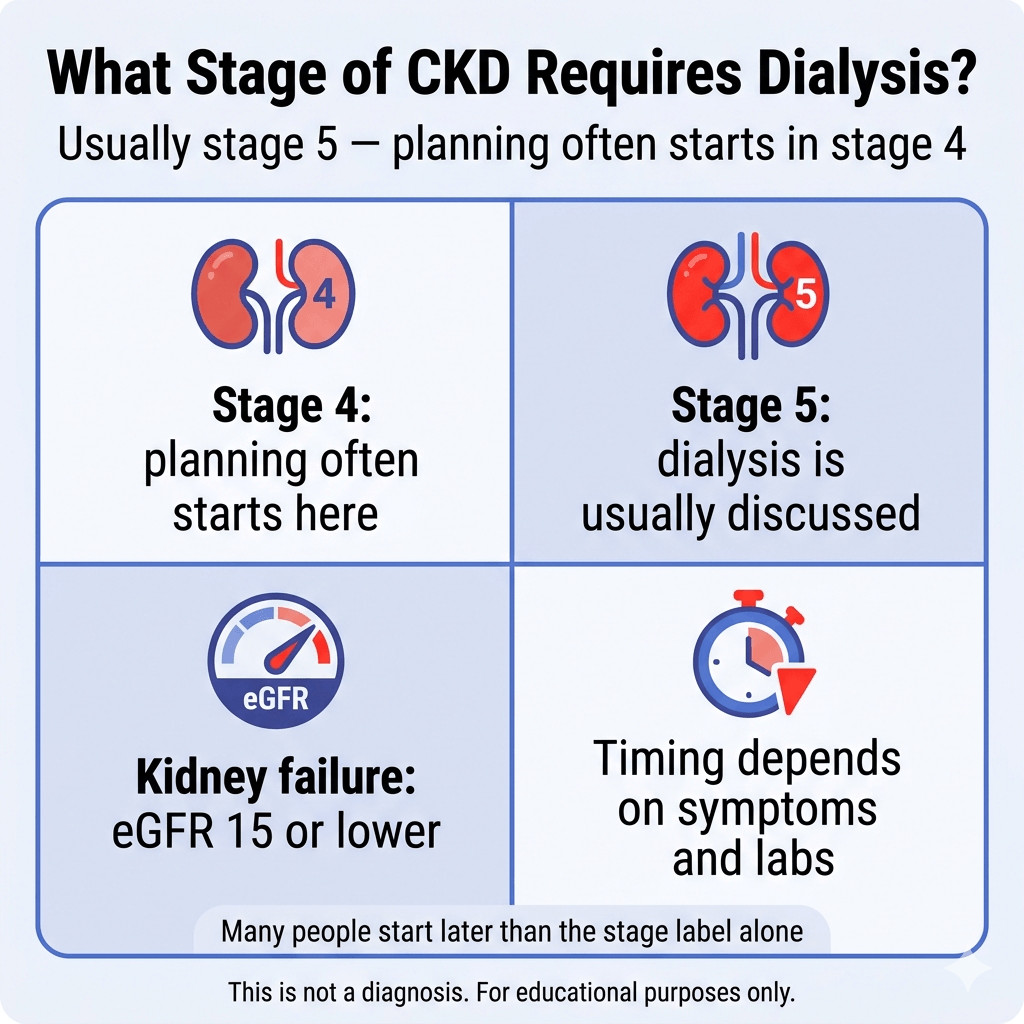
Dialysis is usually discussed in stage 5 CKD, also called kidney failure. NIDDK says kidney failure means kidney function has fallen below 15% of normal, and its testing page says a GFR of 15 or less is kidney failure.
That said, stage 4 CKD is often when planning begins, not necessarily when dialysis starts. National Kidney Foundation defines stage 4 CKD as an eGFR of 15 to 29 and describes it as severe loss of kidney function with the highest risk of progressing to kidney failure. NKF’s stage 4 guidance also tells patients to start asking about nephrology referral and when kidney failure treatment such as dialysis or transplant may be needed.
So the practical answer is: stage 5 usually raises the dialysis decision, while stage 4 often raises the planning conversation.
Does everyone with stage 5 CKD need dialysis right away?
Not always. NIDDK says the need for dialysis usually comes on slowly, and that symptoms such as losing your desire to eat and losing muscle may begin so gradually that you do not notice them at first. It then says many people start dialysis when their kidney function is between 5 and 10, and that starting dialysis at that point may help relieve kidney-failure symptoms.
That means two people can both be in stage 5 CKD and still not start dialysis on the same day or at the same eGFR. One person may be feeling much sicker, with more fluid overload or stronger symptoms from waste buildup. Another may still be closely monitored while treatment planning continues. That is an inference from NIDDK’s description of slow onset and individualized start timing.
NIDDK also explains that some people with kidney failure choose conservative management instead of dialysis or transplant. In that approach, the care team continues treatment focused on symptoms, kidney function preservation, and quality of life without replacing kidney function through dialysis.
What actually makes dialysis necessary?
Dialysis becomes necessary when the kidneys can no longer manage waste and fluid well enough to support safe daily life. NIDDK says kidney failure can cause symptoms from the buildup of waste products and extra water in the body. It also says people often start dialysis when the symptoms of kidney failure are strong enough that dialysis may help them feel better.
That is why the dialysis decision is usually driven by things like:
- worsening appetite or muscle loss
- symptoms from waste buildup
- extra water or fluid that the kidneys can no longer handle well
- low kidney function that is continuing to fall
- overall decline in strength or daily function
In other words, dialysis is not started just because a stage label appeared in the chart. It is started because kidney failure has reached the point where replacing part of kidney function is likely to improve safety or symptoms.
What kidney failure means
NIDDK defines kidney failure as less than 15 percent of normal kidney function. Its CKD testing guidance says a GFR of 15 or lower is called kidney failure.
But kidney failure does not automatically mean dialysis begins the same day. NIDDK’s treatment guidance makes that clear by explaining that many people start dialysis later, often when kidney function is in the 5 to 10 range and symptoms are more significant.
That distinction matters because it helps families understand the real sequence: kidney failure can be diagnosed first, and dialysis timing is then individualized based on symptoms and clinical need.
Why stage 4 CKD is still a very important stage
Stage 4 matters because this is often when doctors begin preparing before dialysis is urgently needed. NIDDK says people should start learning about treatment options early, before they need one, so they have time to understand the choices and create a treatment plan.
That preparation is not just mental. NIDDK’s hemodialysis guidance says one important step before starting hemodialysis is minor surgery to create a vascular access, and that the access should be in place in plenty of time because healing can take several months. It also says no one wants to start dialysis before it is needed, but preparing early matters because dialysis takes time to get ready for properly.
So stage 4 is important because it is often the stage where the family starts asking practical questions: Which treatment options are available? Do we need a fistula? What happens if dialysis becomes necessary later?
Signs dialysis may be getting closer
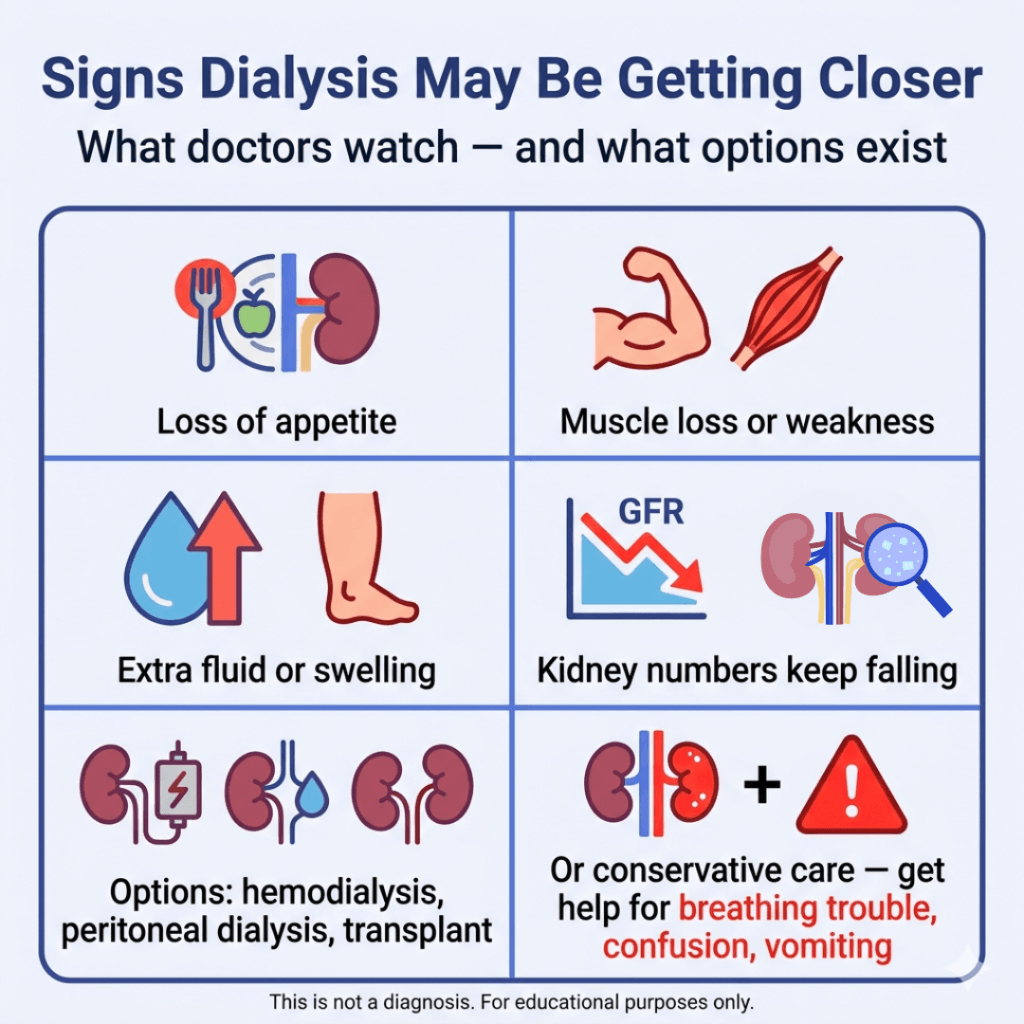
NIDDK says the need for dialysis often develops slowly, and that symptoms can include losing your desire to eat and losing muscle. Its kidney-failure guidance also says people may have symptoms from waste and extra water buildup.
That means dialysis may be getting closer when families begin noticing:
- worsening appetite or unplanned weight loss
- more weakness or muscle loss
- swelling or fluid-related symptoms
- more nausea or feeling generally unwell
- kidney numbers that keep falling over time
These signs do not mean someone should decide on their own that dialysis must start. They mean the situation deserves closer reassessment with the kidney team.
What treatment choices exist once kidney failure is reached
NIDDK lists four broad treatment paths once kidney failure is reached:
- hemodialysis
- peritoneal dialysis
- kidney transplant
- conservative management without dialysis or transplant
That is an important part of this discussion. Dialysis is common in kidney failure, but it is not the only path, and treatment decisions should be made with the care team, based on the person’s health, goals, and expected benefit from treatment.
How doctors decide when to start dialysis
Doctors usually look at more than eGFR. NIDDK says they help decide the best time to begin treatment by looking at symptoms and kidney function together. It also explains that starting dialysis may help relieve symptoms and help people regain appetite and maintain strength.
They also try to plan ahead when possible instead of waiting for a crisis. NIDDK repeatedly advises learning about options early and preparing early, because dialysis works best when the patient and team have time to think through the decision rather than being forced into it suddenly.
So the real-world answer is: doctors start dialysis when kidney failure is advanced enough, symptoms or complications justify it, and the likely benefit is clear enough to move forward.
When the dialysis conversation should happen sooner
The conversation should happen sooner when kidney function is clearly worsening, especially as eGFR moves into stage 4 and then toward stage 5. NKF says stage 4 CKD is the highest-risk stage before kidney failure and includes planning-ahead questions about dialysis or transplant.
It should also happen sooner if symptoms are becoming harder to manage, or if the team thinks access planning may be needed. NIDDK’s hemodialysis guidance is very clear that access surgery should happen with enough lead time, not after dialysis is already urgently overdue.
When symptoms should not wait
Some situations should not wait for a routine follow-up discussion. NIDDK says kidney failure can cause symptoms from the buildup of extra water and waste, and its treatment guidance describes a gradual loss of appetite and strength as warning signs that dialysis may be needed.
In practical terms, urgent reassessment becomes more important if someone with advanced CKD has:
- severe shortness of breath
- major weakness or confusion
- repeated vomiting
- fast-worsening swelling
- a rapid overall decline in how they look or function
For families in Angleton and Brazoria County, this is often the hardest part: knowing whether the situation is still part of a chronic decline or whether it has become something more urgent. If breathing trouble, repeated vomiting, confusion, severe swelling, or a rapid decline is happening, Angleton ER can evaluate the immediate medical problem and help determine what kind of kidney follow-up needs to happen next.
Frequently Asked Questions
What stage of CKD usually requires dialysis?
Usually stage 5 CKD, which is kidney failure. NIDDK says a GFR of 15 or lower is kidney failure, and that most people below this level need dialysis or a transplant.
Does stage 5 CKD always mean dialysis right away?
No. NIDDK says many people start dialysis when kidney function is between 5 and 10, which shows that the start date depends on symptoms and clinical condition, not just the stage label.
At what eGFR do most people start dialysis?
NIDDK says many people start when their kidney function is between 5 and 10.
Can someone with kidney failure choose not to start dialysis?
Yes. NIDDK says conservative management is an option for kidney failure and focuses on symptom control, kidney function preservation, and quality of life without dialysis or transplant.
Why does stage 4 CKD matter if dialysis usually starts in stage 5?
Because stage 4 is often when preparation begins. NKF identifies stage 4 as severe loss of kidney function with high risk for kidney failure, and NIDDK says treatment planning should begin early.
What symptoms suggest dialysis may be getting closer?
NIDDK highlights loss of appetite, muscle loss, and symptoms from waste and extra water buildup as common clues.
Can you have kidney failure without starting dialysis immediately?
Yes. Kidney failure can be diagnosed at a GFR of 15 or lower, but NIDDK says many people do not actually start dialysis until later, often in the 5 to 10 range.
Is dialysis the only treatment for kidney failure?
No. NIDDK lists hemodialysis, peritoneal dialysis, kidney transplant, and conservative management.
How do doctors know when it is time to start?
They look at kidney function together with symptoms and whether dialysis is likely to relieve those symptoms and improve strength or appetite.
When should someone seek urgent care instead of waiting?
When advanced CKD or kidney failure is accompanied by severe breathing trouble, repeated vomiting, confusion, major weakness, or rapidly worsening swelling or decline. This is a practical inference based on NIDDK’s kidney-failure symptom guidance and its explanation that waste and extra water buildup can become severe.