

Seeing a kidney measurement on an ultrasound or scan can be confusing, especially when the report gives a number in centimeters and does not explain whether that number is normal. For many people in Angleton and across Brazoria County, the first question is simple: What is a normal kidney size, and does age change it? The short answer is that kidney size does matter, but there is not one perfect “normal by age” number that fits everyone. In adults, kidney size is influenced by body size, sex, the type of imaging used, and which kidney is being measured. In children, age and growth matter much more directly.
Medical disclaimer: This article is for educational purposes only. It is not medical advice, diagnosis, or a substitute for care from a licensed healthcare professional.
What normal kidney size usually means
Kidney size is usually measured on ultrasound, though CT and MRI can also measure it. NIDDK explains that imaging tests such as ultrasound, CT, and MRI help healthcare professionals look at the structure of the urinary tract, and kidney ultrasound can show whether the kidneys are in the right place or whether there are problems such as blockage, stones, or tumors.
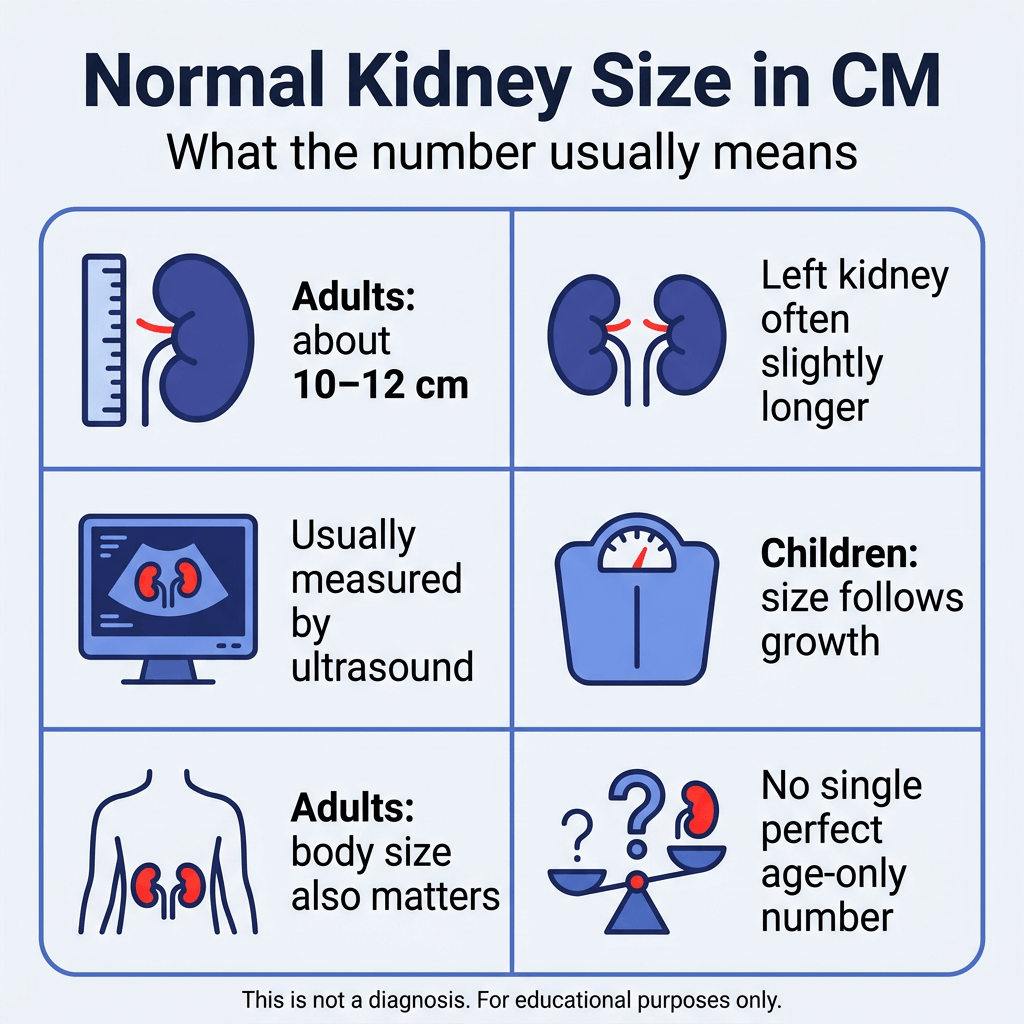
In adults, a normal kidney is commonly described as being about 10 to 12 cm long. National Kidney Foundation patient guidance says kidneys are usually about the size of a fist, or about 10 to 12 cm. Adult imaging studies line up with that general range: one ultrasound study found mean renal lengths of about 10.2 to 10.3 cm, another found about 10.7 cm on both sides, and a CT study found averages of about 10.9 cm on the right and 11.1 cm on the left.
One more detail often seen in imaging studies is that the left kidney is often slightly longer than the right. That is a normal pattern in many adults and does not automatically mean something is wrong.
Does kidney size change with age?
This is where the topic gets more complicated than the blog title suggests. In children, kidney size clearly changes with age and growth. Pediatric ultrasound studies show kidney length correlates with age, height, weight, and body surface area, which is why pediatric charts and nomograms are used much more often.
In adults, age matters, but it is not the only or even always the strongest factor. Some adult studies found that kidney length does not change significantly with age alone, while others found mild differences or decline depending on the population and measurement method. One healthy-adult ultrasound study found mean lengths around 10.68 cm on the right and 10.71 cm on the left with no significant change with age across adult groups. At the same time, National Kidney Foundation guidance on aging notes that kidneys may become smaller in size with age, especially in older adults. The safest way to explain this is that age can influence kidney size, particularly later in life, but adult kidney size is still interpreted in context rather than by one rigid age chart.
Normal kidney size in children vs adults
Children and adults should not be compared using the same logic. In children, kidneys are still growing, so age-based or height-based charts are meaningful. Pediatric studies show renal length correlates strongly with growth and body measurements, and modern pediatric reference work often uses percentiles rather than one fixed number.
In adults, interpretation shifts. Instead of asking, “What should the kidney measure at this exact age?” the more useful question becomes, “Is this kidney size reasonable for this adult’s body and imaging context, and does it match the rest of the clinical picture?” That is why adult kidney measurements are usually discussed as a range rather than a strict age-only chart.
What can make a kidney look smaller than normal
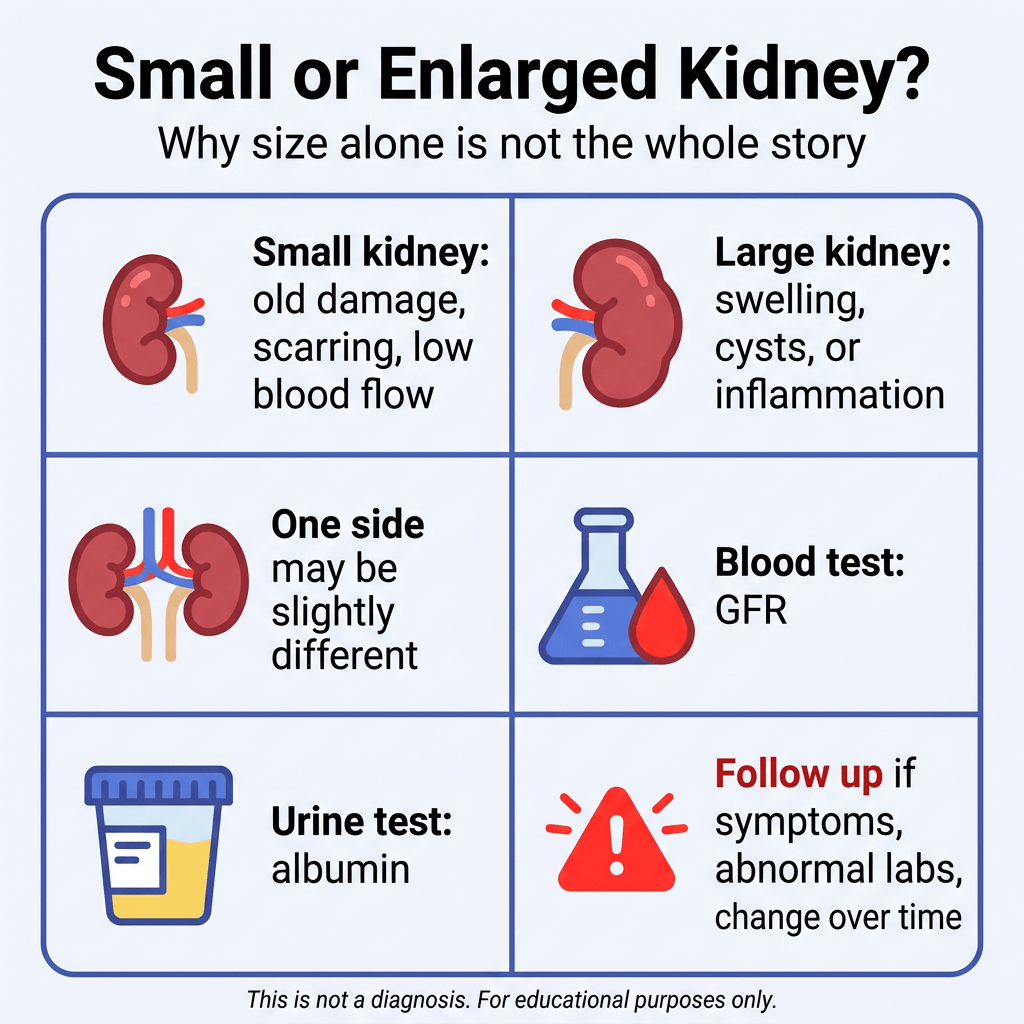
A kidney that is clearly smaller than average may be described as atrophic. National Kidney Foundation defines kidney atrophy as a kidney that is smaller than average and notes that one or both kidneys can be affected. It also lists several possible causes, including reduced blood supply, loss of nephrons, chronic infection, blockage, and being born with a smaller kidney, called renal hypoplasia.
This is one reason a “small kidney” on imaging should not be interpreted in isolation. A small kidney may reflect old scarring, long-standing reduced blood flow, past infection, obstruction, or congenital difference. In some people, only one kidney is small and the other works normally enough to keep overall kidney function stable. In others, small kidneys may be part of chronic kidney disease.
What can make a kidney look larger than normal
A kidney can also look larger than expected. That does not automatically mean something severe, but it does deserve context. NIDDK materials on hydronephrosis describe swelling in the kidney when urine backs up, and NKF and NIDDK information on polycystic kidney disease explains that many cysts can enlarge the kidneys over time.
So when a report mentions an enlarged kidney, doctors may think about possibilities such as swelling from blockage, cyst-related enlargement, acute inflammation, or other structural causes. The key point is that bigger is not automatically better, and smaller is not automatically worse. The meaning comes from the pattern, the symptoms, and the rest of the testing.
When kidney size matters more than the number alone
A kidney measurement becomes much more meaningful when it is paired with kidney function testing. NIDDK says the main tests used to check for kidney disease are a blood test for GFR and a urine test for albumin. Those tests help show how well the kidneys are filtering and whether there is evidence of kidney damage.
That is why a person can have a kidney size that looks fairly normal on imaging and still have kidney disease, or have a somewhat small kidney and still maintain reasonable overall function depending on the situation. Imaging gives structural information. Blood and urine tests give functional information. They work together; one does not replace the other.
Symptoms matter too. Swelling, changes in urination, flank pain, blood pressure problems, repeated infections, or abnormal lab results can make a kidney size finding more important than it might look on paper by itself.
What an ultrasound report may say about kidney size
A report may use phrases such as “normal-sized kidneys,” “small kidneys,” “atrophic kidney,” or “enlarged kidney.” If the report says normal-sized kidneys, it usually means the measurements and overall appearance do not raise obvious structural concern. If it says small or atrophic, that often means the kidney is below typical size expectations and may reflect chronic damage or another long-term process. If it says enlarged, the next question is usually why the kidney looks enlarged, not just how many centimeters it measures.
It is also common for one kidney to be slightly different from the other. Mild side-to-side difference can be normal, especially because the left kidney is often a little longer than the right in adults. A much larger difference, though, may deserve follow-up.
When a kidney size finding should lead to follow-up
Follow-up matters more when the kidneys are much smaller than expected, when only one kidney looks clearly abnormal, when enlargement suggests swelling or cystic disease, or when the imaging result comes with abnormal kidney labs or symptoms. That is especially true if the person also has diabetes, high blood pressure, or a family history of kidney disease, since NIDDK recommends kidney testing for people in those higher-risk groups.
A kidney size number also deserves more attention if it is changing over time on repeat imaging. Comparing old and new studies can help doctors see whether the finding is stable, slowly evolving, or linked to a newer problem such as obstruction or progressive chronic disease.
How doctors decide whether kidney size is actually a problem
Doctors do not decide based on centimeters alone. They consider:
- the imaging method used
- the person’s age and body size
- whether the right and left kidneys are similar
- whether the report mentions scarring, cysts, swelling, or thinning
- whether blood and urine tests are normal or abnormal
- whether symptoms or risk factors are present
That is why two people can both have a kidney reported at 9 cm and still not mean the same thing. In many adults, 9 cm is on the smaller side compared with common adult ranges, but whether it is truly abnormal depends on the whole picture. By the same logic, 12 cm can still fall within a common adult range, especially if the person is larger-framed and the rest of the report is reassuring. That interpretation is partly an inference from adult range studies and NKF’s 10-to-12-cm guidance, not a universal rule.
If a kidney size report is creating more questions than answers, that usually means the number needs to be read in context rather than in isolation. For people in Angleton and Brazoria County, Angleton ER can evaluate urgent symptoms such as pain, vomiting, dehydration, blood in the urine, or sudden worsening weakness and help guide what kind of follow-up is needed next.
Frequently Asked Questions
What is a normal kidney size in adults?
A common adult reference is about 10 to 12 cm in length, though actual measurements vary by imaging method, body size, and side.
Is 9 cm kidney size normal?
In many adults, 9 cm is smaller than the most commonly cited adult average, but it is not automatically a diagnosis by itself. Doctors look at body size, age, the other kidney, the imaging method, and kidney function tests before deciding whether it is concerning.
Is 12 cm kidney size normal?
Often, yes. 12 cm can still fit within a common adult range, especially depending on body size and the rest of the imaging report.
Does kidney size decrease with age?
It can, especially in older adults, but adult kidney size is not determined by age alone. Some adult studies found little change in kidney length with age, while NKF notes kidneys may become smaller with aging.
Why is the left kidney sometimes bigger than the right?
Because that is a common normal pattern in adults. Imaging studies often find the left kidney is slightly longer than the right.
What does a small kidney mean on ultrasound?
It may mean kidney atrophy, old scarring, reduced blood flow, past infection, blockage, or a kidney that developed smaller from birth. Context matters.
Can kidney disease happen even if kidney size is normal?
Yes. Kidney disease is checked with blood GFR and urine albumin testing, not size alone.
Are kidney size charts different for children?
Yes. In children, kidney size is much more closely linked to age, height, and growth, so pediatric charts are used much more often than in adults.
What test is best for checking kidney size?
Ultrasound is commonly used because it is noninvasive and does not use radiation, but CT and MRI can also measure kidney size.
When should someone worry about a kidney size report?
When the finding is clearly outside the expected range, when one kidney looks very different from the other, when symptoms are present, or when blood and urine tests are abnormal.