
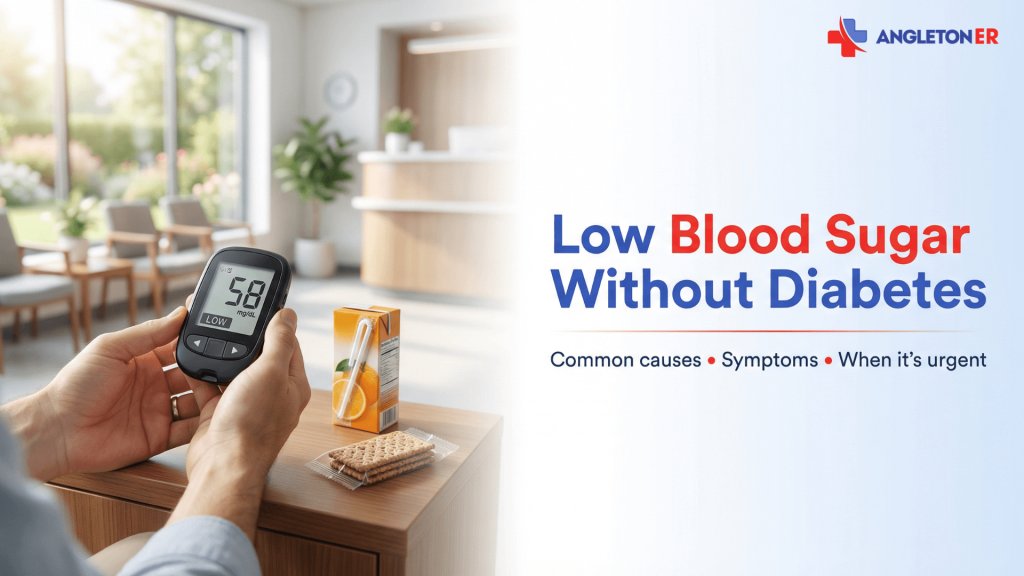
If you’ve ever felt shaky, sweaty, weak, dizzy, or “not right” and wondered, “How can my blood sugar be low if I don’t have diabetes?” — you’re not alone. In the ER, I see this all the time.
And in a place like Angleton, where many people commute and drive daily (the average commute is 28.7 minutes), it matters because low blood sugar symptoms can make driving unsafe fast.
Let’s go step-by-step through what “low” means, the most common non-diabetes causes, and the exact situations where I want you to come to the ER now.
First: what counts as “low blood sugar”?

In medicine, blood sugar below 70 mg/dL is considered low.
That number matters because once you’re under that range, your brain and body may not be getting enough fuel — and symptoms can escalate.
Severely low
If blood sugar drops below 55 mg/dL, the CDC considers that severely low, and you may not be able to treat it safely on your own.
Can low blood sugar happen if you don’t have diabetes?
Yes.
Low blood sugar (hypoglycemia) is more common in people treating diabetes, but Mayo Clinic is clear: other drugs and a variety of conditions (many rare) can cause low blood sugar in people who don’t have diabetes.
Low sugar is not automatically diabetes. (This directly addresses the common question: “is low sugar diabetic”.)
What low blood sugar feels like
Most people feel symptoms before it becomes dangerous, but the symptoms can be different from person to person.
Common early symptoms include:
- Shakiness / trembling
- Sweating
- Fast heartbeat
- Hunger
- Anxiety or irritability
- Lightheadedness
- Headache
More serious symptoms
These are the ones that raise my concern in the ER:
- Confusion
- Trouble speaking
- Fainting
- Seizure
- Loss of consciousness
The most common causes of low blood sugar without diabetes

When you don’t have diabetes, hypoglycemia usually comes from one of two problems:
- you don’t have enough glucose coming in, or
- your body is using glucose faster than it can replace it.
Here are the causes I see most often:
1.Not eating enough (or eating too late)
Skipping meals, eating very little, or going too long between meals can cause your glucose to dip — especially if you’re active or under stress.
2. Stomach illness: vomiting/diarrhea + dehydration
If you’re not keeping food down, your body runs out of available glucose. Dehydration and electrolyte issues can make symptoms feel even worse.
3. Alcohol (especially without food)
Alcohol can interfere with the liver’s ability to release stored glucose when your body needs it. That’s why hypoglycemia can happen after heavy drinking—particularly if you haven’t eaten.
4. Intense exercise without enough fuel
Long workouts, heavy labor, or high activity days without enough carbs/calories can trigger low blood sugar symptoms.
5. “Reactive” low blood sugar after eating
Some people feel symptoms a few hours after meals (especially high-sugar meals) because the body releases a larger insulin response than needed. Mayo Clinic recognizes this as a possible pattern in non-diabetics (often evaluated as part of “non-diabetic hypoglycemia”).
Medication-related causes
This category matters because it’s easy to miss.
Accidental exposure to diabetes medications
Sometimes hypoglycemia happens because of:
- someone accidentally taking another person’s diabetes medication, or
- a medication mix-up.
This is a recognized concern in clinical evaluation (insulin or sulfonylurea exposure).
Can Mounjaro cause low blood sugar if not diabetic?
Here’s the straight answer based on prescribing information:
The FDA label warns that Mounjaro (tirzepatide) increases hypoglycemia risk when used with insulin secretagogues (like sulfonylureas) or insulin, and dose reduction may be needed for those medicines.
So if someone is not diabetic and is using tirzepatide (often for weight loss), the main “hypoglycemia risk” warning is still tied to combining it with insulin/sulfonylureas—but people can still feel lightheaded or shaky from low intake, dehydration, or long gaps between meals, which can mimic or contribute to true low sugar.
Less common but important medical causes
If lows are recurrent, happen without clear triggers, or come with severe symptoms, I start thinking broader:
Adrenal insufficiency (low cortisol)
Cortisol helps maintain blood sugar. Cleveland Clinic notes low cortisol levels can lead to hypoglycemia episodes.
Liver disease
The liver stores and releases glucose. If it can’t do that properly, lows can occur.
Kidney disease
Kidney problems can affect how the body clears insulin and regulates glucose.
Severe infection / critical illness
When the body is under severe stress, glucose regulation can become unstable.
Insulinoma or rare tumors
Rarely, the body may produce too much insulin from a tumor (like an insulinoma). These are uncommon, but they’re on the medical checklist when hypoglycemia is unexplained or repetitive.
When low blood sugar becomes an ER emergency
Go to the ER now if
- You’re confused, disoriented, or can’t think clearly
- You fainted or nearly fainted
- You’re vomiting or can’t keep fluids down
- Symptoms keep coming back even after eating sugar
- Your measured glucose is very low, especially near or below 55 mg/dL
Call 911 immediately if
- Someone is unconscious
- Someone is having a seizure
- Someone cannot safely swallow or is choking/can’t protect their airway
What to do right away
If the person is awake and able to swallow:
- Take fast sugar (glucose tablets, juice, regular soda—not diet, honey, etc.)
- Wait 15 minutes
- Recheck if you can (or reassess symptoms) and repeat if needed
This “15–15” approach is part of CDC guidance for treating low blood sugar.
If you’re experiencing repeated low blood sugar symptoms, confusion, fainting, or can’t keep fluids down, don’t wait and try to figure it out at home. Get checked right away.
Angleton ER is open 24/7 and ready to evaluate low blood sugar safely and quickly.
Frequently Asked Questions
Is low sugar diabetic?
Not automatically. Low blood sugar is commonly linked to diabetes treatment, but Mayo Clinic explains there are other drugs and conditions that can cause hypoglycemia in people without diabetes.
Can type 2 diabetes have low blood sugar?
Yes—especially if someone uses insulin or certain diabetes medicines. (That’s why this topic confuses people.)
What is considered low blood sugar for type 2 diabetes?
The CDC uses the same action threshold: below 70 mg/dL is low and needs treatment.
Is type 2 diabetes hyperglycemia or hypoglycemia?
Type 2 diabetes is primarily associated with high blood sugar (hyperglycemia), but hypoglycemia can happen, usually from medications or mismatches between food/activity and treatment.
Can Mounjaro cause low blood sugar if not diabetic?
Per the FDA label, hypoglycemia risk is especially noted when Mounjaro is used with insulin or sulfonylureas.