

If you have noticed a new change in your fingernails, it is normal to wonder whether it means something more than dryness, aging, or a cosmetic issue. Nails can sometimes reflect what is happening elsewhere in the body, and certain changes have been linked with systemic illnesses, including kidney disease. But this part matters just as much: nail changes do not diagnose kidney disease on their own. Kidney disease is often silent early on, and blood and urine testing are still the main way doctors find it.
For people in Angleton and across Brazoria County, this question often comes up after someone notices pale nails, brittle nails, or a strange color change that does not go away. The most helpful way to think about it is this: nails can sometimes be a clue, but they are only one clue. The bigger picture still includes symptoms, medical history, blood pressure, diabetes risk, and lab testing.
Medical disclaimer: This article is for educational purposes only. It is not medical advice, diagnosis, or a substitute for care from a licensed healthcare professional.
Can Kidney Disease Affect Your Fingernails?
Yes, it can. MedlinePlus notes that kidney disease can lead to a buildup of nitrogen waste products in the blood, and that buildup can affect the nails. MedlinePlus also explains more broadly that the health of the fingernails can offer clues about overall health, and changes in nail color, shape, or texture may be linked with disease.
At the same time, nail changes are not specific enough to be used like a diagnosis test. Many nail abnormalities can happen for other reasons, including fungal infection, thyroid disease, iron deficiency anemia, psoriasis, malnutrition, injury, and simple aging. That is why persistent nail changes are worth noticing, but not worth self-diagnosing from.
The Nail Changes Most People Ask About With Kidney Disease
Half-and-half nails
The nail change most strongly associated with kidney failure is called half-and-half nails, also known as Lindsay nails. MSD Manual describes this pattern as a nail with a white portion closer to the cuticle and a pink, red-brown, or darker band toward the tip. In its consumer guide, MSD says kidney failure may cause the bottom half of the nails to turn white and the top half to turn pink or appear pigmented. In its professional guide, MSD notes that Lindsay nails occur in 20% to 50% of patients with chronic kidney disease, although they can also appear in other conditions and even in healthy people.
Pale or dull-looking nails
Pale nails are another change people may notice. Pale nails are not a classic “kidney-only” sign, but they can overlap with anemia, and anemia is a common complication of chronic kidney disease that becomes more likely as kidney function declines. NIDDK explains that anemia in CKD is common, is less common in early kidney disease, and often worsens as kidney disease progresses.
Brittle, splitting, or weak nails
Brittle nails are common, but they are also very nonspecific. MedlinePlus says brittle nails are often a normal result of aging, and can also happen with thyroid disease or other conditions. That means brittle nails can appear in someone with CKD, but brittle nails by themselves are not a strong kidney sign.
Spoon-shaped nails
Spoon-shaped nails, called koilonychia, curve inward and are more classically associated with iron deficiency anemia than kidney disease itself. MedlinePlus specifically links koilonychia with iron deficiency anemia. That makes it useful to mention here, mostly because readers sometimes assume every unusual nail shape must point back to the kidneys.
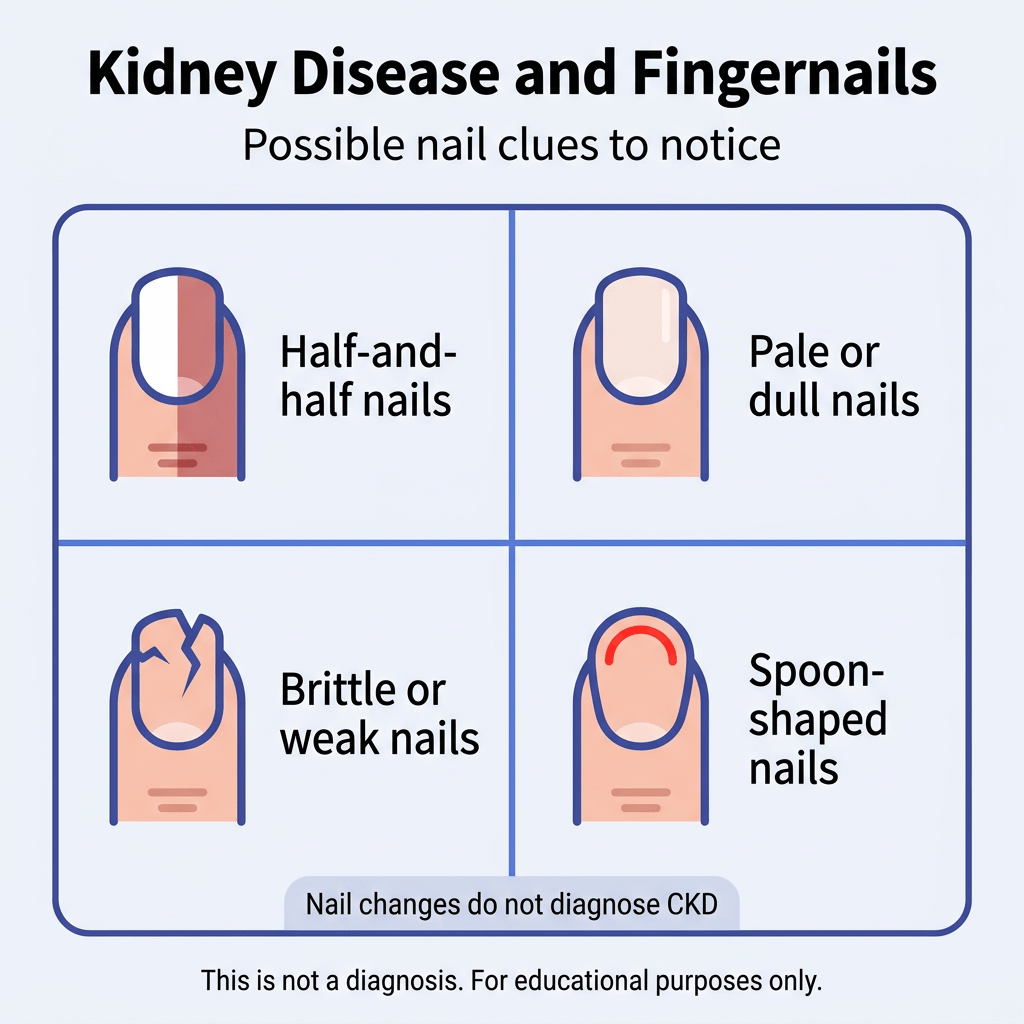
What Half-and-Half Nails Look Like
Half-and-half nails usually have a sharp horizontal split in color. The section closer to the base of the nail looks white, while the outer portion looks pink, reddish-brown, or darker. This is different from more common cosmetic streaks, surface ridges, or tiny white spots. MSD describes Lindsay nails as leukonychia caused by changes in the nail bed rather than the nail plate itself.
This sign gets attention because of its connection with kidney failure, but it still should not be used as a self-diagnosis. MSD notes that Lindsay nails can also be seen with Crohn disease, cirrhosis, pellagra, Kawasaki disease, and sometimes even in healthy people. So even this more distinctive nail pattern still needs medical context.
Why Kidney Disease Can Change the Appearance of Nails
One reason nail changes can happen in kidney disease is that CKD affects the body far beyond the kidneys themselves. When kidney function falls, waste products and fluid can build up, mineral balance changes, and complications such as anemia become more common. MedlinePlus specifically says kidney disease can lead to buildup of nitrogen waste products in the blood, which can damage nails.
Anemia is another important part of the picture. NIDDK explains that CKD can cause anemia because damaged kidneys produce less erythropoietin, a hormone that helps the body make red blood cells. With fewer red blood cells and less hemoglobin, tissues and organs get less oxygen. That helps explain why someone with CKD-related anemia may look unusually pale and feel weak or fatigued, even though pale nails alone do not prove anemia.
Nutrition can matter too. NIDDK notes that people with anemia and CKD may have low levels of nutrients such as iron, vitamin B12, and folate, and MedlinePlus lists malnutrition and vitamin deficiency among conditions that can affect nail appearance. So when nails start changing, the issue may not be one single cause. Sometimes it is CKD itself, sometimes anemia, sometimes nutrition, and sometimes something unrelated to the kidneys.
Nail Changes That Are Not Always From Kidney Disease
This is one of the most important parts of the article because over-attributing nail changes can send people in the wrong direction.
Fungal or yeast infection can change the color, thickness, and shape of the nails. Bacterial infection can cause painful areas, discoloration, and swelling around the nail. Thyroid disease can cause brittle nails or nail separation. Psoriasis can cause pitting, splitting, and chronic nail damage. Injury, repeated wet work, and aging can also make nails peel or become brittle. MedlinePlus lists all of these as real causes of nail abnormalities.
That is why it is safer to ask, “What else is happening with the nails and the rest of the body?” instead of assuming the kidneys are the answer every time. Nail changes are meaningful mainly when they are persistent, unexplained, or happening together with other health clues.
When Nail Changes Should Lead to a Medical Checkup
A nail change deserves more attention when it is new, persistent, affecting several nails, or showing up alongside other symptoms. That is especially true if the person also has diabetes, high blood pressure, heart disease, or a family history of kidney failure, because NIDDK lists those as major reasons to get checked for kidney disease.
It is also worth getting checked when nail changes happen with symptoms such as swelling, fatigue, itching, nausea, changes in urination, or poor appetite. MSD’s CKD overview lists fatigue, nausea, itching, confusion, breathing difficulty, and body swelling among possible symptoms of chronic kidney disease, especially as it gets worse.
How Doctors Check Whether Kidney Disease May Be Part of the Picture
Doctors do not diagnose kidney disease by looking at the nails alone. NIDDK says the two main tests used to check for kidney disease are a blood test for GFR and a urine test for albumin. GFR helps show how well the kidneys are filtering blood, and the urine albumin test helps show whether protein is leaking into the urine, which can be a sign of kidney damage.
Doctors also look at the bigger picture. That may include blood pressure, diabetes history, anemia testing, symptoms, and whether the kidney numbers have stayed stable or worsened over time. If nail changes are present, they are usually treated as one small clue within that broader evaluation.
What You Can Do If You Notice Nail Changes
The first useful step is not to panic and not to self-diagnose from photos online. If the change is persistent, it can help to take a photo, note when it started, and pay attention to whether other symptoms are developing too. This gives a clinician something more concrete to compare over time. The goal is not to obsess over the nails. It is to notice whether the change is temporary, slowly progressing, or part of a bigger pattern.
It also helps to think through the obvious non-kidney possibilities: recent illness, nail trauma, frequent wet work, polish damage, fungal infection, thyroid history, or iron deficiency. That kind of context often matters as much as the nail appearance itself.
When Fingernail Changes Should Not Be Ignored
Nail changes should not be brushed off when they appear together with more concerning symptoms such as swelling, shortness of breath, severe fatigue, major appetite loss, vomiting, confusion, or very low urine output. NIDDK and MSD both describe these as symptoms that can happen as kidney disease or kidney failure becomes more serious.
Nail discoloration also deserves faster attention if it comes with pain, obvious infection, rapid worsening, or dark streaking that raises concern for something more serious. MedlinePlus warns that bacterial infection, severe infection around the nail, and even skin cancers near the nail can distort nail appearance.
If a nail change is paired with more serious symptoms and you are not sure whether it is cosmetic or medical, it is safer to get checked. For people in Angleton and Brazoria County, Angleton ER can evaluate urgent symptoms such as swelling, shortness of breath, weakness, confusion, or vomiting and help determine what kind of follow-up is needed next.
Frequently Asked Questions
Can kidney disease show up in your fingernails?
It can, but not reliably enough to diagnose kidney disease by itself. Nail changes may be one clue, while blood and urine testing are still the main way doctors check kidney function.
What are half-and-half nails?
Half-and-half nails, or Lindsay nails, are nails with a white portion near the base and a pink, red-brown, or darker band toward the tip. They are one of the nail changes classically associated with kidney failure.
Do half-and-half nails always mean kidney disease?
No. MSD says Lindsay nails can also appear in other conditions and sometimes in healthy people, so they are not a stand-alone diagnosis.
Can kidney disease make nails brittle?
It can be associated with nail changes, but brittle nails are very nonspecific. MedlinePlus says brittle nails are often due to aging and can also happen with thyroid disease and other conditions.
Are spoon nails a sign of kidney disease?
Not usually as a classic CKD sign. MedlinePlus links spoon nails more strongly with iron deficiency anemia.
Can anemia from CKD affect the nails?
It can contribute to a pale appearance overall, and CKD-related anemia is common, especially as kidney disease progresses. But nail appearance alone does not confirm anemia.
What nail changes should be checked by a doctor?
Changes that are new, persistent, affecting several nails, worsening over time, or happening with fatigue, swelling, itching, nausea, or urination changes are worth medical attention.
How do doctors know if nail changes are related to kidney disease?
They use blood and urine testing, especially GFR and urine albumin, and then look at the person’s symptoms, medical history, blood pressure, diabetes risk, and other findings.
Can nail changes improve if kidney disease is treated?
Sometimes they can improve if the underlying cause is addressed, but that depends on what is actually causing the change. Some nail findings may persist, while others improve as the overall condition improves. This is an inference based on the fact that nail changes can reflect underlying systemic illness rather than being the primary disease themselves.
When should someone seek urgent care instead of waiting?
Urgent care is more important when nail changes come with symptoms such as shortness of breath, chest pain, confusion, severe vomiting, major weakness, or very low urine output.