

If someone in your family has chronic kidney disease, it is natural to wonder whether it can be passed down. The honest answer is sometimes yes, but not always. Chronic kidney disease, or CKD, is not one single illness with one single cause. Some kidney diseases are clearly inherited, while many CKD cases happen because of more common health problems such as diabetes and high blood pressure.Family history still matters, though, because it can raise risk and make earlier testing more important.
For people in Angleton and across Brazoria County, this question is often less about genetics in theory and more about real-life worry: If my parent has kidney disease, will I get it too? Should my children be checked? Does dialysis in the family mean this runs in our blood? Those are reasonable questions, and the answer depends on the cause of the kidney disease, the family pattern, and whether there are signs of a known inherited kidney disorder.
Medical disclaimer: This article is for educational purposes only. It is not medical advice, diagnosis, or a substitute for care from a licensed healthcare professional.
Is chronic kidney disease hereditary?
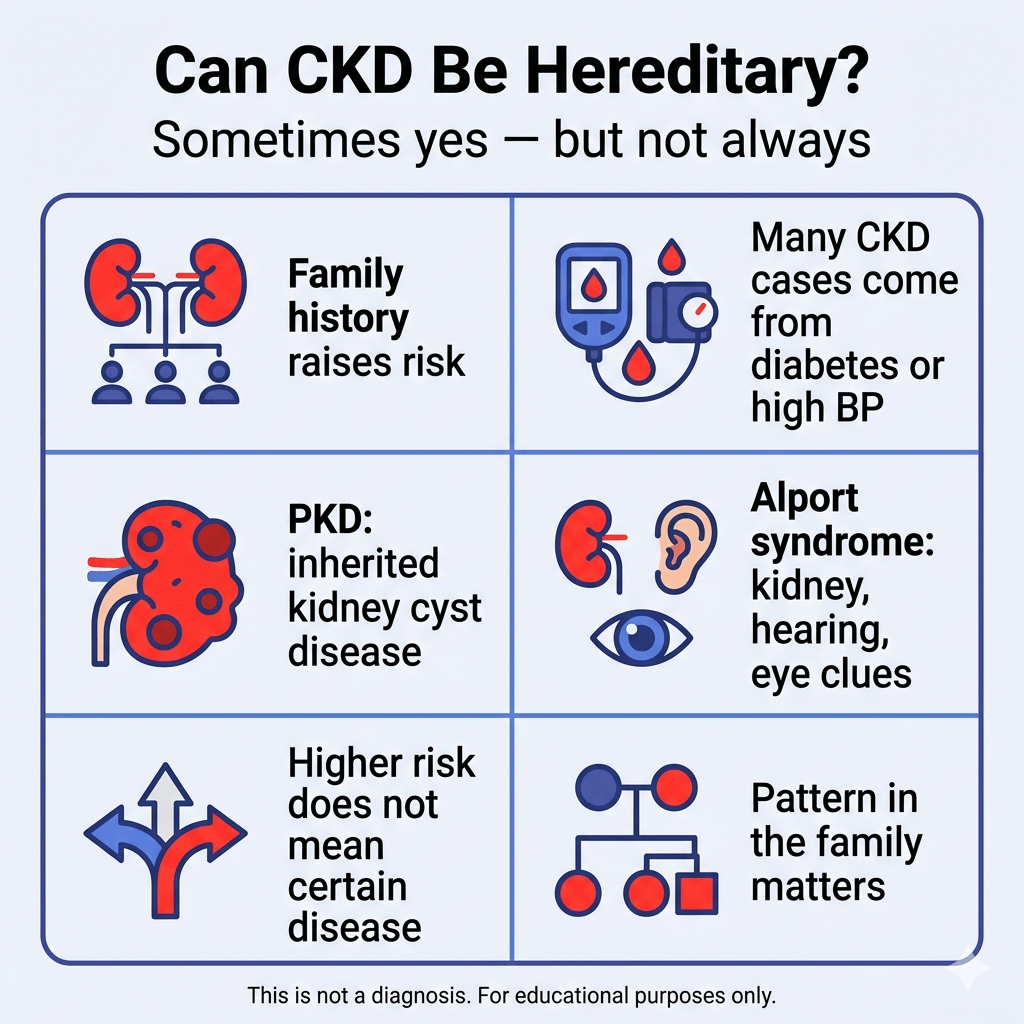
CKD can be hereditary, but it is not always hereditary. NIDDK lists family history of kidney disease as a risk factor for CKD, which means kidney problems can run in families even when the exact cause is not immediately obvious. National Kidney Foundation also explains that family history raises your chances of kidney disease compared with someone who has no family history.
At the same time, a family history does not guarantee that you will develop CKD. It means your risk may be higher, not that your future is fixed. Some families carry a clearly inherited kidney condition. In other families, what runs together may be a combination of high blood pressure, diabetes, and kidney damage, rather than one direct gene disorder affecting everyone the same way.
The most common causes of CKD are not usually inherited diseases
This is an important balance point. In adults, the most common causes of CKD are still diabetes and high blood pressure. NIDDK states this directly in its adult CKD causes guidance. So if a parent or sibling has CKD, the explanation is often one of these common conditions rather than a rare inherited kidney disorder.
That said, family history can still matter even here. Diabetes and high blood pressure also tend to run in families, which means some people inherit a higher risk profile for kidney disease even when the kidney condition itself is not a classic genetic syndrome. In real life, inherited risk and everyday medical risk can overlap.
Kidney diseases that can be inherited
Some kidney diseases are clearly inherited, and these are the cases where the hereditary question becomes much more direct.
One of the best-known examples is polycystic kidney disease (PKD). NIDDK states that PKD is a genetic disorder that causes many fluid-filled cysts to grow in the kidneys. PKD is also a form of CKD and can lead to kidney failure. NIDDK further explains that the most common form, autosomal dominant PKD, is the most common kidney disorder passed down through family members.
Another important inherited kidney disease is Alport syndrome. MedlinePlus Genetics describes Alport syndrome as a genetic condition marked by kidney disease, hearing loss, and eye abnormalities. It also explains that many affected people have blood in the urine and later develop protein in the urine and progressive loss of kidney function.
There are also other inherited kidney disorders, but for a patient-facing article, PKD and Alport syndrome are the clearest examples because they are well-described, strongly genetic, and directly tied to long-term kidney damage.
What family history can mean for your kidney risk
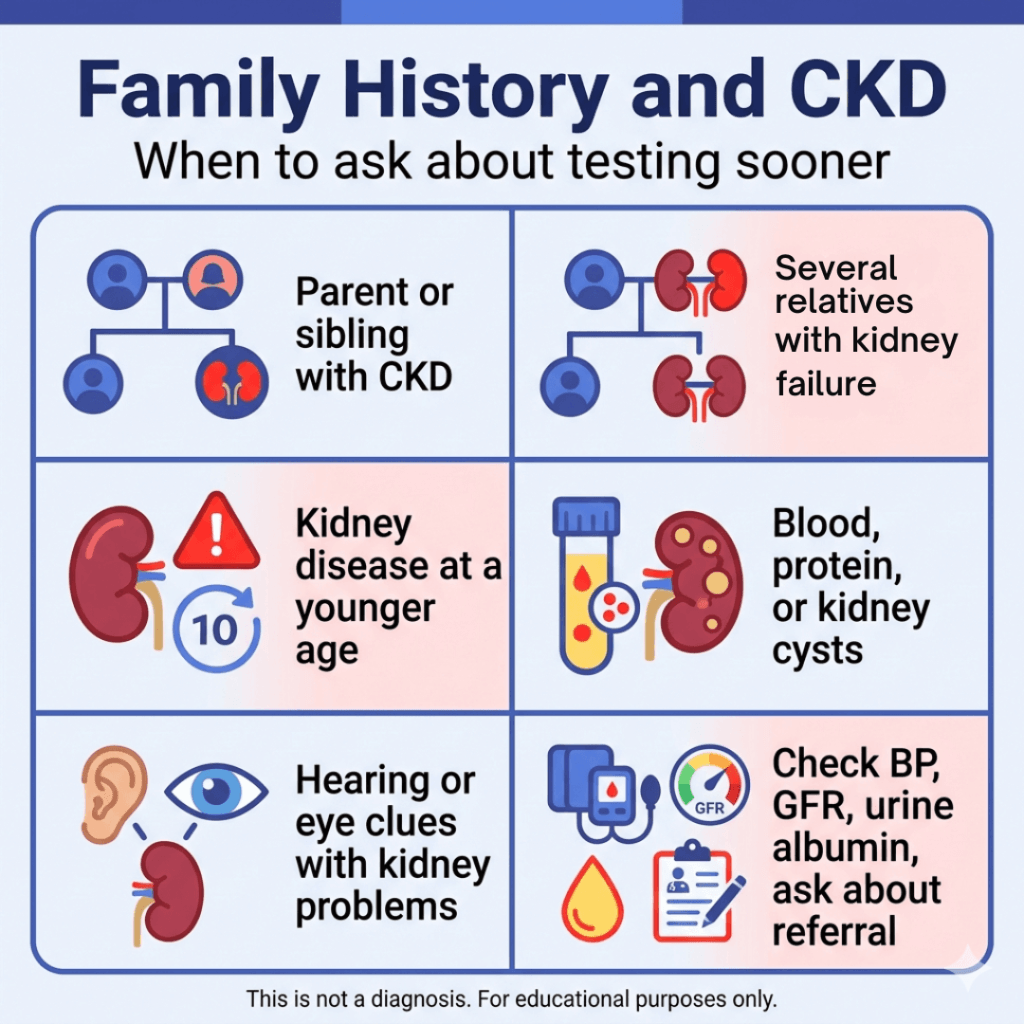
Family history becomes more meaningful when the pattern looks stronger than chance. National Kidney Foundation says family history includes parents, siblings, or other relatives with kidney disease, especially if several family members were affected or if kidney disease happened at a younger age.
That means the hereditary question becomes more important if:
- a parent has kidney disease
- multiple relatives had kidney failure
- several relatives needed dialysis or transplant
- kidney disease showed up unusually early in life
- the cause of kidney disease in the family was never clearly explained
These patterns do not prove a genetic disease by themselves, but they do make it more reasonable to ask whether something inherited could be part of the picture.
Signs that CKD may have an inherited component
Certain clues make inherited kidney disease more likely. One is a strong family history of kidney failure or CKD affecting more than one generation. Another is kidney disease showing up at a younger age than usual.
Other clues come from the pattern of symptoms or testing. For example, blood in the urine without a clear reason can be part of Alport syndrome. Hearing loss or eye findings along with kidney disease can also point in that direction. MedlinePlus Genetics specifically describes kidney disease, hearing loss, and eye abnormalities as key features of Alport syndrome.
Likewise, enlarged kidneys or multiple kidney cysts can raise suspicion for PKD. NIDDK explains that PKD causes many cysts to grow in the kidneys and can make the kidneys much larger.
These are clues, not proof. They should point someone toward proper evaluation, not toward self-diagnosis.
Can you get CKD even if no one else in the family has it?
Yes, absolutely. Most CKD is not discovered because someone already knows it runs in the family. Many people develop CKD because of diabetes, high blood pressure, cardiovascular disease, older age, or other non-inherited reasons.
Also, even some inherited kidney diseases can appear without a known family history. NIDDK says that in a small number of PKD cases, the gene mutation develops on its own rather than being inherited from either parent. That means “no family history” does not always rule out a genetic kidney condition.
So the safer way to think about it is this: family history is important, but its absence does not completely rule out inherited disease, and its presence does not automatically explain every kidney problem.
Should family members get tested if one person has CKD?
Sometimes they should at least talk to a doctor about testing. NIDDK says people should get checked for kidney disease if they have diabetes, high blood pressure, heart disease, or a family history of kidney failure. It also notes that if you have a family history of kidney failure, you should talk with your healthcare provider about how often to get tested.
That does not mean everyone in the family needs advanced genetic testing right away. Often the first step is much simpler:
- blood pressure checks
- a blood test for kidney function
- a urine test for albumin or protein
- review of the family history and any related symptoms
This becomes especially important when the affected family member had kidney failure at a young age, multiple relatives are involved, or the diagnosis sounds like PKD, Alport syndrome, or another inherited disorder.
When doctors may think about genetic testing or specialist referral
Doctors are more likely to consider genetic testing or nephrology referral when inherited kidney disease is strongly suspected. That may happen if there is a strong family pattern, kidney disease is showing up early, cystic kidneys are present, or hearing and eye findings are appearing alongside kidney problems.
NIDDK specifically notes that people at risk for autosomal dominant PKD may be referred for genetic testing and even genetic counseling. That kind of testing is not for everyone with CKD, but it can be useful when the family pattern is strong or the diagnosis is uncertain.
The goal is not to order genetic testing casually. The goal is to use it when it may actually change how the patient or family is evaluated, monitored, or counseled.
What to do if kidney disease runs in your family
The most practical first step is to know your family history clearly. Try to find out who in the family had kidney disease, whether they had dialysis or transplant, whether they also had diabetes or high blood pressure, and whether the diagnosis was ever clearly named.
The next step is to get checked earlier if you are at risk. NIDDK emphasizes that testing is the only way to know how well your kidneys are working and specifically includes family history of kidney failure among the reasons to get tested.
It also still matters to control the big everyday risks. Even in families where kidney disease runs in the background, protecting blood pressure, blood sugar, weight, and overall cardiovascular health still helps reduce CKD risk and slow progression.
If kidney disease is running through a family and symptoms, lab changes, or unanswered questions are starting to pile up, it helps to get clarity earlier rather than later. For people in Angleton and Brazoria County, Angleton ER can evaluate urgent symptoms such as swelling, weakness, vomiting, or major urine changes and help guide what follow-up should happen next.
Frequently Asked Questions
Is chronic kidney disease hereditary?
Sometimes. Some kidney diseases are inherited, but many CKD cases happen because of diabetes, high blood pressure, and other non-genetic causes.
Does CKD run in families?
It can. NIDDK lists family history of kidney disease as a CKD risk factor, and NKF says family history can raise your risk even if it does not guarantee you will develop kidney disease.
If my parent has CKD, will I get it too?
Not necessarily. A parent with CKD may raise your risk, but it does not mean you will definitely develop it. The cause of your parent’s CKD matters a lot.
What kidney diseases are genetic?
Important inherited examples include polycystic kidney disease (PKD) and Alport syndrome.
Is polycystic kidney disease inherited?
Usually, yes. NIDDK says PKD is a genetic disorder, and autosomal dominant PKD is commonly passed down through families.
Is Alport syndrome inherited?
Yes. MedlinePlus Genetics describes Alport syndrome as a genetic condition and explains that it can follow different inheritance patterns, including X-linked, autosomal recessive, and autosomal dominant forms.
Should siblings or children get tested?
They may need to discuss testing with a doctor, especially if there is a strong family history, early kidney failure, or concern for an inherited kidney disease.
Can CKD happen without family history?
Yes. Many CKD cases happen without known family history, and even some genetic disorders like PKD can occur because of a new mutation.
What symptoms suggest inherited kidney disease?
Clues can include blood in the urine, protein in the urine, enlarged kidneys or kidney cysts, hearing loss, eye abnormalities, and kidney disease at a younger age.
When should someone ask about genetic testing?
When several family members are affected, the pattern suggests PKD or Alport syndrome, kidney disease appeared early, or the cause is still unclear.