
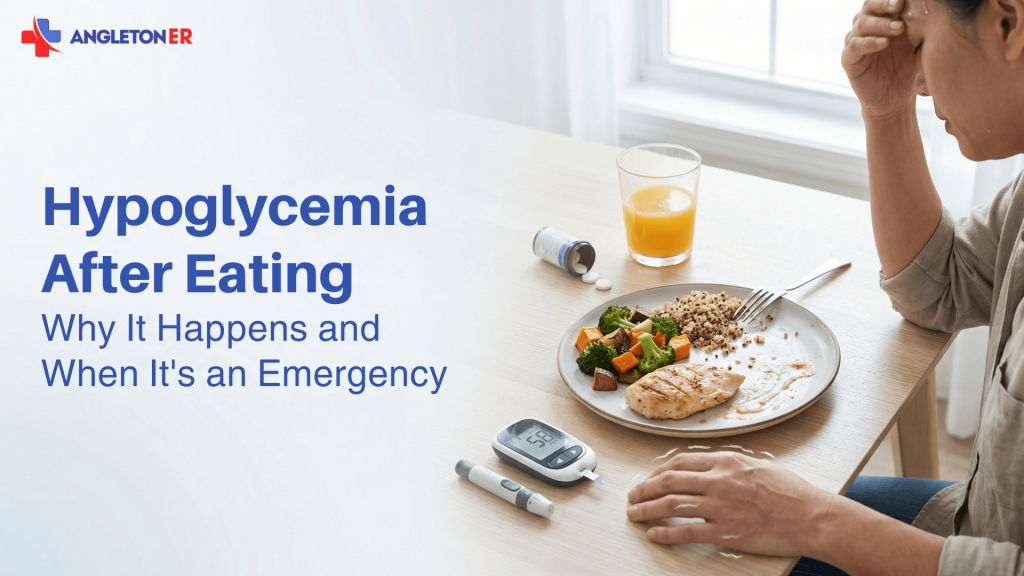
If you feel shaky, sweaty, weak, anxious, or foggy a little while after a meal and you’re thinking, “How can my blood sugar drop after I just ate?” — you’re describing something we commonly call reactive (postprandial) hypoglycemia.
And here in Angleton, where the mean commute time is 28.7 minutes, that post-meal lightheadedness isn’t just uncomfortable — it can be unsafe if you’re driving.
Quick answer
What counts as “low blood sugar”?
- Low blood sugar = below 70 mg/dL.
- Severely low = below 55 mg/dL (often too low to safely treat alone).
You can feel low before you confirm a number, especially if your sugar is dropping quickly. If symptoms are strong, treat it seriously.
What hypoglycemia after eating feels like
Reactive hypoglycemia symptoms often include:
- Shakiness
- Dizziness/lightheadedness
- Sweating
- Hunger
- Fast or uneven heartbeat
- Feeling weak or tired
- Irritability or anxiety
- Headache
- Confusion
In the ER, the symptoms that worry me most are the ones that suggest your brain isn’t getting enough glucose: confusion, fainting, trouble speaking, or loss of coordination.
Why hypoglycemia can happen after eating

A “too much insulin” response after a meal
For some people, the body releases more insulin than needed after certain meals (often meals heavy in refined carbs/sugars), and blood sugar drops afterward. Mayo Clinic notes reactive hypoglycemia can happen after meals, though the exact reason isn’t always clear.
Diabetes medications (if you have diabetes)
If you have diabetes, insulin or other glucose-lowering medications can cause post-meal lows.
After certain stomach surgeries
Alcohol (especially without enough food)
Alcohol can contribute to glucose swings and may worsen post-meal symptoms in some people. (I see this pattern more than people realize.)
Less common causes (worth checking if this keeps happening)
If episodes are frequent, severe, or escalating, you shouldn’t self-diagnose. Persistent post-meal lows sometimes need a deeper workup.
Can this happen without diabetes?
Yes. Reactive hypoglycemia can happen with or without diabetes.
That’s why the question “is low sugar diabetic?” has a nuanced answer: low sugar can happen in diabetes (often medication-related), but it can also happen without diabetes.
What to do during an episode
If you’re awake and can swallow
Use the 15/15 rule:
- Take 15 grams of fast-acting carbs (glucose tablets, juice, regular soda—not diet).
- Wait 15 minutes
- Recheck and repeat if needed.
If your blood sugar is severely low
If your blood sugar drops below 55 mg/dL, CDC notes it’s considered severely low and you may not be able to treat it with the 15/15 rule—this often requires help (and may require glucagon and urgent care).
Safety rule I insist on
If you feel shaky, dizzy, or confused do not drive—especially with Angleton’s long average commute time.
When to go to the ER / call 911

Go to the ER now if
- Symptoms are not improving after treatment
- You have repeated episodes in a short period
- You fainted, are too weak to stand, or you’re confused
- You can’t keep fluids down (vomiting) and symptoms are worsening
- You suspect your blood sugar is severely low
Call 911 immediately if
- Someone is unconscious
- Someone is having a seizure
- Someone can’t swallow safely or is choking/aspirating risk
ADA is clear: severe low blood glucose is an emergency and you should not hesitate to call 911.
If you’re getting shaky, sweaty, or lightheaded after meals, don’t ignore it—especially if it’s recurring, worsening, or causing confusion or fainting.
Visit Angleton ER — open 24/7.
Frequently Asked Questions
Can type 2 diabetes have low blood sugar?
Yes—most commonly from medications (especially insulin or insulin-stimulating meds), missed meals, or unexpected activity.
What is considered low blood sugar for type 2 diabetes?
Below 70 mg/dL is considered low and should be treated.
Is type 2 diabetes hyperglycemia or hypoglycemia?
Type 2 diabetes is primarily associated with high blood sugar, but low blood sugar can happen, usually because of treatment/food/activity mismatch.
What is too low blood sugar for a diabetic?
Below 70 mg/dL is low, and below 55 mg/dL is severely low (often not safe to manage alone).