
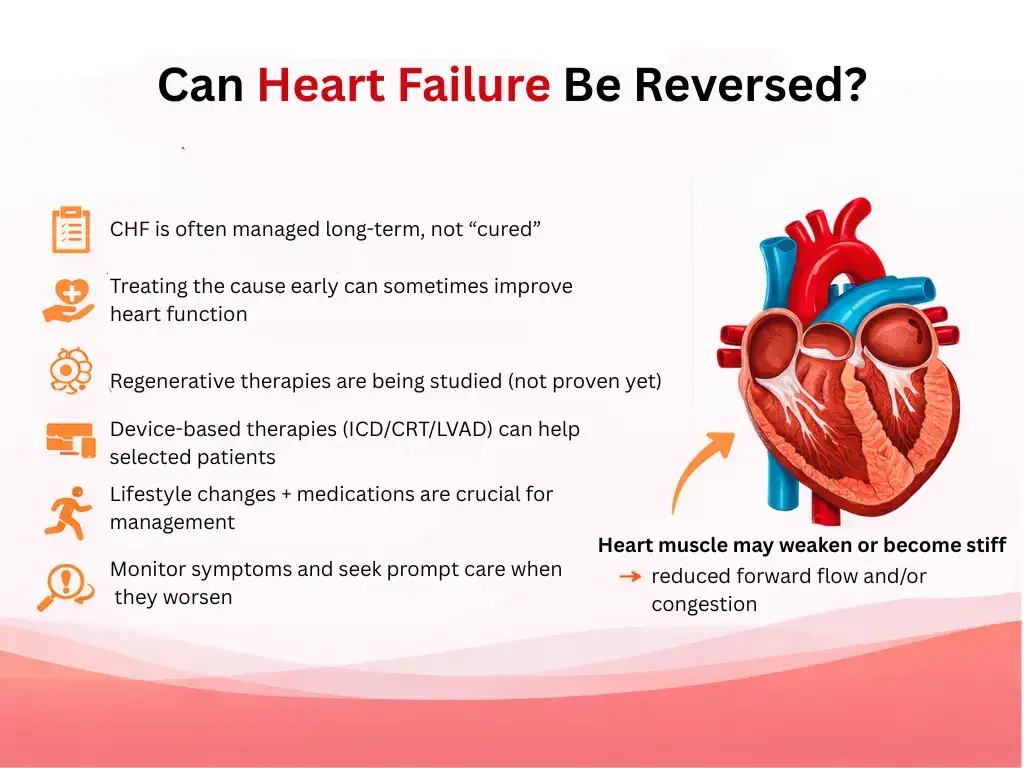
If you searched “can heart failure be reversed,” you’re probably not looking for a perfect medical definition.
You’re looking for something simpler—and more personal:
“Is there any way this gets better?”
Yes, heart failure can improve in many people with the right treatment and follow-up. And in some cases, heart function can improve dramatically—especially when the underlying cause is identified and treated.
But I’m going to be careful with the word “reversed.” Online, it gets used in a way that can be misleading. Let’s talk about what doctors mean, what improvement can look like, and when symptoms shouldn’t wait.
Educational only. This is not medical advice or a diagnosis. If symptoms are severe, rapidly worsening, or you’re concerned, seek in-person evaluation.
A quick anonymous scenario (what we hear all the time)
Someone comes in and says:
- “I’ve been more winded than normal.”
- “My legs are swelling by the end of the day.”
- “I’m sleeping propped up.”
- “I keep asking myself… is this heart failure? And if it is… am I stuck like this forever?”
That question—“am I stuck?”—is exactly why this article exists.
What “reversible” actually means (in plain language)
“Reversible” doesn’t always mean “cured”
When people ask “can you reverse heart failure,” they usually mean one of these:
- Can my symptoms get better? (less shortness of breath, less swelling, more stamina)
- Can my heart function improve on tests?
- Can I get back to normal life?
All three are possible for many people, but not in the same way for everyone.
There are two different kinds of “getting better”
1) Symptom improvement:
You breathe easier, you retain less fluid, you can do more without feeling wiped out.
2) Heart function improvement:
Your heart looks stronger on imaging (like an echocardiogram), and the overall strain on the heart can decrease.
Doctors often measure this improvement using something called the ejection fraction—that’s the percentage of blood your heart pumps out with each beat. On an echocardiogram, a normal ejection fraction is typically 50–55% or higher. If your number falls between 40% and 50%, it’s considered mildly reduced; 30–40% is moderately reduced; and anything under 30% is severely reduced.
So, when your heart function improves, you might see your ejection fraction rise into a better range, which can mean less strain on your heart and sometimes a big difference in how you feel—or in what the numbers show.
Sometimes both happen. Sometimes symptoms improve more than the heart function numbers. Sometimes it’s the other way around. The important thing is: improvement is real—and it’s worth pursuing.
The two main types of heart failure (and why it matters)
Let’s break it down in plain English: not all heart failure is exactly the same. Doctors usually talk about two main types—each with its own quirks:
Systolic heart failure:
This is what most people picture when they think of “heart failure.” Here, the heart’s main pumping action is weaker than normal. (You might hear your doctor call this “reduced ejection fraction.”) The heart can’t squeeze out blood as forcefully, so less oxygen-rich blood gets out to the body with each beat.
Diastolic heart failure:
But you can have heart failure even if the pumping looks normal. In diastolic heart failure, the heart muscle has trouble relaxing between beats. It gets stiff, so it doesn’t fill up with blood the way it should. The end result? Blood flow is still compromised, and symptoms can look very similar.
Why does this distinction matter?
Because figuring out which type you have helps guide treatment, track progress, and set realistic goals. Either way, improvement is possible—and that’s what matters most.
Can congestive heart failure be reversed?
People also search “can congestive heart failure be reversed” and “is congestive heart failure reversible.”
“Congestive” often refers to the fluid-backup side of heart failure—fluid in the lungs, swelling in the legs, rapid weight changes from fluid shifts.
That congestion can often be brought under control with treatment. For some people, once the underlying driver is addressed, the heart and fluid balance can stabilize long-term.
But again: “reversed” can mean different things.
- Congestion controlled is a huge win.
- Heart function improved can also happen.
- A permanent cure depends heavily on the cause.
Causes that are more likely to improve (this is where hope gets practical)
Heart failure isn’t one single disease. It’s a final common pathway—many different problems can lead to the same symptom pattern.
Some of those problems are more treatable than others.
Ischemic vs. Non-Ischemic Causes: What’s Behind Heart Failure?
When it comes to what triggers heart failure, doctors usually break things down into two big categories: ischemic and non-ischemic causes. Let’s translate that.
Ischemic causes are all about blood flow—or more specifically, when your heart isn’t getting enough of it. The classic example is a past heart attack (thanks, blocked arteries). Over time, those blockages in the heart’s own blood vessels (the coronary arteries) can weaken the heart. Think of it like a garden hose that’s kinked—parts of the lawn just aren’t getting watered and start to wilt.
Non-ischemic causes are… well, everything else. And there’s a long list. Some of the most common non-ischemic root causes include:
- Longstanding high blood pressure: When your heart has to work overtime for years, the muscle can start to tire out.
- Heart valve troubles: Leaky or narrowed valves force the heart to strain, kind of like running with clogged shoes.
- Heart inflammation (myocarditis): This can jump in after a viral infection, leaving the heart a bit sluggish.
- Arrhythmias: Abnormal rhythms, like atrial fibrillation, can make the heart beat too fast for too long and sap its strength.
- Medication side effects: Certain chemo drugs, street drugs, or even too much alcohol can be tough on the heart muscle.
- Other medical conditions: Problems like thyroid disease, autoimmune conditions, or rare disorders such as sarcoidosis can all be culprits.
- Genetics: Sometimes, it runs in the family—a genetic glitch steps in and weakens the heart muscle for no obvious reason.
And yes, sometimes you can do all the tests in the book and still never pin down an exact cause. When that happens, it gets labeled “idiopathic”—medical speak for “we tried, but it’s still a mystery.”
So, whether it’s a plumbing issue (ischemic), a mechanical glitch, or an outside force (non-ischemic), the ‘why’ behind heart failure matters. Because in many cases, getting to the root of the problem means there’s a way forward—and sometimes, a real chance at meaningful improvement.
High blood pressure strain (a common driver)
If the heart has been pushing against uncontrolled blood pressure for years, treatment and consistent control can reduce strain and, in some cases, allow the heart to recover some function.
Rhythm-related heart failure (like uncontrolled atrial fibrillation)
Certain rhythm problems—especially when fast or irregular over time—can weaken the heart. When the rhythm issue is controlled, heart function can improve in some people.
Valve problems (when addressed)
If a valve issue is significantly contributing to heart strain, addressing it can sometimes lead to meaningful improvement.
Inflammation or certain temporary triggers
Some cases related to inflammation or a clear temporary trigger may improve with time and treatment. Not all—but some.
Heart attacks: a major cause—and tough roadblock—for reversibility
Heart attacks are a leading cause of heart failure, and they deserve special mention when we talk about what can (and can’t) be reversed.
Here’s why:
When a heart attack strikes, blood supply to part of the heart muscle is suddenly blocked. Unless that blood flow is restored quickly, heart muscle cells start to die. What’s left behind is scar tissue—not living, pumping muscle. The bigger the heart attack, the more significant the scarring.
Why does this matter for “reversibility”?
Scar tissue doesn’t contract like healthy muscle, so the heart may lose some of its pumping power for good. If the scar is small, the rest of the heart sometimes compensates with time and treatment. But if a large area is affected, the lost function is much harder to regain, even with optimal care.
The bottom line:
While many causes of heart failure can be improved, heart failure from a major heart attack is less likely to fully reverse, mostly because scarred muscle won’t come back. That said, managing other treatable contributors (like blood pressure or rhythm problems) is still absolutely worthwhile—sometimes the surrounding healthy muscle can get stronger, and life can still get noticeably better.
Heart damage, scarring, and the limits of “reversibility”
Here’s where things get trickier: the longer the heart has been under stress—whether from high blood pressure, ongoing rhythm issues, heavy alcohol use, or other causes—the more challenging it becomes to turn things around. That’s because, over time, repeated strain can lead to actual damage inside the heart muscle itself.
When the heart is injured repeatedly, it often responds by forming scar tissue (known as fibrosis). This scarring is the body’s way of patching up the area, but scar tissue doesn’t contract or pump like healthy heart muscle. Once that scarring is there, it generally doesn’t go away—even with the best treatment.
What does that mean for improvement? If there’s only a little bit of scarring, some heart function may still bounce back. But if there’s quite a lot, the heart may not regain its former strength—even if symptoms get better or congestion is controlled. The key point: addressing underlying causes early gives the best shot at meaningful recovery, before scarring sets in.
Lifestyle and medication contributors (the real-world “hidden drivers”)
We also see heart failure symptoms worsen or improve based on:
- medication adherence (not shame—just reality)
- high sodium intake sensitivity
- alcohol use patterns
- sleep issues (including sleep apnea)
- uncontrolled diabetes
- kidney strain
- infections
Fluid retention is a major part of why these factors matter. People with heart failure tend to hold on to extra fluid, which can trigger symptoms and, at its worst, land you in the hospital. Because sodium and fluid intake can increase this retention, most people with heart failure need to stick to a low-sodium diet—and sometimes, limit fluids too. Even a seemingly small bump in salt or water can tip the balance and make symptoms worse.
When these drivers are managed consistently, many people feel noticeably better and have fewer flare-ups.
What are the symptoms of systolic heart failure?
Systolic heart failure commonly shows up in a few recognizable ways, but it doesn’t always announce itself with dramatic flair. The classic signs include:
- Shortness of breath, especially with exertion or lying flat
- Swelling in the legs, ankles, or abdomen from fluid retention
- Fatigue that makes everyday activities feel harder
- Weight gain from fluid buildup, sometimes occurring quickly
But here’s the sneaky part: Some people have much milder symptoms. You might just notice feeling winded climbing stairs or needing to prop yourself up with extra pillows at night. Others may simply feel more tired than usual or catch themselves limiting their activities without realizing why.
Everyone’s experience is different, and symptoms can be subtle—sometimes flying just under the radar until you start putting the pieces together.
Symptoms: what “improvement” often looks like in real life
People sometimes expect improvement to feel dramatic. Often it’s quieter:
- you’re less winded walking across the house or parking lot
- you can lie flatter without feeling like you can’t breathe
- your shoes don’t feel tight every evening
- swelling becomes less frequent or less severe
- you stop “saving your energy” all day because you don’t feel as depleted
- your sleep becomes less interrupted by breathing discomfort
- you have fewer sudden “bad days”
If you’re tracking your symptoms and thinking, “Some weeks I’m better, some weeks I’m worse,” that can still be normal—especially early in treatment or during trigger events (like respiratory illness).
Diagnosis: how we tell whether heart failure is improving (without guessing)
If you’re asking “how to reverse heart failure” or “how can heart failure be reversed,” part of the answer is: we monitor what’s changing.
We look at your symptom trend
- How far can you walk compared to last month?
- Are you sleeping flatter?
- Are flare-ups less frequent?
- Is swelling less persistent?
We use testing to confirm what’s happening
Depending on your situation, clinicians may use:
- Echocardiogram (to reassess structure/function over time)
- Blood tests (to monitor strain and organ effects)
- EKG (to watch rhythm issues that can worsen or improve the picture)
- Chest imaging when breathing symptoms shift
One of the key numbers we watch is something called the ejection fraction—essentially, how much blood your heart pumps out with each beat. This is usually measured by an echocardiogram (an ultrasound of the heart). In general:
- Normal ejection fraction: 50–55% or above
- Mildly reduced: 40–50%
- Moderately reduced: 30–40%
- Severely reduced: under 30%
Tracking changes in your ejection fraction over time can help us see if your heart’s pumping ability is improving, holding steady, or needs more attention.
The point isn’t to chase a perfect number. The point is to confirm:
- Is your heart under less strain?
- Are we controlling fluid balance?
- Are we addressing the cause?
Understanding ejection fraction (the heart’s “squeeze” measurement)
One way we track heart function is by looking at your ejection fraction—basically, how much blood your heart pumps out with each beat (measured via imaging like an echocardiogram).
Here’s what those numbers usually mean:
- Normal: 50–55% or higher
- Mildly reduced: 40–50%
- Moderately reduced: 30–40%
- Severely reduced: below 30%
If you’ve ever seen these numbers on your report, they’re a snapshot of how efficiently your heart is pumping. The important takeaway: changes over time can reveal whether treatment is helping, so we keep a close eye on these trends.
Cardiac MRI: another tool for seeing the heart’s recovery potential
Sometimes, your care team may turn to cardiac MRI—a specialized imaging test—to get a clearer picture of what’s happening inside the heart muscle. One of the big questions: how much of the heart muscle is scarred, and how much is still healthy and potentially “revivable”?
Why does this matter? Because the amount and location of scar tissue can give us clues about whether the heart has a chance to recover lost function. If there’s still a meaningful amount of healthy heart muscle left (what we call “viable tissue”), it’s more likely that treating the underlying problem will lead to real improvements.
In short, cardiac MRI helps us move beyond guesswork and personalize your treatment and outlook—giving a clearer sense of whether trying to reverse heart failure is realistic based on what we see inside your unique heart.
Treatment: what typically helps (the “getting better” plan)
There isn’t one magic switch. Treatment is usually a combination of:
Treat the driver (the cause)
If blood pressure, rhythm, valve disease, coronary disease, or another underlying issue is driving heart failure, addressing that driver matters.
Medications that reduce strain and help stability
Different medications are used depending on the type of heart failure and your overall health picture. The big idea is:
- reduce the workload on the heart
- improve the heart’s efficiency
- prevent fluid overload flare-ups
- reduce symptom burden
I’m intentionally not listing dosing, thresholds, or “this medicine guarantees recovery,” because that’s not safe or honest. Medication choice is individualized and should be decided with your clinician.
Lifestyle that actually supports recovery (without preaching)
People often search:
- can heart failure be reversed with exercise
- can exercise reverse heart failure
- can weight loss reverse heart failure
Here’s the doctor answer:
- Exercise can help many people with heart failure—but it needs to be appropriate and safe for your condition. The goal is usually steady conditioning, not pushing through symptoms.
- Weight management can help—especially when excess weight is contributing to blood pressure strain, sleep apnea, and metabolic stress.
- The best lifestyle plan is the one you can sustain and the one your clinician says is safe for you.
If exercise makes you severely short of breath, dizzy, faint, or causes chest pressure, that’s not a “push through it” situation. That’s a get evaluated situation.
Prevention: how to reduce flare-ups and protect your progress
Even when heart failure improves, flare-ups can happen. Preventing setbacks often comes down to:
- taking medications as prescribed (again: no shame, just cause-and-effect)
- keeping follow-up appointments (so treatment can be adjusted early)
- watching for symptom drift (your baseline matters)
- being careful with respiratory infections (they can trigger worsening symptoms)
- asking about medications that can worsen symptoms (your clinician can advise)
The goal is not perfection. The goal is stability.
Is heart failure curable?
This is one of the most common (and most loaded) searches:
- is heart failure curable
- is congestive heart failure curable
In many cases, heart failure is treated as a long-term condition. That doesn’t mean “nothing can be done.” It means:
- you may need ongoing management
- you can still improve significantly
- many people live meaningful lives with good symptom control
Sometimes, if the underlying cause is corrected early and effectively, a person can improve to the point where the heart functions much better and symptoms are minimal. But I avoid promising the word “cure” online, because it depends heavily on the cause and the individual medical picture.
The reality is: the longer and more severely the heart has been damaged, the harder it is to “reverse” heart failure. For example, if someone has had uncontrolled high blood pressure for years, or has been drinking too much alcohol or living with an untreated arrhythmia, the heart muscle may develop scarring (fibrosis) that doesn’t go away—even if the underlying issue is fixed. Once scar tissue sets in, it’s like a permanent footprint on the heart: the pumping function (ejection fraction) may not fully recover, even with the best therapy.
Some clinicians use cardiac MRI to estimate how much scarring is present and whether there’s still healthy heart muscle left. That information helps set realistic expectations about what’s possible for recovery.
Heart attacks are another big player here. When a heart attack blocks blood flow to heart tissue, it can cause part of the heart muscle to die and scar over. The sooner treatment happens, the more heart muscle can be saved—but if too much is lost, “reversal” becomes less likely.
So, while significant improvement is often possible, whether heart failure is reversible (or how much it can improve) truly depends on the timing, the cause, and how much healthy heart tissue remains.
Warning symptoms that shouldn’t wait
If you’re wondering whether you’re “safe to watch this,” here are warning symptoms that shouldn’t wait:
- Severe or rapidly worsening shortness of breath, especially at rest
- New or worsening chest pain, pressure, or tightness
- Fainting, near-fainting, severe weakness, or new confusion
- Bluish lips/face or obvious breathing distress
- A very fast or irregular heartbeat with feeling unwell
- Symptoms escalating quickly or clearly different from your baseline
If you’re on the fence, it’s reasonable to be checked. With breathing and chest symptoms, guessing wrong can get dangerous.
If you’re experiencing new or worsening shortness of breath, swelling, chest discomfort, or a fast/irregular heartbeat—and you’re in or near Angleton or elsewhere in Brazoria County—it’s reasonable to get evaluated rather than trying to “wait it out.”
At Angleton ER, we’re open 24/7, with board-certified physicians and on-site diagnostics (including lab services and CT/X-ray/ultrasound imaging) to help assess urgent symptoms when time matters.
Educational only. This is not medical advice or a diagnosis. If symptoms are severe, rapidly worsening, or you’re concerned, seek in-person evaluation.
Frequently Asked Questions
Can heart failure be reversed?
Heart failure can often improve with treatment, and in some cases heart function can improve significantly—especially when the underlying cause is identified and managed. “Reversed” can mean different things, so it’s best to talk with your clinician about what improvement looks like in your specific case.
Can congestive heart failure be reversed?
“Congestive” refers to fluid backup. Fluid-related symptoms can often be brought under control, and some people experience major symptom improvement when treatment is consistent and triggers are addressed.
Is heart failure reversible?
Sometimes. Some causes are more treatable than others, and improvement depends on the underlying driver, how early treatment starts, and how consistently the plan is followed.
Is congestive heart failure reversible?
Congestion can often improve with treatment. Whether heart function itself improves depends on what’s causing the heart failure and how well it responds to therapy.
Can heart failure be reversed with exercise?
Exercise can help many people with heart failure, but it needs to be safe and appropriate for your condition. If exercise triggers severe shortness of breath, dizziness, fainting, or chest pressure, you should be evaluated.
Can weight loss reverse heart failure?
Weight loss can reduce strain on the heart in some people, especially when excess weight is contributing to blood pressure issues, sleep-disordered breathing, or metabolic stress. It’s not a guarantee, but it can be a meaningful part of improvement for the right person.