
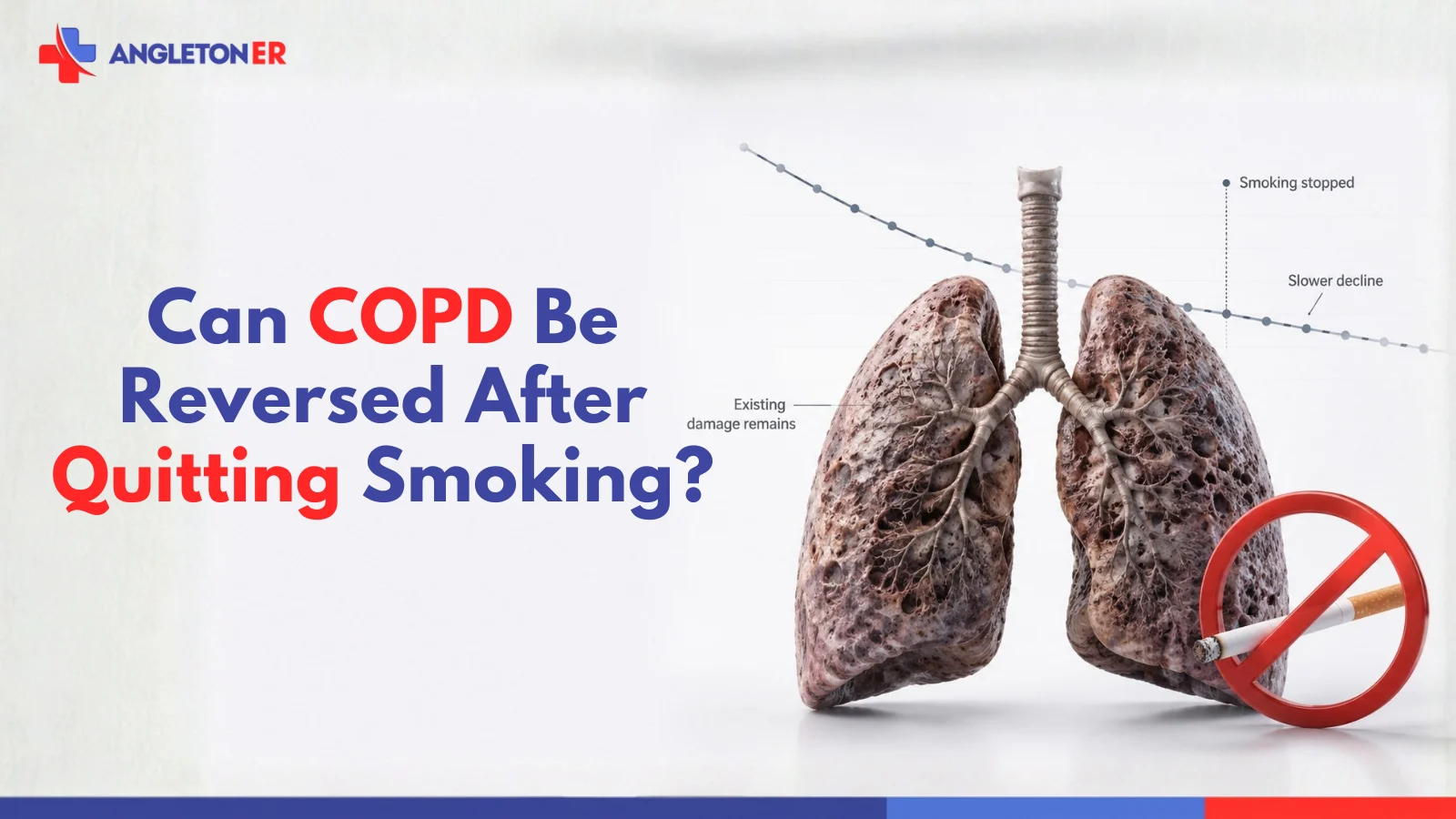
If you have COPD and quit smoking, the disease does not reset. Established COPD is not considered reversible, and stopping smoking does not return the lungs to a pre-COPD state. But quitting can still change what happens next by slowing lung-function loss and improving some respiratory symptoms. The key is to separate three outcomes: reversal, improvement, and slower progression.
Can COPD Be Reversed After You Quit Smoking?
No. Quitting smoking does not cure established COPD or undo the lung changes already present. The National Heart, Lung, and Blood Institute (NHLBI) explains that COPD has no cure, although treatment and lifestyle changes can improve symptoms and slow the disease.
Quitting still matters. CDC guidance for people with COPD states that quitting smoking slows COPD progression and reduces the loss of lung function over time. Quitting is not a rewind button, but it removes a major source of ongoing injury and improves the course ahead compared with continued smoking.
For broader COPD background, Angleton ER has a separate overview of chronic lower respiratory disease, including COPD. Here, the focus is what quitting can and cannot change after diagnosis.
What Does “Reversing COPD” Actually Mean?
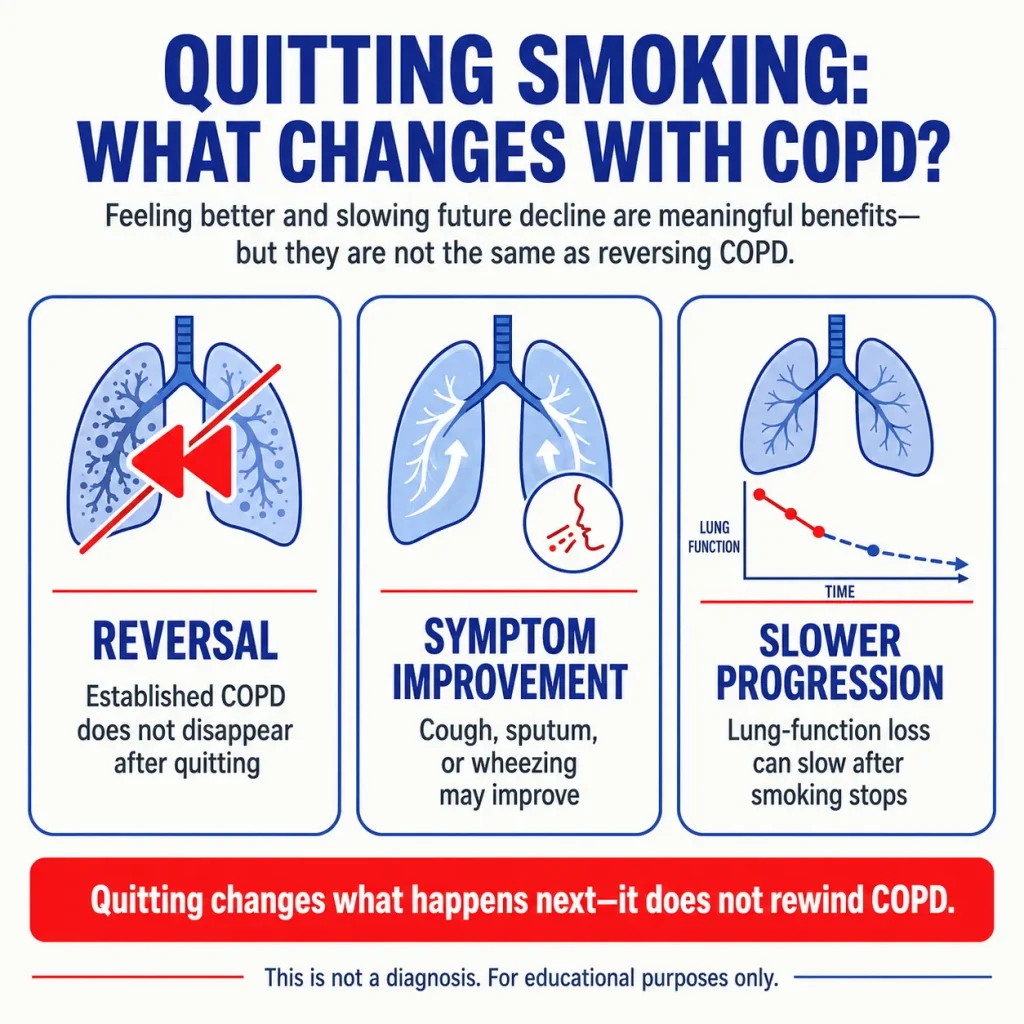
“Reversal,” “recovery,” “improvement,” and “stability” are often used interchangeably online, but they are not medically equivalent. A person can feel better after quitting and still have COPD.
Cure or Complete Reversal
MedlinePlus describes COPD as a disease with no current cure. Quitting should not be framed as making established COPD disappear, even when symptoms improve.
Symptom Improvement
Some respiratory symptoms may improve after quitting. CDC notes that smoking cessation can reduce symptoms such as cough, sputum production, and wheezing. Feeling better is valuable, but it does not prove that COPD has been reversed.
Slowing Future Progression
The most important distinction is what happens next. In the Lung Health Study, sustained quitters with mild-to-moderate airflow obstruction had a slower subsequent decline in FEV1 than participants who continued smoking. This does not imply normal lung function; it shows why the future rate of decline matters.
What Can Quitting Smoking Change When You Already Have COPD?
Stopping smoking removes a continuing source of lung irritation. Its benefits are better understood as protection against additional harm than restoration of the lungs to an earlier state.
It Can Slow Continued Lung-Function Loss
Continuing to smoke prolongs tobacco exposure; quitting ends it. The expected benefit is a slower decline over time, not a promise that spirometry will become normal or lost lung function will fully return.
It May Help You Feel Better
Symptoms may improve, although the degree varies. A Lung Health Study analysis of respiratory symptoms found fewer chronic respiratory symptoms among sustained quitters than continuing smokers. Less cough or wheezing is meaningful, but it is not evidence that COPD is gone.
It Changes the Future Even If Past Damage Remains
Quitting cannot change past exposure, but it can stop tobacco smoke from continuing to add to the burden. A COPD diagnosis is not a reason to conclude that quitting is “too late.” The benefit is forward-looking.
What Quitting Smoking Cannot Do
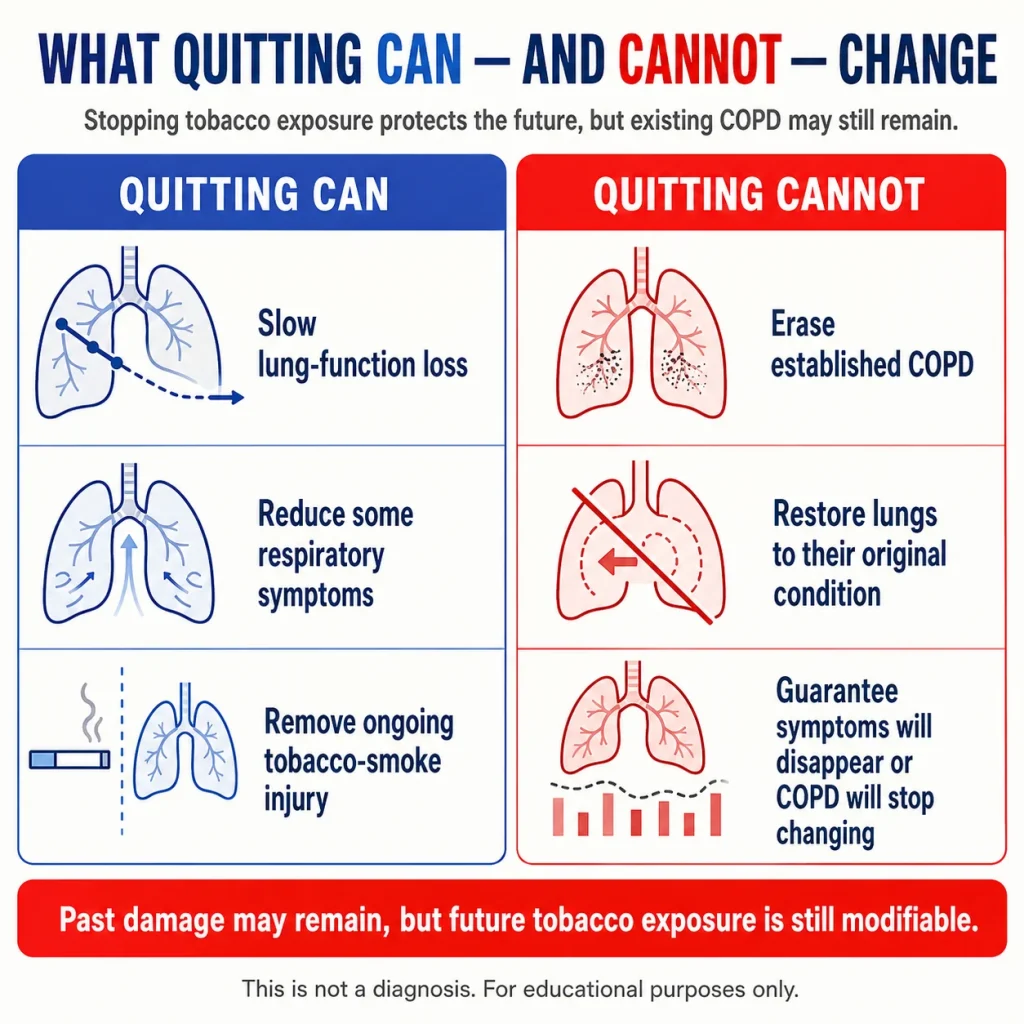
Quitting cannot be expected to erase COPD, guarantee normal lung function, restore damaged lungs to their original condition, make every symptom disappear, or guarantee that COPD will never progress. It also cannot predict an individual’s future severity or lifespan. Its value is removing an important source of continuing damage.
Can COPD Still Get Worse After You Quit Smoking?
Yes. COPD is chronic, so quitting does not guarantee that symptoms or lung function will remain unchanged. A former smoker can still have breathlessness or cough, experience flare-ups or respiratory infections, and notice changes in activity tolerance. NHLBI notes that COPD symptoms can worsen and that flare-ups may occur, so ongoing medical follow-up remains important.
Continued disease does not mean quitting “didn’t work.” The useful comparison is the future course after tobacco exposure ends versus the course if smoking continues.
If My Breathing Improves After Quitting, Does That Mean My COPD Is Gone?
No. Symptoms describe how you feel; COPD describes an underlying chronic lung condition. You may notice less cough, easier breathing during some activities, or better exercise tolerance without the disease disappearing.
Likewise, no dramatic symptom change does not mean quitting provided no benefit. Slower lung-function loss can matter even when the day-to-day difference is subtle.
Why Quitting Still Matters After a COPD Diagnosis
A diagnosis does not make prevention meaningless. NHLBI identifies quitting smoking as the most important step a person who smokes can take to help slow COPD progression. That benefit still applies after COPD is present.
“The damage is already done” is therefore incomplete. Existing damage may remain, but future tobacco exposure is still modifiable. Quit medications, nicotine replacement, counseling, and withdrawal management are separate topics to discuss with a healthcare professional.
What If COPD Symptoms Keep Getting Worse After You Quit?
Persistent or worsening symptoms should not be explained only by past smoking. Contact the healthcare professional managing your COPD if breathlessness is becoming more limiting, your cough changes, normal activities become harder, respiratory worsening recurs, or symptoms differ from your usual pattern.
Because shortness of breath can have more than one cause, Angleton ER’s guide to possible causes of shortness of breath explains why a new breathing change should not automatically be attributed to COPD.
Quitting Smoking Changes the Outlook—Not the Diagnosis Backward
COPD is not considered reversible simply because smoking stops. Quitting can still reduce continued tobacco-related harm and slow lung-function loss. Symptom improvement, when it occurs, is worthwhile without being the same as a cure.
Do not judge quitting only by whether COPD disappears. Judge it by the continuing exposure removed and the additional harm that may now be avoided.
When Sudden Breathing Changes Need Emergency Care in Angleton
For people in Angleton and nearby communities, long-term COPD questions generally belong with the healthcare professional managing the condition. If breathing becomes suddenly or significantly worse, Angleton ER provides 24/7 emergency evaluation and treatment for urgent breathing problems; evaluation may include monitoring, lab testing, imaging, medication, and stabilization when medically appropriate. For life-threatening breathing difficulty or when it is unsafe to drive, call 911.
Frequently Asked Questions
Can COPD completely go away after quitting smoking?
No. Quitting smoking does not cure established COPD or return the lungs to a pre-COPD state. It can still slow progression and reduce additional smoking-related harm.
Can lung function improve after you stop smoking with COPD?
Some people may show modest improvement in measured lung function after quitting, especially early on, but that is not the same as full reversal. The more consistent long-term benefit is a slower rate of lung-function decline compared with continued smoking.
Does COPD continue to get worse even after you quit smoking?
It can. COPD remains a chronic condition, and symptoms, lung function, or flare-up patterns may still change over time. Quitting reduces an important driver of progression; it does not make COPD completely static or reversible.
How does quitting smoking slow COPD progression?
Quitting stops continued exposure to tobacco smoke, which otherwise keeps irritating and damaging the lungs. Removing that exposure helps reduce the ongoing loss of lung function associated with continued smoking.
If my breathing improves after quitting, does that mean my COPD is reversed?
No. Better breathing or fewer respiratory symptoms can be a real benefit, but symptoms and the underlying disease are not identical. COPD may still be present even when you feel noticeably better.
Is it still worth quitting smoking if I already have COPD?
Yes. Quitting remains one of the most important steps for slowing COPD progression in a person who smokes. Existing damage does not make prevention of further smoking-related harm meaningless.