

Bread is one of those foods people rarely think about until they are told to follow a kidney-conscious diet. Then suddenly, a basic slice of toast starts to feel confusing. Is white bread better than whole wheat? Is multigrain healthier, or does that make it harder on the kidneys? Does sodium matter more than fiber? The clearest answer is this:bread can fit into many kidney diets, but the best bread is usually the one with lower sodium, fewer problematic additives, and a serving size that fits your overall plan. There is not one single “best bread” for every person with kidney disease because CKD diets are individualized based on sodium, potassium, phosphorus, diabetes, and lab results.
Medical disclaimer: This article is for educational purposes only. It is not medical advice, diagnosis, or a substitute for care from your doctor or renal dietitian. Bread choices may need to change depending on your CKD stage, potassium and phosphorus levels, blood pressure, diabetes, and whether you are on dialysis.
Can people with kidney disease eat bread?
Yes. Bread is not automatically off-limits with kidney disease. What matters more is the type of bread, the nutrition label, the ingredients, and how often you eat it. NIDDK’s CKD nutrition guidance does not ban bread as a category. Instead, it emphasizes choosing foods with less sodium, watching phosphorus and potassium when needed, and using labels to guide decisions.
Bread becomes confusing in CKD because it can quietly add up in several ways. Some breads are high in sodium. Some processed breads or bread products may contain phosphorus additives. Some lower-sodium products use potassium-containing ingredients. And for people who also have diabetes, bread is still a carbohydrate food that can affect blood sugar. So the question is usually not “Can I eat bread?” but rather “Which bread fits my kidney plan better?”
What makes one bread better than another for kidney disease
The first thing to think about is sodium. NIDDK explains that too much sodium causes the body to hold on to fluid, which can worsen swelling and raise blood pressure, putting stress on the kidneys and heart. Bread may not taste especially salty, but because many people eat it every day, the sodium from bread can add up faster than expected.
The second thing is additives. NIDDK says phosphorus additives are a major source of phosphorus for many people and recommends checking ingredient lists for words containing “PHOS.” This matters because phosphorus can build up in CKD and affect bones and blood vessels. A bread that looks ordinary on the front of the package may still be less helpful if the ingredient list is full of phosphate additives.
The third thing is potassium, but only when potassium is actually an issue for you. NIDDK says CKD can make it harder for the kidneys to remove potassium from the blood and specifically warns that some packaged foods use potassium chloride in place of salt. That means a bread advertised as “reduced sodium” is not automatically better if it replaces sodium with potassium and your potassium level already runs high.
The last piece is portion size. Even a better bread choice can stop being helpful if it becomes several slices at every meal, plus crackers, toast, sandwiches, and packaged bread snacks throughout the day. In CKD, the total pattern matters more than one label claim on one loaf. That is an inference based on NIDDK’s emphasis on total sodium, potassium, and phosphorus intake across the full diet.
The bread features to look for on the label
The most practical starting point is to check sodium first. NIDDK says a Nutrition Facts label showing 5% Daily Value or less for sodium is considered low, while 20% Daily Value or more is high. That gives you a quick way to compare breads side by side, especially if bread is something you eat often.
Next, check the ingredient list for phosphorus additives. NIDDK recommends looking for the word “phosphorus” or ingredients containing “PHOS,” such as phosphoric acid, disodium phosphate, and monosodium phosphate. This step matters because added phosphorus is often absorbed more easily than naturally occurring phosphorus.
Then check for potassium chloride if your care team has told you to watch potassium. NIDDK specifically says potassium chloride is sometimes used in place of salt in packaged foods. That does not make every reduced-sodium bread unsafe, but it does mean “less salt” is not the only thing worth checking.
A final helpful rule is to prefer simpler ingredient lists when possible. That is not a magic guarantee, but simpler breads often make it easier to avoid hidden sodium and additive-heavy formulas. This is an inference drawn from NIDDK’s broader advice to limit packaged and processed foods with added sodium and phosphorus.
Bread options that often work better for kidney disease
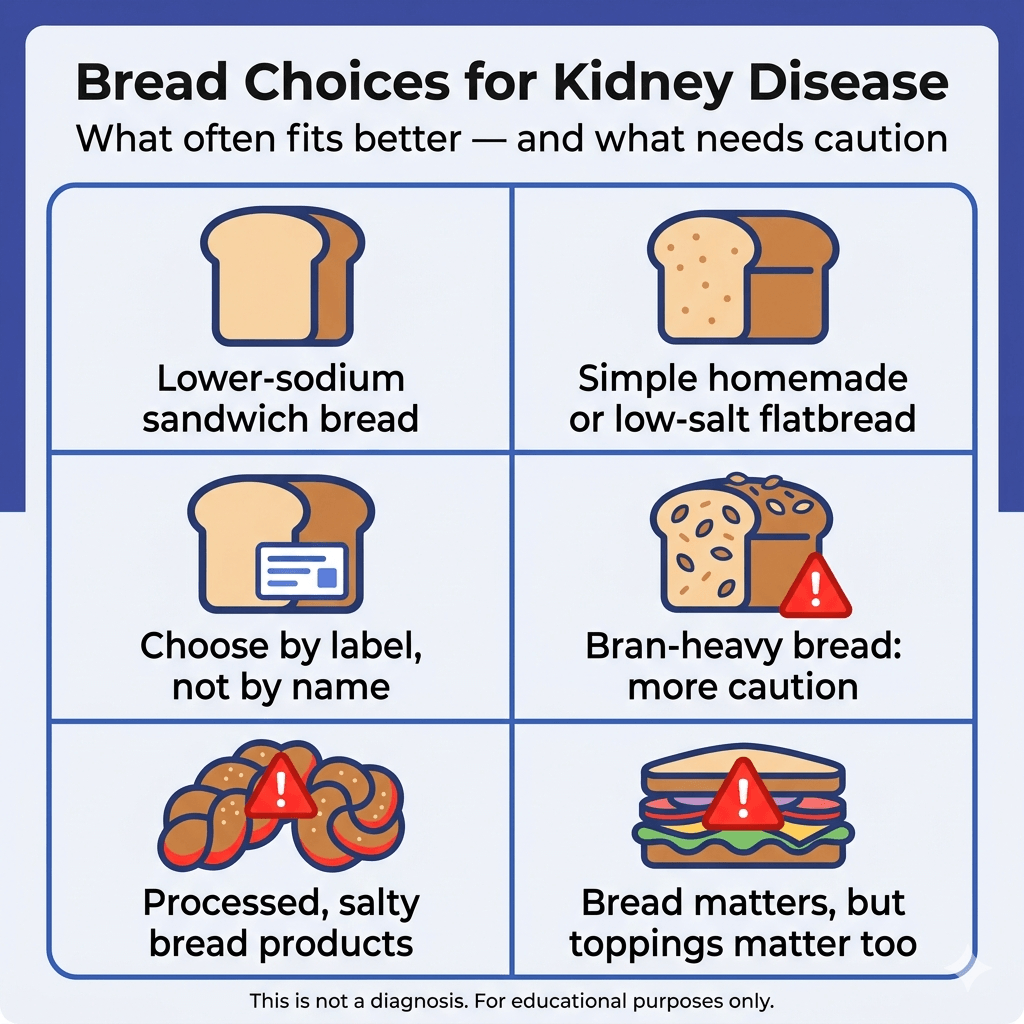
For many people, a lower-sodium white or wheat sandwich bread is one of the easier starting points. It is common, easy to portion, and easier to compare on a label than artisan breads with no nutrition information. The reason it may work better is not because white bread is automatically “kidney healthy,” but because some ordinary sandwich breads are easier to find in lower-sodium versions and may have fewer bran-related phosphorus concerns than breads built heavily around bran.
Homemade bread or bakery bread made with simpler ingredients can also work well when the salt content is controlled. This is especially true if it lets you avoid phosphate additives and overly processed extras. National Kidney Foundation even features a low-salt flatbread recipe, which reinforces the broader point that simpler, lower-salt bread options can fit well in a kidney-conscious eating pattern.
Flatbreads and similar breads can also be reasonable when sodium and additives stay lower, but the bread style itself is not what makes it better. The label and ingredient list still matter more than the bread name. That point is an inference based on NIDDK’s focus on sodium and additives rather than specific brand-style endorsements.
So the “best bread” is often the one that fits your labs, blood pressure goals, and total daily intake—not the one with the trendiest label.
Bread choices that may need more caution
Breads that need more caution are often the ones that are more processed, saltier, or more additive-heavy. NIDDK says packaged and processed foods are major sources of sodium, and that warning applies to many bread products too.
One especially important example comes from National Kidney Foundation’s nutrition guidance for kidney failure: bran bread and bran cereals are listed among foods high in phosphorus. That does not mean every person with CKD must never eat bran bread, but it does mean bran-heavy breads may need more caution if phosphorus is already a concern.
Highly processed bread products can also be a problem if they contain phosphate additives. NIDDK specifically recommends limiting packaged foods and checking for “PHOS” ingredients because added phosphorus can raise blood phosphorus levels more than naturally occurring phosphorus in foods.
And some bread-like products are really closer to snack foods than simple bread: seasoned toast products, garlic breads, crackers, stuffed breads, packaged bread snacks, and heavily flavored bakery items can push sodium much higher without people realizing it. That is a reasonable inference from NIDDK’s broader warning that many snack foods and processed foods are high in salt.
What about whole wheat, multigrain, rye, or sourdough?
This is where kidney advice often differs from generic “healthy eating” advice. In the general population, people may hear that whole grain or multigrain automatically means better. In CKD, the answer is more conditional. The question is not just whether the bread sounds healthy. The question is whether it fits your sodium, phosphorus, potassium, and blood sugar needs.
For some people, whole wheat or multigrain bread may fit just fine, especially if sodium is controlled and phosphorus is not a major issue. For others, especially if phosphorus needs tighter control, breads with more bran may need more caution. NKF specifically names bran bread as higher in phosphorus, which is why “whole grain” is not automatically the best answer for every CKD patient.
Rye and sourdough are not automatically kidney-specific choices either. They may fit well, or they may not, depending on sodium, additives, portion size, and what you are eating with them. Bread names are less useful than labels. That is an inference based on NIDDK’s label-first nutrition guidance.
If diabetes is also part of the picture, fiber and carbohydrate response matter more too. In that case, the “best” bread may need to balance CKD concerns with blood sugar goals rather than following a kidney-only rule.
How much bread is reasonable with kidney disease?
Bread can fit into a kidney-conscious diet, but it can also add up quickly across the day. Two slices at breakfast, a sandwich at lunch, crackers as a snack, and garlic bread at dinner can quietly turn into a large share of your sodium and carbohydrate intake. That is why serving size matters almost as much as bread type. This is an inference based on NIDDK’s emphasis on total nutrient load across the full diet.
It is also worth paying attention to what goes on the bread. Deli meats, processed cheese, salty spreads, and seasoning-heavy toppings can make a reasonable bread choice much less kidney-friendly. NIDDK specifically lists processed meats and salty sauces among foods high in sodium.
Best bread choices when CKD and diabetes overlap
When CKD and diabetes overlap, bread choices become more individualized. Carbohydrates still matter for blood sugar, and sodium still matters for the kidneys and blood pressure. In that situation, bread should usually be judged as part of the whole meal, not by the loaf alone. NIDDK’s CKD guidance and broader diabetes nutrition principles both support individualized planning rather than one-size-fits-all answers.
A bread that is lower in sodium but served in oversized portions may not help much. A bread that has better fiber but contains more phosphorus-heavy ingredients may not fit everyone either. This is why people with both CKD and diabetes often do better when their bread choice is matched to their labs, glucose patterns, and the rest of their meal rather than chosen by marketing terms.
When bread choices may need to change
Bread choices may need to change when phosphorus is high, potassium is high, sodium limits become stricter, or dialysis changes the nutrition picture. NIDDK is clear that CKD nutrition plans change over time and should be individualized.
They may also need to change if appetite is poor, weight is dropping, or the person is eating very little overall. In those cases, the question may shift from “best bread” to “how do we keep nutrition adequate while still protecting the kidneys?” That is an inference based on NKF’s emphasis on maintaining adequate nutrition in kidney failure.
For people in Angleton and Brazoria County, bread questions are usually part of a bigger issue: trying to eat normally while also protecting kidney function. If kidney-related symptoms are worsening, if swelling or vomiting is becoming more serious, or if diet questions are piling up around abnormal labs, Angleton ER can evaluate urgent symptoms and help point you toward the right follow-up care.
Frequently Asked Questions
What is the best bread for kidney disease?
There is no single best bread for everyone with CKD. In general, breads that are lower in sodium, have fewer phosphorus additives, and fit your potassium and diabetes needs tend to work better.
Is white bread okay for kidney disease?
Often, yes. White bread is not automatically unhealthy for CKD. In some cases, a lower-sodium white bread may actually be easier to fit than a more additive-heavy or bran-heavy bread. This is a cautious inference based on NIDDK sodium guidance and NKF’s note that bran bread is higher in phosphorus.
Is whole wheat bread okay for CKD?
Sometimes. It may fit for many people, but if phosphorus is a concern, some whole-grain or bran-heavy breads may need more caution.
Is sourdough bread good for kidney disease?
It can be, but the bread name alone does not decide that. Sodium, additives, and portion size still matter more than the label “sourdough.” This is an inference based on NIDDK’s label-based CKD nutrition guidance.
Why does sodium matter in bread?
Because too much sodium can cause fluid retention, swelling, and higher blood pressure, all of which put more stress on the kidneys and heart.
What does “PHOS” on a label mean?
It is a clue that the product may contain a phosphorus additive. NIDDK recommends checking ingredient lists for “phosphorus” or words containing “PHOS.”
Is bran bread bad for kidney disease?
Not for everyone, but NKF specifically lists bran bread as a higher-phosphorus food, so it may need more caution when phosphorus is an issue.
Can people with stage 3 CKD eat bread?
Yes, many can. Bread is not automatically restricted in stage 3 CKD, but label reading and portion awareness still matter. This is an inference based on NIDDK’s general CKD nutrition guidance.
What bread is better if you have CKD and diabetes?
Usually one that balances lower sodium with a carbohydrate profile that fits your blood sugar plan. The best choice depends on the rest of the meal and your personal nutrition goals.
When should someone ask for personalized diet advice?
When potassium, phosphorus, or sodium limits are becoming stricter, when CKD is advancing, when diabetes is also part of the picture, or when food choices are starting to feel confusing.