
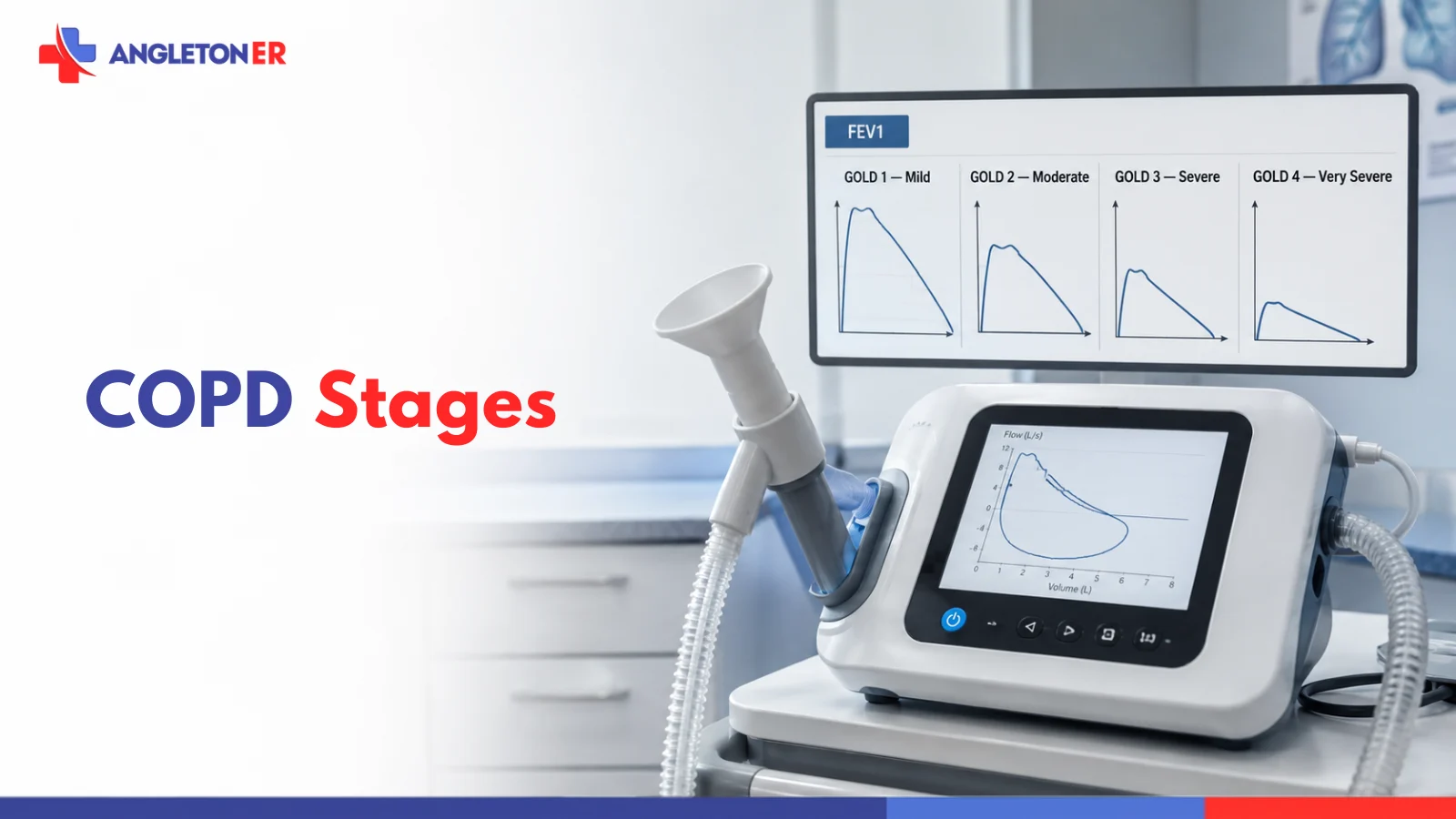
When someone is told they have Stage 1, 2, 3, or 4 COPD, the number can sound like a forecast. It is not. In the familiar four-level framework, the number primarily describes the severity of airflow obstruction measured on spirometry. The 2026 GOLD strategy for COPD continues to treat lung-function measurement as one part of a broader clinical assessment rather than a complete description of the person.
A COPD grade describes airflow obstruction, but it cannot tell you exactly how breathless you will feel or what will happen during a new breathing problem. For broader COPD background, Angleton ER’s chronic lower respiratory disease overview covers the condition more generally; this article stays focused on staging and severity interpretation.
What Are the 4 Stages of COPD?
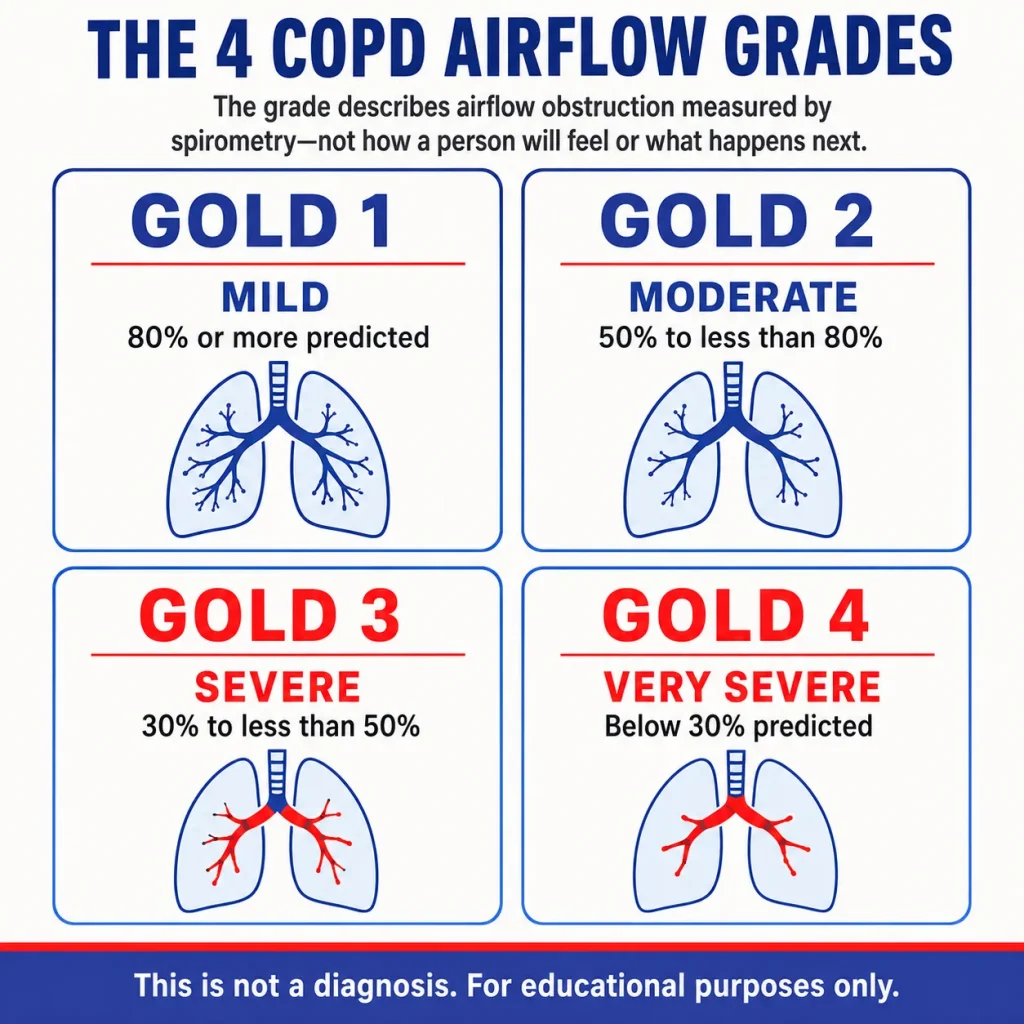
GOLD more precisely calls these spirometric grades of airflow obstruction, although patients often hear them described as stages. The long-used GOLD cut points are based on post-bronchodilator FEV1 as a percentage of the predicted value. An American Thoracic Society journal review of GOLD grading and later COPD research using the same GOLD categories describe the four levels as follows:
• GOLD 1 — Mild airflow obstruction: FEV1 is 80% or more of predicted.
• GOLD 2 — Moderate airflow obstruction: FEV1 is 50% to less than 80% of predicted.
• GOLD 3 — Severe airflow obstruction: FEV1 is 30% to less than 50% of predicted.
• GOLD 4 — Very severe airflow obstruction: FEV1 is below 30% of predicted.
A 2023 American Journal of Respiratory and Critical Care Medicine study confirms the same FEV1 percentage-predicted thresholds. Here, “predicted” is a reference value for expected lung function, not a prediction of your future.
How Doctors Determine a COPD Severity Grade
What FEV1 Means
FEV1 stands for forced expiratory volume in one second. It measures how much air you can forcefully breathe out during the first second of a spirometry maneuver. A lower percentage of the predicted FEV1 indicates a greater degree of measured airflow obstruction.
The American Thoracic Society’s pulmonary function testing guidance explains that measured results are compared with predicted values based on factors such as age, height, and sex. That comparison helps place an individual result in context.
Why Spirometry Matters
Spirometry provides an objective measure of airflow limitation. The National Heart, Lung, and Blood Institute identifies spirometry as the main test for COPD and notes that the results can also help clinicians judge how serious the airflow limitation is. In March 2026, GOLD and the Global Lung Function Initiative also emphasized that spirometry is essential to confirm COPD.
This article does not go further into how to prepare for spirometry, detailed FEV1/FVC interpretation, imaging, blood-gas testing, or other pulmonary function tests; those are separate diagnostic questions.
Stage 1 COPD — Mild Airflow Obstruction
GOLD 1 is the least severe level of airflow obstruction in the four-grade spirometric framework. “Mild” describes the lung-function measurement, not how important the condition feels to a particular person.
Some people at this grade have few limitations; others already notice cough, mucus, wheezing, breathlessness, or reduced exercise tolerance. A low spirometric grade does not make symptoms unimportant.
Stage 2 COPD — Moderate Airflow Obstruction
GOLD 2 means measured airflow is more reduced than in GOLD 1. Some people notice more breathlessness during activity or normal routines, but symptoms vary between patients.
Moving to a higher spirometric grade means the measured airflow obstruction is more severe. It does not mean that everyone will develop the same symptoms, at the same intensity, or on the same timeline.
Stage 3 COPD — Severe Airflow Obstruction
GOLD 3 represents substantially reduced airflow. People with this degree of obstruction may have greater respiratory limitations, but the grade alone does not show how a person functions on a particular day.
COPD severity is not determined by how breathless someone looks at one moment. Lung-function results, symptom burden, prior exacerbations, other health conditions, and the overall clinical picture each add different information.
Stage 4 COPD — Very Severe Airflow Obstruction
GOLD 4 is the most severe category of airflow obstruction in the four-grade spirometric framework. Very severe airflow limitation may bring substantial respiratory impairment and greater care needs, but the stage is not an exact forecast.
In particular, GOLD 4 does not by itself tell an individual how long they will live, whether they will require oxygen, or what treatment they must receive. Those questions depend on much more than one spirometry number and belong in individualized clinical care.
COPD Stage and COPD Symptoms Are Not the Same Thing
Measured airflow obstruction and day-to-day symptom burden can differ substantially. GOLD’s assessment framework has long recognized that FEV1 alone is an incomplete description of COPD, while NHLBI’s COPD symptom guidance notes that people do not necessarily have all of the same symptoms.
Two people with the same GOLD grade may differ in breathlessness, cough or mucus, exercise tolerance, daily activity, and exacerbation history. A lower grade can still come with meaningful symptoms.
The practical takeaway is simple: a COPD stage is one part of the clinical picture, not a complete description of how a person feels.
Why You May Hear About GOLD Grades and Other COPD Groups
COPD records may use both numbered grades and broader assessment categories. GOLD 1 through GOLD 4 describe spirometric airflow-obstruction severity, while broader assessment also considers symptoms and previous exacerbations. The American Lung Association’s current COPD staging overview similarly explains that clinicians look beyond a stage label when evaluating severity and planning care.
These labels answer different questions: the number describes airflow obstruction, while broader assessment describes more of the overall COPD picture.
Does COPD Always Progress From Stage 1 to Stage 4?
COPD is chronic, but the four grades are not a rigid countdown. Lung function can change at different rates, and symptoms or functional limitations may change independently of a stage label.
Ongoing assessment therefore matters more than trying to calculate a personal timeline from the stage. A spirometric grade cannot supply an individualized progression schedule.
Can Your COPD Stage Change?
Yes. COPD severity can be reassessed over time, and clinicians may repeat lung-function testing when it is medically appropriate. MedlinePlus guidance on lung function tests notes that pulmonary function testing is used both to help diagnose and to monitor lung disease.
A change in how you feel today does not automatically mean you have moved to another GOLD grade. Symptoms can improve or worsen temporarily because of an acute illness, a flare, or another medical problem. Long-term airflow obstruction and an acute breathing change are not the same question.
What a COPD Stage Can—and Cannot—Tell You
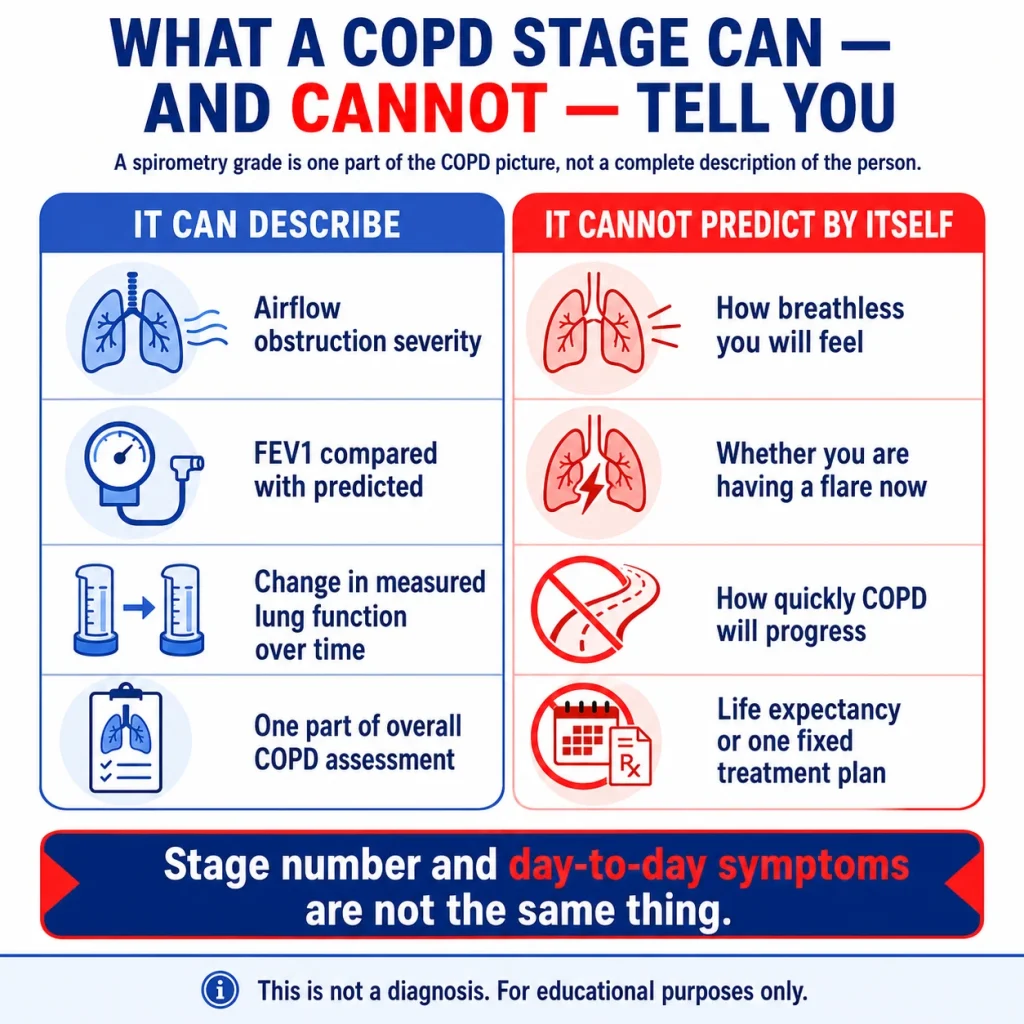
A COPD stage can help describe:
• the measured severity of airflow obstruction
• how reduced FEV1 is compared with predicted lung function
• one important component of overall COPD assessment
• changes in measured lung function when tests are compared over time
A COPD stage cannot tell you by itself:
• exactly how breathless you will feel
• whether you are having an acute COPD exacerbation right now
• what treatment every patient should receive
• precisely how quickly COPD will progress
• how long an individual patient will live
• whether a new breathing problem is safe to manage at home
A Stage Number Should Not Override a New Change in Breathing
A chronic COPD grade and an acute breathing problem are different questions. GOLD 1 or 2 does not prevent a serious new respiratory problem, and GOLD 3 or 4 does not make every worsening symptom “normal.” Because shortness of breath can have many possible causes, a sudden, severe, or unusual change should be assessed according to what is happening now rather than dismissed because of a pre-existing COPD label.
When Breathing Changes Need Urgent Evaluation in Angleton
For ongoing questions about COPD stage, repeat lung-function testing, or long-term management, your regular healthcare provider or pulmonary specialist is generally the appropriate place to start. If the concern is a sudden or severe change in breathing, Angleton ER provides 24/7 emergency care in Angleton and evaluates breathing problems with testing, monitoring, treatment, and transfer coordination when medically appropriate. Do not assume a chronic COPD stage explains a new emergency. If breathing trouble feels life-threatening or it is unsafe to drive, call 911.
Frequently Asked Questions
What are the four stages of COPD?
The four commonly used stages are GOLD 1 mild, GOLD 2 moderate, GOLD 3 severe, and GOLD 4 very severe airflow obstruction. They are spirometric grades based on post-bronchodilator FEV1 percentage predicted, not a complete measure of a person’s symptoms or future.
What does GOLD 1 COPD mean?
GOLD 1 means mild measured airflow obstruction, with FEV1 at 80% or more of predicted. “Mild” refers to the spirometry grade; a person can still have noticeable or important symptoms.
What does Stage 4 COPD mean?
Stage 4, or GOLD 4, means very severe airflow obstruction, with FEV1 below 30% of predicted. It indicates markedly reduced measured airflow but does not, by itself, determine life expectancy, oxygen use, or a specific treatment plan.
How do doctors determine what stage of COPD you have?
The numbered GOLD airflow-obstruction grade is determined from post-bronchodilator spirometry, especially FEV1 as a percentage of predicted. Clinicians then consider that result alongside symptoms, exacerbation history, and the broader clinical picture.
Can COPD symptoms be severe even at an earlier stage?
Yes. Symptoms and FEV1 grade do not always match closely. A person with an earlier spirometric grade can still have significant breathlessness, cough, mucus, or activity limitation and should discuss those symptoms with their clinician.
Does COPD always progress from Stage 1 to Stage 4?
No fixed schedule applies to everyone. COPD can change over time, but lung-function decline and symptom changes vary between individuals, so the stages should not be treated as a predictable countdown.
Can your COPD stage change over time?
Yes. Clinicians may reassess lung function over time, and a person’s spirometric grade may change as measured airflow changes. A temporary symptom worsening, however, does not automatically mean the spirometric grade has changed.
Is COPD stage the same as how severe your symptoms are?
No. The numbered GOLD grade describes airflow obstruction measured by spirometry. Symptom burden and previous exacerbations are assessed separately because people with the same FEV1 grade can feel and function very differently.
Does Stage 4 COPD automatically mean a specific life expectancy?
No. GOLD 4 identifies very severe airflow obstruction, but a spirometry number cannot provide an exact life-expectancy estimate for an individual. Prognosis depends on multiple clinical factors and should be discussed with the clinicians who know the patient’s full health history.