
Yes — smoking does affect your kidneys. Many people think of smoking as a lung or heart issue first, but the kidneys are deeply affected too because they depend on healthy blood vessels and steady blood flow to filter waste and balance fluid in the body. National Kidney Foundation says smoking damages blood vessels, raises blood pressure, and reduces blood flow to the kidneys. Over time, it increases the risk of chronic kidney disease (CKD), kidney failure, and kidney cancer.
For people in Angleton and across Brazoria County, this question often comes up after abnormal kidney labs, high blood pressure, diabetes, or a CKD diagnosis. The most useful way to think about it is this: smoking is not always the only cause of kidney disease, but it is a real kidney risk factor and it can make an existing kidney problem worse. Diabetes and high blood pressure are still the most common causes of CKD in adults, but smoking adds more strain to a system that may already be vulnerable.
Medical disclaimer: This article is for educational purposes only. It is not medical advice, diagnosis, or a substitute for care from a licensed healthcare professional.
Yes, smoking can affect your kidneys
Smoking affects much more than the lungs. NKF explains that smoking harms blood vessels throughout the body, including the vessels that supply the kidneys. Because the kidneys rely on that circulation to filter blood properly, vessel damage can make it harder for them to do their job well.
The kidneys are especially vulnerable because they filter a large amount of blood every day. When blood vessels harden, narrow, or carry blood less efficiently, the kidneys can be forced to work under more stress. NKF says smoking can change how blood flows through the kidneys and may increase the chance of developing CKD or make existing kidney disease progress more quickly.
How smoking harms the kidneys
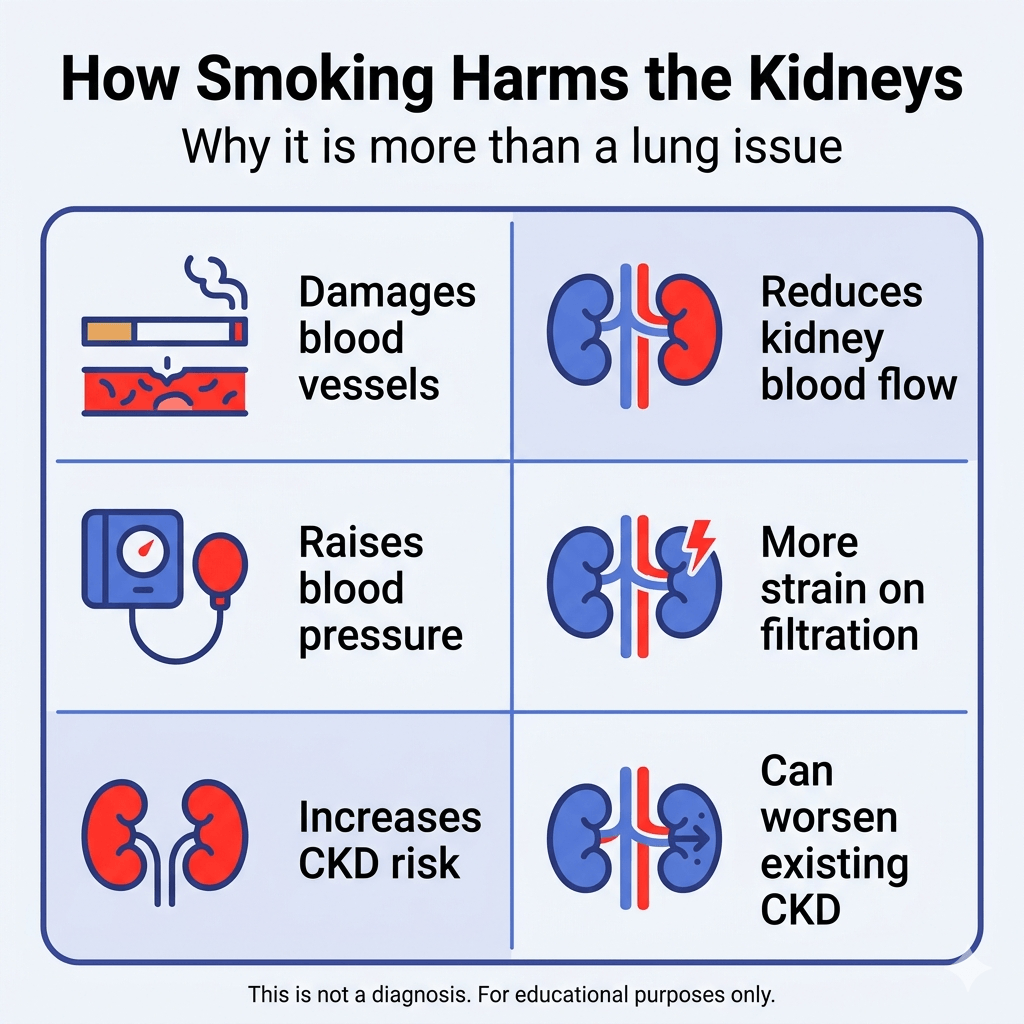
One major problem is blood vessel damage. NKF says smoking can harden and narrow blood vessels, reducing the kidneys’ ability to get the oxygen and nutrients they need to stay healthy. That means the kidneys are not only dealing with toxins from smoking itself, but also with poorer circulation.
Another major problem is blood pressure. NKF says smoking raises blood pressure, and high blood pressure is already one of the leading causes of kidney disease. NIDDK also identifies high blood pressure as one of the most common causes and risk factors for CKD. When smoking and hypertension overlap, the kidneys can face repeated long-term damage.
Put simply, smoking makes the kidneys work in a less healthy environment: tighter blood vessels, less efficient blood flow, and more pressure on the filtration system. That is why smoking is not just “bad for health in general.” It has a direct kidney impact.
Can smoking cause chronic kidney disease?
Smoking can increase the risk of CKD, but it is not usually the only factor involved. NKF says smoking increases the chance of developing chronic kidney disease, while NIDDK still identifies diabetes and high blood pressure as the most common causes of CKD in adults. The most accurate way to say it is that smoking is an important risk amplifier for kidney disease.
This matters even more when diabetes or high blood pressure is already present. NIDDK lists both conditions as major CKD risks, and NKF explains that smoking adds blood vessel injury and blood pressure strain on top of them. So even when smoking is not the main cause, it can still push kidney risk higher.
Can smoking make existing kidney disease worse?
Yes. This is one of the most important takeaways. NKF says smoking may make existing kidney disease progress more quickly. That means the conversation is not only about prevention. Quitting still matters after CKD is diagnosed because smoking continues to strain the kidneys through vessel damage, reduced blood flow, and blood pressure effects.
This is especially important for people who already have CKD, albumin in the urine, diabetes, or hypertension. In those situations, the kidneys are already under pressure, so smoking is not just an extra bad habit. It becomes part of the reason progression risk may be higher. That is an evidence-based inference from NKF’s smoking guidance and NIDDK’s CKD risk-factor guidance.
Other kidney-related risks from smoking
Smoking is linked not only with CKD, but also with kidney failure and kidney cancer. NKF states this directly in its patient guidance on smoking and kidney health. MedlinePlus also lists smoking among the risk factors for kidney cancer.
This broader kidney risk matters because smoking-related damage is rarely limited to one organ. The same blood vessel injury that affects the kidneys also affects the heart, brain, and circulation more generally. That is one reason smoking-related kidney risk is part of a bigger whole-body risk pattern, not an isolated issue.
Why smoking matters even more if you already have CKD, diabetes, or high blood pressure
When CKD and smoking happen together, the risks stack. Smoking reduces kidney blood flow and may speed CKD progression, while CKD already makes the kidneys more vulnerable.
When diabetes is also present, the risk picture becomes even heavier because diabetes is a major cause of CKD and smoking adds vascular damage on top of that. When high blood pressure is also present, smoking becomes even more concerning because both smoking and hypertension damage blood vessels and increase kidney strain.
This is why smoking can be especially harmful in people who already know they are “at risk.” The danger is not only the cigarette. It is the combination of smoking plus the conditions that already threaten the kidneys.
Signs your kidneys are being affected are not always obvious
One of the tricky parts of kidney disease is that it can stay quiet for a long time. NIDDK says testing may be the only way to know if you have kidney disease, and CKD often develops slowly. That means smoking-related kidney harm is not something most people can reliably feel early.
So waiting for dramatic symptoms is not a good safety strategy. Blood pressure checks, kidney blood tests, and urine testing matter much more than trying to “sense” whether smoking has affected your kidneys yet.
What happens to kidney risk after quitting smoking?
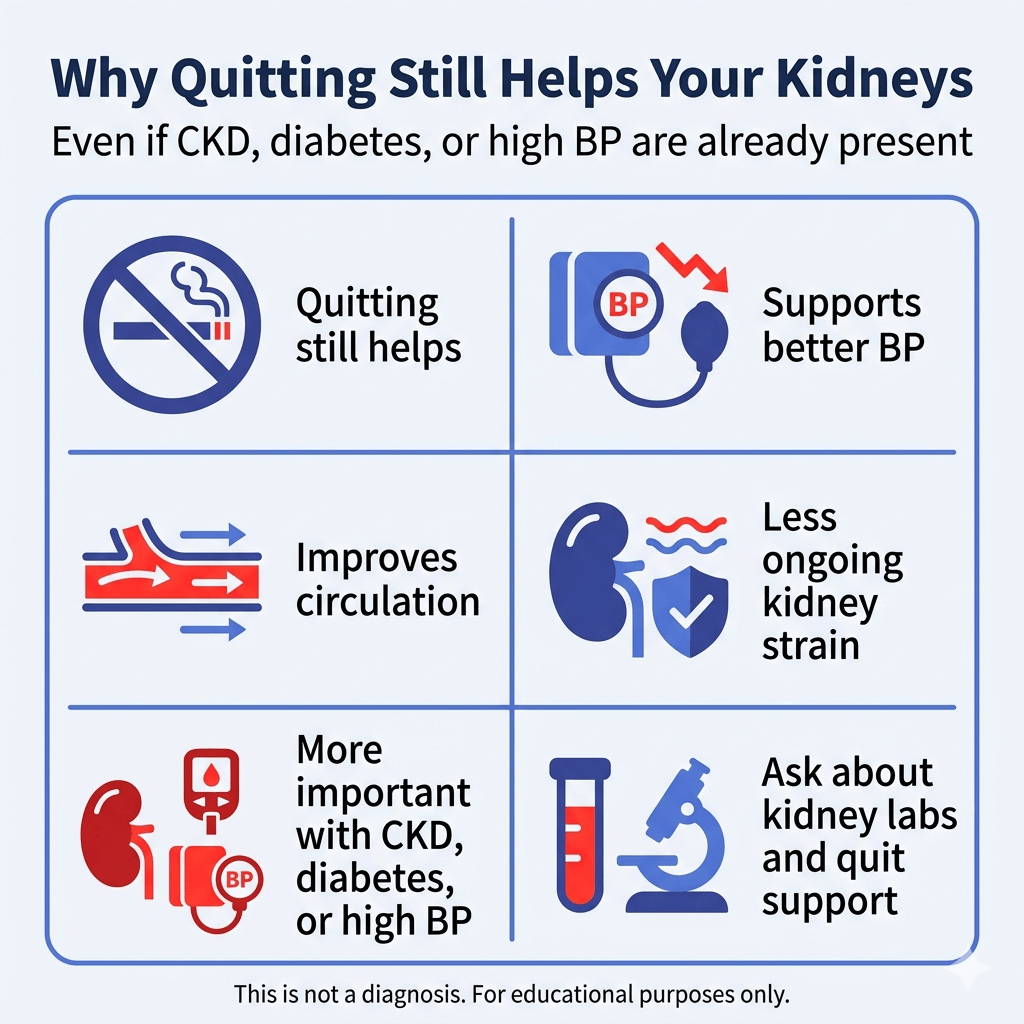
Quitting smoking helps. NKF says quitting smoking is one of the most important steps a person can take to protect kidney and overall health, and that the body begins healing within hours of stopping. Its guidance also notes that blood pressure lowers and circulation improves over time after quitting.
That does not mean quitting instantly erases years of risk. It means it is still worth doing, even after many years of smoking or even after a CKD diagnosis. Kidney benefit is part of a larger benefit pattern that includes better circulation, lower cardiovascular risk, and less ongoing stress on the organs.
What to do if you smoke and have kidney disease
Do not wait for a crisis to bring it up. Ask your clinician how smoking may be affecting your kidneys specifically, whether your blood pressure is being affected, and whether your kidney labs or urine protein suggest added stress. NKF specifically encourages people to ask how smoking affects their kidneys and what quitting resources are available.
It also helps to keep up with kidney monitoring instead of assuming you would “know” if damage was happening. NIDDK emphasizes testing for kidney disease, especially in people with risk factors such as diabetes, high blood pressure, heart disease, and family history.
And if quitting has felt difficult before, that does not mean the conversation is over. It means it is worth asking for actual support instead of trying to delay the issue until symptoms get worse. That recommendation follows directly from NKF’s emphasis on quitting support and the clear kidney risks tied to smoking.
When smoking-related kidney concerns should lead to medical follow-up sooner
It is worth seeking earlier follow-up if you already have CKD and are noticing worsening swelling, weakness, nausea, urine changes, or uncontrolled blood pressure. Smoking is not the only possible explanation for these problems, but it can add to the risk picture and should not be ignored.
A stronger reason for timely follow-up is when multiple kidney risks are happening together, such as smoking plus diabetes, smoking plus hypertension, or smoking plus already abnormal kidney labs. In that situation, it is safer to get checked than to assume the damage is minor or reversible on its own.
For people in Angleton and Brazoria County, smoking questions often come up when kidney labs are already abnormal or symptoms are starting to feel more serious. If swelling, weakness, vomiting, breathing trouble, or major urine changes are showing up, Angleton ER can evaluate urgent symptoms and help guide the next medical step.
Frequently Asked Questions
Does smoking affect your kidneys?
Yes. NKF says smoking damages blood vessels, raises blood pressure, reduces blood flow to the kidneys, and increases the risk of CKD, kidney failure, and kidney cancer.
Can smoking cause chronic kidney disease?
It can increase the risk of CKD, but it is not usually the only cause. Diabetes and high blood pressure are still the most common causes of CKD in adults.
Can smoking make CKD worse?
Yes. NKF says smoking may make existing kidney disease progress more quickly.
Does smoking reduce blood flow to the kidneys?
Yes. NKF says smoking reduces blood flow to the kidneys and damages the blood vessels that support them.
Can smoking raise blood pressure and hurt the kidneys?
Yes. NKF says smoking raises blood pressure, and NIDDK identifies high blood pressure as a major kidney disease risk factor.
Is vaping safer for kidney health than smoking?
It should not be treated as a kidney-safe option. CDC says there are no safe tobacco products, including e-cigarettes, and most e-cigarettes contain nicotine. CDC and MedlinePlus also say more research is needed on the long-term health effects of vaping, so it is not accurate to frame vaping as clearly safe for kidney health.
Does smoking increase kidney failure risk?
Yes. NKF explicitly says smoking increases the risk of kidney failure over time.
Does smoking cause kidney cancer?
Smoking is a risk factor for kidney cancer. NKF states that smoking is linked to a higher risk of kidney cancer, and MedlinePlus lists smoking among kidney cancer risk factors.
Will quitting smoking help protect my kidneys?
Yes. NKF says quitting smoking is one of the most important steps you can take to protect kidney and overall health.
When should someone with kidney disease ask for help quitting?
As early as possible. This is especially important if CKD, diabetes, high blood pressure, or abnormal kidney labs are already part of the picture. That recommendation follows directly from NKF’s smoking guidance and NIDDK’s CKD risk guidance.