
When a loved one has kidney failure and hospice is brought into the conversation, families often want to know one thing right away: What should we expect now? The hardest part is that there is no exact day-by-day timeline that fits every person. Hospice in kidney failure is usually less about predicting the exact number of days left and more about preparing for a phase where the focus shifts to comfort, symptom relief, emotional support, and quality of life.
For families in Angleton and across Brazoria County, this stage can feel deeply emotional because the questions are no longer only about treatment. They are about comfort, dignity, practical caregiving, and how to recognize the changes that often happen near the end of life. The good news is that hospice is designed to support not only the patient, but also the family caring for them.
Medical disclaimer: This article is for educational purposes only. It is not medical advice, diagnosis, or a substitute for direct guidance from a licensed healthcare professional or hospice team. Hospice decisions and end-of-life expectations should always be discussed with the patient’s medical team.
What hospice means in kidney failure
Hospice is comfort-focused care for people nearing the end of life. CMS explains that hospice shifts the focus away from trying to cure the illness and toward pain relief, symptom management, and support for patients and families. Medicare hospice eligibility generally requires a physician certification that the person has a prognosis of 6 months or less if the illness follows its expected course.
In kidney failure, hospice may become part of care when the patient and care team decide that the priority is no longer life-prolonging kidney treatment, but comfort and quality of life instead. NIDDK explains that as a person nears the end of life, they may choose hospice care, which provides symptom and pain relief as well as emotional and spiritual support.
It is also important to say clearly that hospice is not the same as conservative kidney care. Conservative care can begin earlier and may continue for quite a while before hospice is needed. National Kidney Foundation explains that many people choose conservative care first and may later transition to hospice as the end of life gets closer.
When hospice may become part of the kidney failure journey
Hospice often enters the picture when a patient is not starting dialysis, when dialysis is being stopped, or when the overall medical situation makes comfort-focused care a better fit than continued life-prolonging treatment. NIDDK says people who choose conservative management focus on symptom control and quality of life, and as they near the end of life, they may choose hospice care. NKF also notes that people who stop or do not start dialysis are often eligible for hospice services.
The timing varies widely. Some people are on conservative care for a meaningful stretch of time before hospice becomes appropriate. Others enter hospice after a sharper decline, after dialysis no longer feels helpful, or when symptoms and overall health suggest the illness is in its final phase. That is why hospice is better understood as a change in care goals rather than a single kidney stage.
What families should understand about the hospice timeline
The most important truth is that there is no one exact timeline. NIDDK says people who choose not to begin dialysis may live for a few weeks or for several months, depending on their health and remaining kidney function. NKF also explains that people on conservative care can live much longer before hospice is needed, while people who stop dialysis may decline over a shorter period.
That means families should be cautious about expecting a clean sequence like “this symptom means exactly this many days remain.” In real life, one person may stay fairly stable for a while and then decline more quickly. Another may gradually sleep more, eat less, and become weaker over a longer period. The timeline depends on factors like remaining kidney function, overall frailty, heart disease, diabetes, nutrition, and whether dialysis has already been stopped or was never started.
A useful way to think about the hospice timeline is not as a clock, but as a pattern of increasing dependence and decreasing reserve. Families often notice that the person needs more help, rests more, eats less, and becomes less engaged with daily activity over time.
What families may notice earlier in hospice care
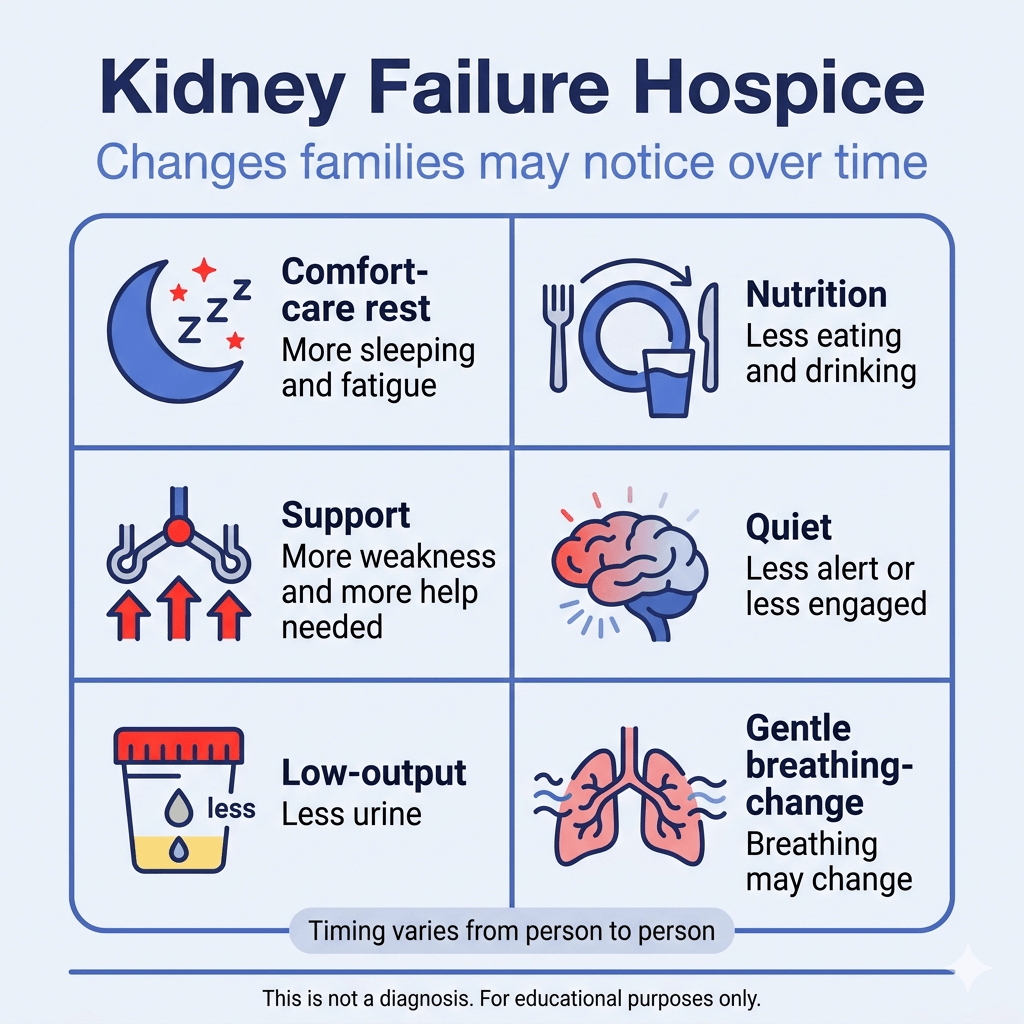
Earlier in hospice care, families often notice more fatigue and more sleeping. NIDDK says that as waste products build up in kidney failure, people may become less alert, and its kidney-failure guidance also lists daytime tiredness, sleep problems, weakness, and reduced appetite among common symptoms.
Another common change is less interest in food and activity. NIDDK says conservative management includes treating symptoms such as nausea and poor appetite, and it specifically notes that appetite may decline as kidney failure progresses. Families may also notice the person withdrawing from routines that used to matter to them, simply because they do not have the same energy anymore.
This stage is also when the need for help often increases. The person may need more support with walking, bathing, getting dressed, getting comfortable in bed or a chair, and managing symptoms like nausea, itching, swelling, or breathlessness. Hospice is meant to support exactly this phase, not only medically but also practically and emotionally.
What changes may happen as the end of life gets closer
As kidney failure moves closer to the end of life, families may notice more sleeping, less alertness, and much less eating or drinking. NIDDK says that as waste products build up, appetite may decline and the person may become less alert. Its kidney-failure guidance also notes that people may make little or no urine, feel confused, have trouble focusing, lose weight, and become weaker.
Families may also notice slower responses, longer periods of quiet, less interest in conversation, and a growing need for comfort over activity. Some people become more confused or more drowsy. Others remain mentally present for much of the time but do not have the strength to do very much. This part of the process looks a little different for each person, which is why hospice teams help families understand changes as they happen rather than relying only on general descriptions.
Breathing can also change, especially if fluid buildup or overall weakness is part of the picture. NIDDK lists swelling and breathing-related discomfort among common kidney-failure symptoms, and hospice teams often help families understand what changes are expected versus what needs urgent symptom management.
What hospice usually helps with in kidney failure
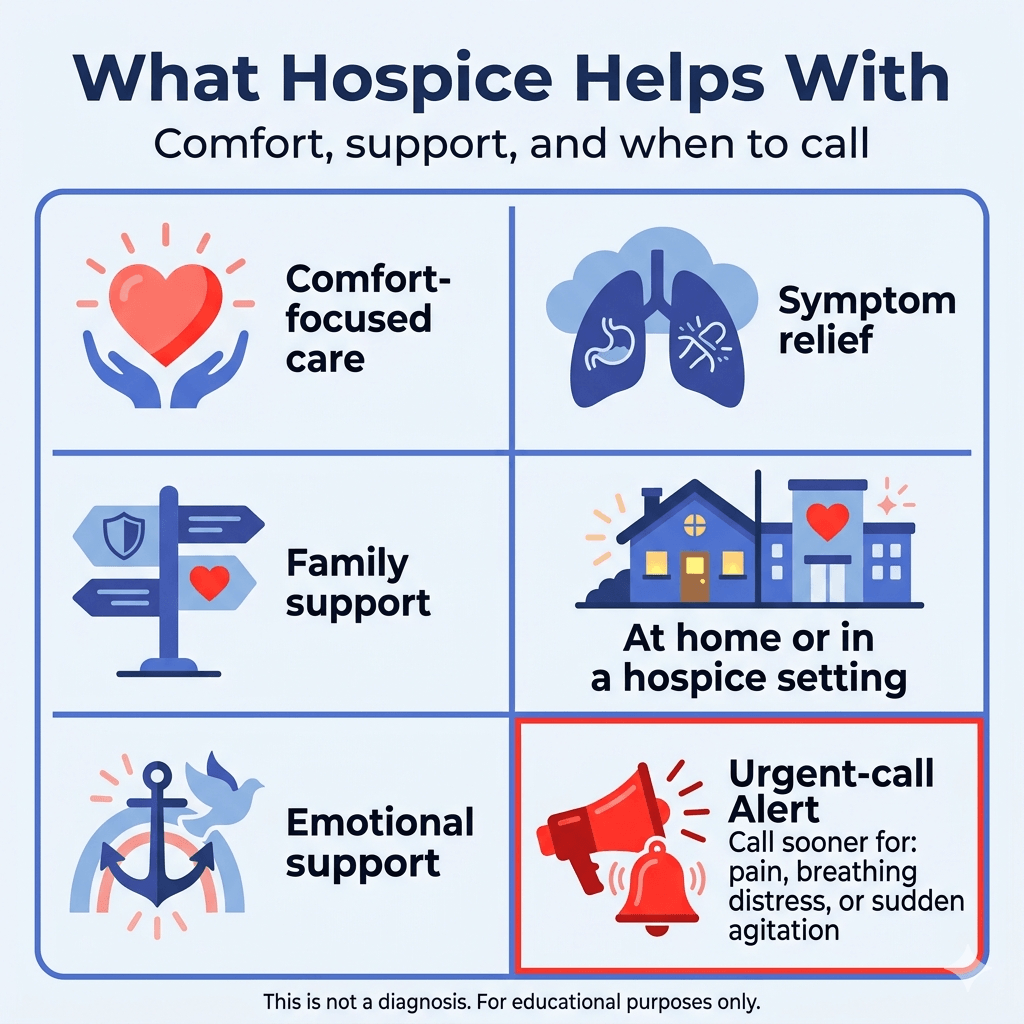
Hospice helps with symptom relief first. CMS describes hospice as comfort-centered care focused on pain relief and symptom management, while NIDDK says hospice includes symptom and pain relief as well as emotional and spiritual support. In kidney failure, that can include support for symptoms like nausea, itching, swelling, breathlessness, agitation, poor appetite, and discomfort.
Hospice also supports the family, not just the patient. NIDDK says the hospice team supports family caregivers, and CMS describes hospice as a program of support for both terminally ill patients and their families. That may include caregiver guidance, counseling, help planning care at home, and knowing who to call when symptoms change.
Another important point is setting. NIDDK says that with hospice care, a person may choose to die at home or in a home-like hospice setting instead of in a hospital. For many families, that option matters because it allows the final phase of life to happen in a more familiar and less medical environment.
Conservative care, palliative care, and hospice: how they differ
These terms are often mixed together, but they are not identical. Conservative care in kidney failure means ongoing care without dialysis or transplant, with a focus on symptom management and quality of life. NIDDK says conservative care may also be called supportive care, nondialytic care, or comfort care.
Palliative care is one part of that broader approach. NIDDK says palliative care addresses the physical, psychological, and spiritual needs of someone with a serious illness. It can be part of conservative care and can also support people who are still receiving other treatments.
Hospice is more specific. CMS says hospice is for people whose doctors certify a prognosis of 6 months or less if the illness runs its normal course, and the focus is no longer cure-oriented care. So a simple way to think about it is this: conservative care may begin earlier, palliative care can overlap with many stages of serious illness, and hospice is usually the more clearly end-of-life phase.
What families can do during this phase
One of the most helpful things families can do is ask clear questions early. Ask what symptoms are expected, which changes are common, and which symptoms should trigger a call day or night. Hospice teams expect these questions. Families do not need to guess their way through this stage alone.
It also helps to keep the patient’s wishes visible and central. If the goal is comfort, then day-to-day decisions should keep returning to that goal: reducing distress, avoiding burdens that no longer help, and making space for presence, rest, and dignity. This is a care philosophy directly reflected in hospice and conservative kidney care guidance.
Families should also accept help when it is offered. Hospice is designed to reduce the feeling that everything is falling on one exhausted caregiver. Emotional support, practical coaching, and symptom guidance are part of the service, not extra favors.
When symptoms should still be reported urgently
Even in hospice, families should still report uncontrolled pain, severe breathing distress, agitation that suddenly worsens, or any symptom the hospice team has asked them to report immediately. Hospice does not mean ignoring suffering. It means managing suffering quickly and appropriately.
Families should never feel like they are “bothering” the team by calling. Hospice is built around ongoing support, especially when symptoms change or the family is unsure what they are seeing. If symptoms feel severe, sudden, or frightening, it is appropriate to call for guidance right away.
For people in Angleton and Brazoria County, there are times when symptoms may feel bigger than what the family can safely interpret at home. If breathing distress, chest pain, repeated vomiting, severe weakness, confusion, or another rapidly worsening problem makes the situation feel urgent, Angleton ER can help evaluate the immediate medical concern while the family and care team sort out what should happen next.
Frequently Asked Questions
How long can someone be on hospice with kidney failure?
There is no single answer. Hospice eligibility generally uses a 6-month-or-less prognosis if the illness runs its expected course, but the actual time varies from person to person.
Is hospice the same as stopping all care?
No. Hospice still provides active care, but the goal changes from cure to comfort, symptom relief, and support.
What happens when someone with kidney failure stops eating?
Families often notice less appetite and less interest in food as kidney failure progresses. NIDDK says appetite may decline as waste products build up.
Do people with kidney failure sleep more near the end of life?
Often, yes. NIDDK says people may become less alert, and kidney failure can cause fatigue, weakness, and increased sleepiness.
Can hospice help with nausea, itching, and swelling?
Yes. Hospice focuses on symptom management, and NIDDK specifically notes that conservative end-of-life kidney care addresses symptoms such as nausea and poor appetite, while hospice provides symptom relief and comfort support.
Is hospice only for the last few days?
No. Hospice is often used in the last phase of life, but it is not limited to the final days. Medicare hospice eligibility is based on a physician’s judgment that life expectancy is 6 months or less if the illness runs its normal course.
Can someone receive hospice at home?
Yes. NIDDK says people may choose hospice care at home or in a home-like hospice setting, and NKF also notes that home hospice is often available.
What is the difference between conservative care and hospice?
Conservative care can begin earlier and focuses on symptom control and quality of life without dialysis or transplant. Hospice is usually the later end-of-life phase when prognosis is limited and comfort is the main goal.
What signs often show that the end of life is getting closer?
Families may notice more sleeping, less alertness, less eating and drinking, more weakness, less urine, and increasing dependence on others.
When should families call for urgent help?
They should call when symptoms are severe, sudden, uncontrolled, or different from what they were told to expect, especially with pain, breathing distress, agitation, or major decline.
For many families, the hardest part of kidney failure hospice is not just the sadness of it. It is the uncertainty. Knowing that the timeline is variable, that comfort is the priority, and that support is available can make this stage feel a little less frightening and a little less lonely.