

One of the most common questions after a chronic kidney disease diagnosis is, “How fast will this get worse?” The honest answer is that CKD does not progress at the same speed for everyone. In many people, it develops very slowly over time. In others, it can worsen faster, especially when certain risk factors are present. Some people with CKD never progress to kidney failure at all.
For people in Angleton and across Brazoria County, this question usually comes from a very real place: not just curiosity, but worry about what the next few years may look like. The best way to answer it is not with one fixed timeline, but by looking at the things that most strongly affect progression, including the cause of CKD, eGFR trends, urine albumin levels, blood pressure, diabetes control, and complications over time.
Medical disclaimer: This article is for educational purposes only. It is not medical advice, diagnosis, or a substitute for care from a licensed healthcare professional.
Does chronic kidney disease always get worse?
CKD is usually a slow, long-term process. National Kidney Foundation says developing CKD is usually very slow, often with few symptoms at first. That is why some people remain in the same stage for years, especially when the disease is found early and the main risk factors are well managed.
But CKD does not follow one script. NIDDK says some patients progress to kidney failure more rapidly than others, while some never progress to kidney failure at all. That is why two people with the same stage of CKD may still have very different long-term outcomes.
So the better question is not, “How long does CKD take?” but rather, “What is driving my CKD, and are my numbers staying stable or getting worse?” That is what really shapes the pace of progression.
What makes CKD progress faster?
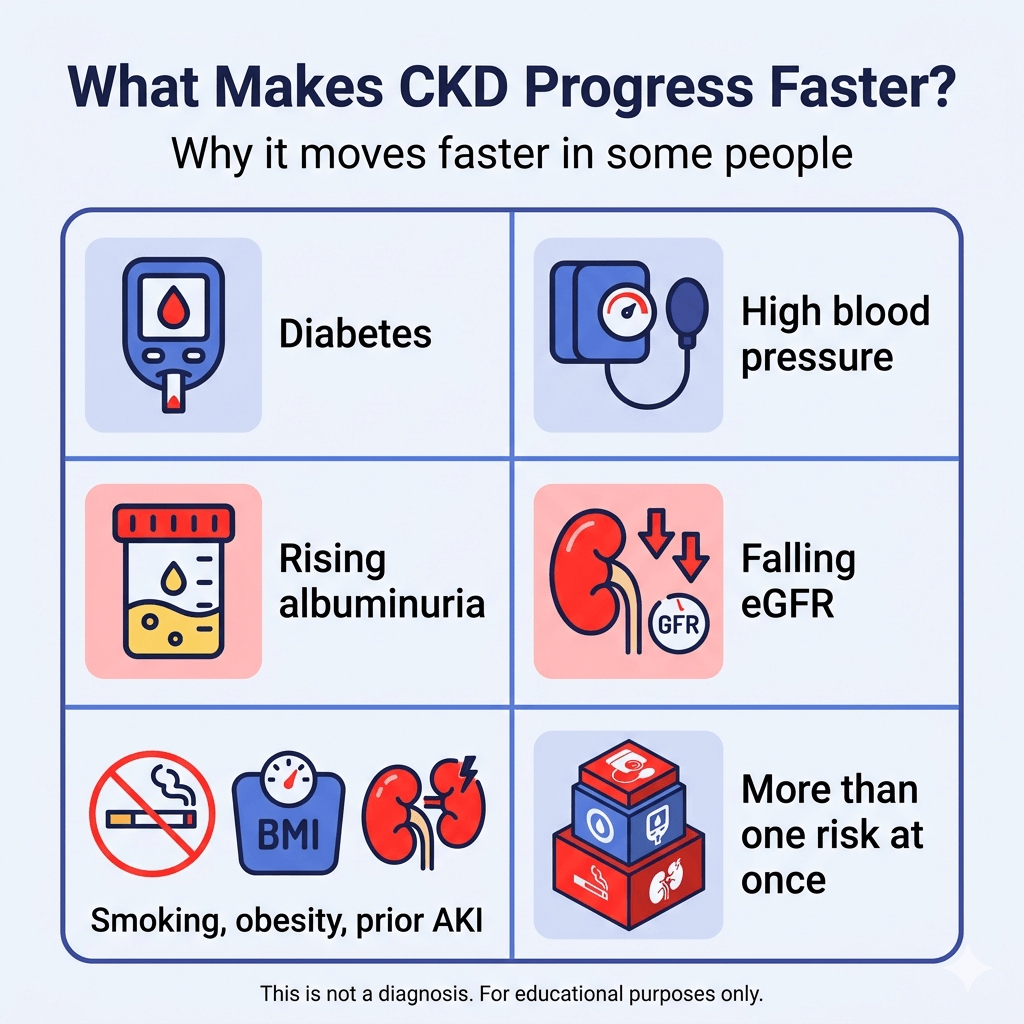
NIDDK identifies several major risks for faster progression: diabetes, especially when paired with high albuminuria, high blood pressure, increasing albuminuria, and decreasing eGFR. These are some of the strongest predictors clinicians watch when trying to estimate whether CKD is likely to worsen more quickly.
National Kidney Foundation also lists broader CKD risk factors such as obesity, family history of CKD or kidney failure, smoking, and prior acute kidney injury (AKI). These do not guarantee fast progression, but they can make the kidneys more vulnerable over time, especially when layered on top of diabetes or hypertension.
In practical terms, CKD tends to move faster when the kidneys are being hit from multiple directions at once: poor blood pressure control, uncontrolled blood sugar, ongoing protein leakage into the urine, recurrent stress on the kidneys, and declining filtration numbers over time.
What can slow CKD progression?
The most important tools for slowing CKD progression are usually not dramatic. They are steady, repetitive, and often frustratingly basic: controlling blood pressure, improving blood sugar when diabetes is present, lowering urine albumin when possible, following the treatment plan, and keeping up with repeat testing. NIDDK’s CKD management guidance specifically says medical interventions that may help slow progression include blood pressure control, medications that block the renin-angiotensin-aldosterone system to lower urine albumin, and glucose control in people with diabetes.
Early detection matters too. National Kidney Foundation emphasizes that CKD is best found early, because treatment is more likely to help preserve kidney function before more damage is done. Even when CKD cannot be reversed, progression can often be slowed.
That is why “slow progression” is usually about protecting the kidney function that remains, not waiting for symptoms to force action later.
Why albumin in the urine matters so much
Albumin in the urine, often tracked as uACR, is one of the most useful clues about CKD risk. NIDDK says albuminuria is one of the two key markers of CKD, along with eGFR. If albumin stays the same or goes down, that may suggest treatment is helping; if it rises, that can point toward worsening kidney damage or higher progression risk.
NIDDK’s progression tool goes further and says increasing albuminuria is a progression risk factor, while reducing urine albumin toward the normal range may improve kidney and cardiovascular prognosis. NKF also states that albuminuria is a sign of kidney damage and that treatment may help lower the risk of CKD getting worse.
This is why albumin can matter even when eGFR is not yet deeply reduced. A person can still have meaningful kidney damage and progression risk because of persistent albuminuria.
How doctors track whether CKD is progressing
Doctors usually monitor CKD progression with the same two main tests used to diagnose it: eGFR and urine albumin testing. NIDDK says these are the key markers used to detect and monitor kidney disease.
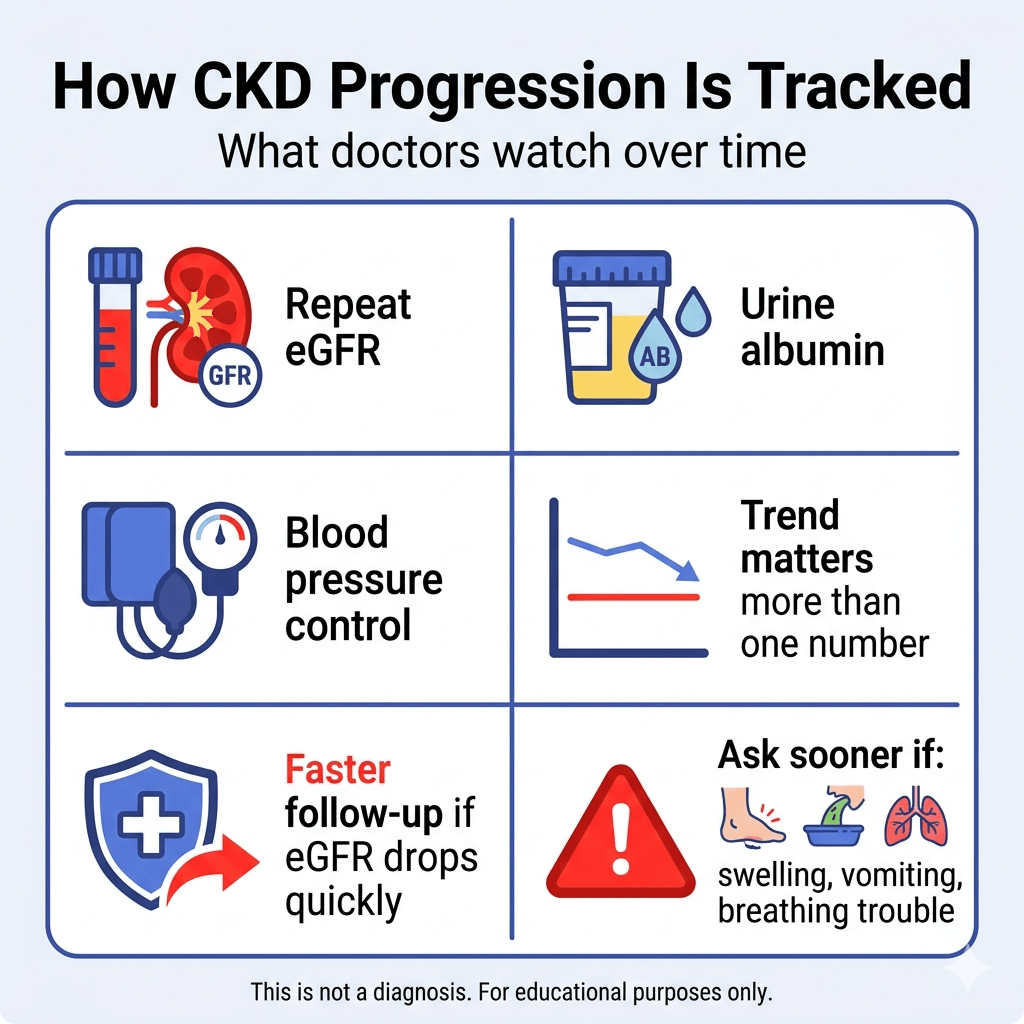
What matters most is trend over time, not one isolated number. NIDDK specifically advises monitoring change in kidney function using eGFR and monitoring urine albumin to assess response to therapy and progression of disease. It also notes that more frequent monitoring may be needed when clinical status is changing or treatment has recently changed.
Blood pressure, symptoms, and complications matter too, but when doctors ask, “Is CKD progressing?” they are usually looking for patterns in repeat eGFR values, repeat albumin results, and whether those numbers are stabilizing or trending in the wrong direction.
Does CKD progress at the same speed in every stage?
No. Stage still matters, but it does not create an exact timeline. National Kidney Foundation explains that CKD is divided into 5 stages using eGFR and uACR, and those stages help guide treatment decisions and risk understanding. In general, higher stages mean less kidney function and greater risk, especially stage 4 and stage 5.
Early-stage CKD can stay quiet for a long time, especially when it is detected early and monitored closely. Stage 3 may stay stable for years in some people, while in others it may move gradually toward stage 4. Stage 4 carries a much higher risk of kidney failure, but even there, progression is still not one fixed countdown.
So stage tells you how much kidney function remains, but it does not tell you by itself how fast the next change will happen. That still depends on the underlying drivers.
Signs CKD may be getting worse
Symptoms are not the best way to measure progression, but they still matter. As CKD advances, people may notice worsening swelling, more fatigue or weakness, nausea, vomiting, appetite loss, shortness of breath, sleep problems, or trouble thinking clearly. NKF notes that many symptoms are vague and often appear later, while Mayo Clinic also describes symptoms as usually developing slowly over time and becoming more noticeable in advanced disease.
Changes in urination can matter too, but they are not always the earliest or clearest sign. This is why symptoms should be taken seriously, but not treated as a substitute for lab follow-up. Many people with CKD still have few symptoms until disease becomes more advanced.
When progression may lead to specialist follow-up sooner
Progression deserves quicker follow-up when there is a rapid drop in eGFR, rising albuminuria, new or worsening complications, or eGFR below 30. NIDDK’s professional guidance links rapid eGFR decline and progressive disease with higher-risk CKD that may need more aggressive management, and its nephrology collaboration guidance uses eGFR below 30 as an important threshold for specialist involvement and preparation for kidney replacement therapy.
The referral question also becomes more important when the cause of CKD is unclear or when complications like anemia, hyperkalemia, or mineral and bone problems are starting to shape daily care. Those are the moments when “monitoring” may need to turn into more specialized kidney management.
Questions to ask if you are worried about CKD progression
If you are worried that CKD is worsening, the most useful questions are usually:
- Are my kidney numbers stable or falling?
- What is my current eGFR?
- How much albumin is in my urine?
- What is most likely driving my CKD?
- What can I do right now to slow progression?
- How often should my labs be checked?
These questions are useful because they push the conversation toward measurable risk instead of fear alone.
When symptoms or lab changes should not wait
Some changes should not sit until the next routine visit. A fast drop in kidney numbers, severe swelling, trouble breathing, repeated vomiting, dehydration, confusion, very low urine output, or rapid overall decline deserves quicker medical attention. These can reflect more serious fluid imbalance, toxin buildup, or complications that need urgent reassessment.
For people in Angleton and Brazoria County, one of the hardest parts of CKD is figuring out whether a bad day is just part of a chronic condition or a sign that something has shifted. If symptoms are worsening quickly or the person looks significantly sicker than before, Angleton ER can evaluate urgent symptoms and help determine what kidney follow-up should happen next.
Frequently Asked Questions
How fast does CKD usually progress?
Usually slowly, but not always. Some people progress much faster than others, and some never progress to kidney failure at all.
Can CKD stay stable for years?
Yes. Many people remain stable for long periods, especially when CKD is found early and major risk factors are controlled.
What makes CKD get worse faster?
Diabetes, high blood pressure, increasing albuminuria, and decreasing eGFR are major progression risks. Smoking, obesity, family history, and prior AKI can also add risk.
Does stage 3 CKD always progress to stage 4?
No. Some people with stage 3 stay stable for years, while others worsen gradually.
Is albumin in the urine a sign CKD is worsening?
It can be. Persistent or increasing albuminuria is associated with higher progression risk.
Can high blood pressure speed up CKD progression?
Yes. NIDDK lists high blood pressure as a risk for CKD progression.
Can diabetes make CKD progress faster?
Yes, especially when diabetes is accompanied by high albuminuria.
What tests show whether CKD is progressing?
The main tests are eGFR and urine albumin testing, followed over time.
When should someone worry about a falling eGFR?
When the drop is persistent, faster than expected, or paired with worsening symptoms or rising albuminuria.
When should someone seek urgent care instead of waiting?
When there is severe swelling, breathing trouble, repeated vomiting, dehydration, confusion, very low urine output, or rapid overall worsening.