

This is one of the hardest kidney questions a family can ask, and it deserves a careful answer. If someone has stage 5 kidney failure and does not start dialysis, there is no single life expectancy that fits everyone. Some people decline quickly. Others live longer, especially when they still have some remaining kidney function and are receiving conservative management, which means symptom-focused care without dialysis or transplant. NIDDK explains both that a person who needs dialysis to survive and does not receive it may live a few days or weeks, and that people who decide not to begin dialysis may live a few weeks or several months, depending on their health and remaining kidney function.
For families in Angleton and across Brazoria County, this topic is often not just about time. It is also about comfort, symptoms, quality of life, and whether dialysis is the right fit for that person’s health, goals, and overall condition. The most helpful approach is to understand what stage 5 kidney failure means, what affects survival without dialysis, and what supportive care can still do.
Medical disclaimer: This article is for educational purposes only. It is not medical advice, diagnosis, or a substitute for direct care from a licensed healthcare professional. Decisions about dialysis, conservative management, or end-of-life care should always be made with the medical team involved in the patient’s care.
What stage 5 kidney failure means
Stage 5 CKD means kidney failure. National Kidney Foundation guidance defines stage 5 CKD as kidney failure with an eGFR below 15 for 3 months or more, or being on dialysis. NIDDK similarly explains that kidney failure means less than 15 percent of normal kidney function remains. At this point, the kidneys are no longer able to do enough of their usual work to keep the body in balance on their own.
That matters because healthy kidneys do far more than make urine. They help remove waste, clear extra fluid, balance minerals such as sodium and potassium, support blood pressure control, and help the body maintain internal stability. When stage 5 kidney failure develops, waste and extra water can build up in the body, and symptoms often become more serious than they were in earlier CKD stages.
This is also why stage 5 kidney failure should not be thought of as “just a worse version” of stage 3 or stage 4 CKD. It is the point where the body’s margin becomes much smaller, and treatment decisions become more urgent and more personal.
There is no single life expectancy without dialysis
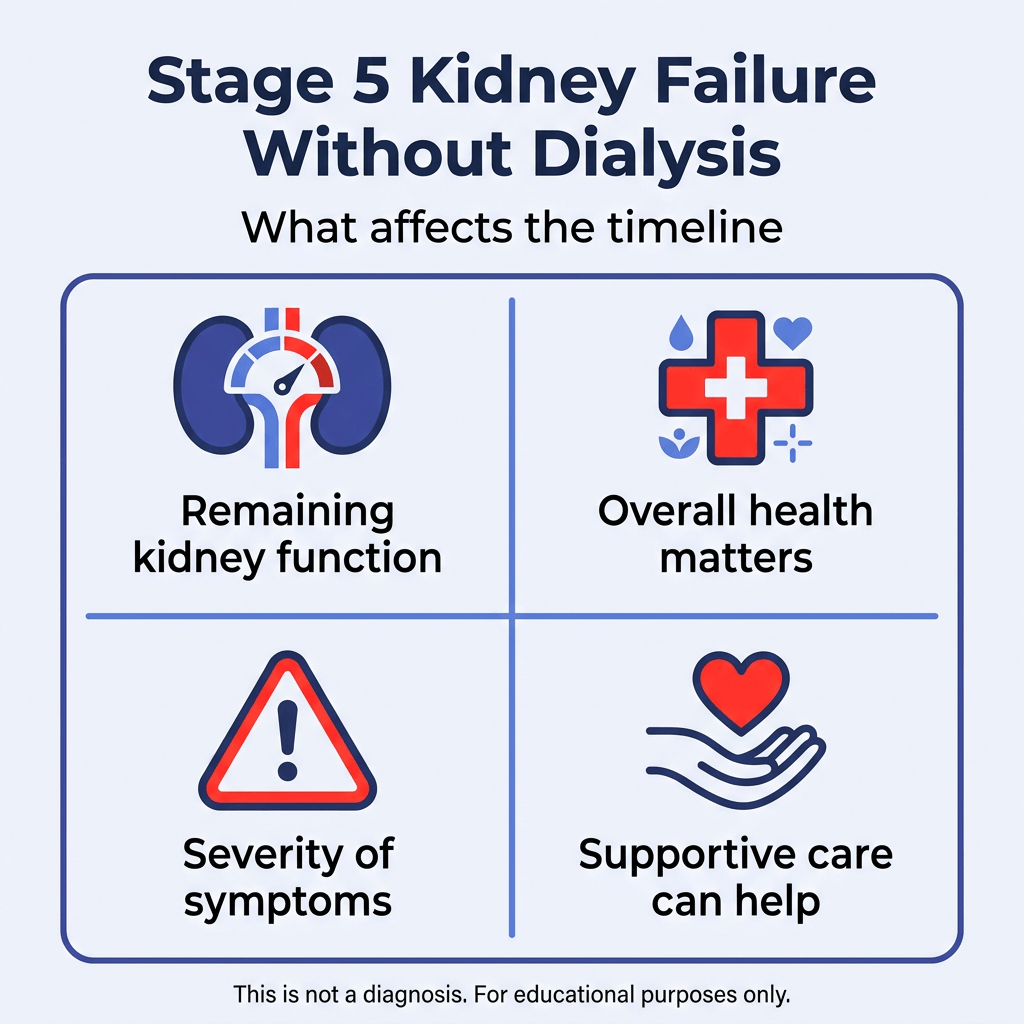
The question in the title is common because families want a concrete number. The difficulty is that medicine cannot honestly give one number that fits every person with stage 5 kidney failure who does not start dialysis. NIDDK states clearly that the answer is different for each person. Overall health, how much kidney function remains, how quickly symptoms are progressing, and what other illnesses are present can all change the timeline.
Still, official sources do give general ranges that help frame expectations. NIDDK explains that if a person needs dialysis to survive and does not receive it, survival may be a few days or weeks. On a related NIDDK kidney-failure treatment page, the institute says that if someone decides not to begin dialysis, they may live for a few weeks or for several months, depending on health and remaining kidney function.
The reason both of those statements can be true at the same time is that “without dialysis” does not describe one single medical situation. One person may be extremely ill with severe fluid overload, dangerous potassium levels, and rapidly worsening symptoms. Another may have stage 5 kidney failure, but still retain enough kidney function to live longer with supportive care. That is why the most responsible answer is not one number, but a discussion of what affects the timeline.
What affects life expectancy in stage 5 kidney failure without dialysis
One major factor is how much kidney function is left. Even within stage 5, not every person is at the same point. Some people are closer to the stage-4/stage-5 transition and still have more residual function. Others are much sicker and declining more quickly.
Another major factor is other serious health problems. NIDDK says dialysis may not prolong or improve quality of life for some people who are elderly and frail or who have other serious health problems such as dementia, heart failure, or cancer. Those same conditions also affect survival when dialysis is not started. A person’s overall health often matters just as much as the kidney number itself.
Symptoms also matter. As kidney failure progresses, buildup of waste products and fluid can lead to worsening appetite, nausea, itching, swelling, weakness, breathing difficulty, confusion, low urine output, and increasing sleepiness or reduced alertness. The more severe these symptoms become, the more serious the overall situation is likely to be.
Supportive care can also influence the experience, even when it does not replace kidney function. NIDDK explains that conservative management can include preserving kidney function as long as possible, treating symptoms such as nausea and poor appetite, managing related problems like anemia, and maintaining quality of life for as long as possible. That does not cure kidney failure, but it can change comfort, clarity, and how the remaining time is lived.
What happens if someone chooses not to start dialysis
Choosing not to start dialysis is often misunderstood. It is not automatically the same as “doing nothing,” and it is not always the same as giving up. NIDDK defines conservative management as ongoing care without dialysis or transplant, with the focus placed on quality of life and symptom control.
Under conservative management, the healthcare team may still treat nausea, poor appetite, itching, anemia, swelling, blood pressure problems, and other symptoms caused by kidney failure. The plan may also include diet guidance, medication review, emotional support, and discussion of end-of-life goals. NIDDK notes that the care team can include a nephrologist, primary care clinician, nurse, dietitian, social worker, and pharmacist.
Dialysis and conservative management differ in one major way: dialysis replaces part of kidney function, while conservative management does not replace kidney function. Conservative care is aimed at helping the patient feel as well as possible for as long as possible, while also reducing burdensome interventions when those interventions may no longer match the patient’s goals.
What symptoms may become more noticeable without dialysis
As kidney failure worsens without dialysis, symptoms often become more noticeable because waste products and extra fluid continue to build up in the body. NIDDK lists symptoms of kidney failure that can include swelling in the legs, feet, or ankles; itching; daytime tiredness and nighttime sleep problems; nausea; poor appetite; weight loss; making little or no urine; muscle cramps; weakness; and confusion or trouble focusing.
NIDDK’s conservative-management guidance adds that as waste products build up in the blood, appetite may decline and the person may become less alert. Families often notice this as increasing fatigue, more sleeping, reduced interest in food, or slower conversation and thinking.
Not every person experiences the same pattern. Some people have more swelling and shortness of breath because fluid becomes harder to manage. Others struggle more with nausea, itching, weakness, or sleepiness. The course can differ because kidney failure is affected by age, heart health, nutrition, baseline strength, and other illnesses happening at the same time.
What supportive care usually focuses on
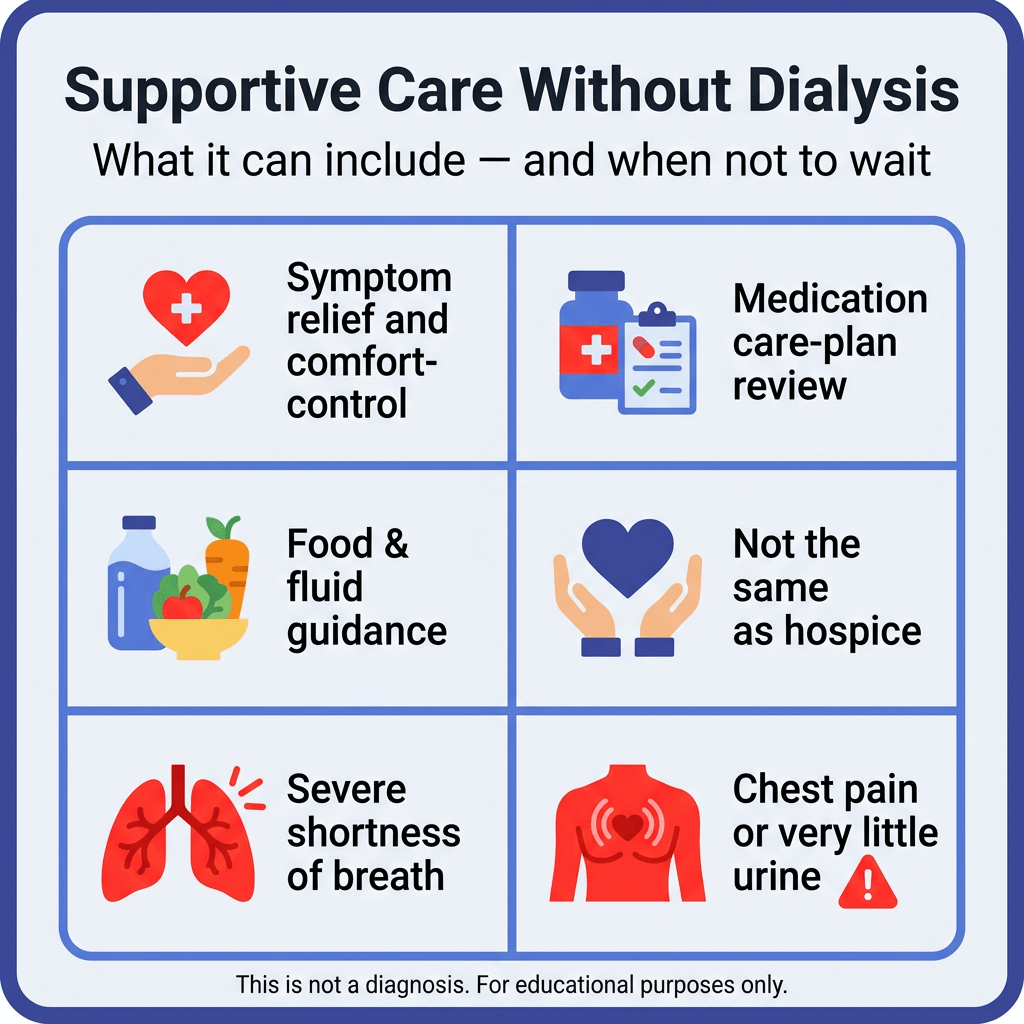
Supportive care usually focuses first on symptom control. That may include medicines or strategies for nausea, itching, anxiety, poor appetite, swelling, breathlessness, and discomfort. It may also include treating anemia and adjusting the plan when symptoms change.
It also focuses on quality of life. NIDDK explains that conservative management aims to provide the best quality of life possible and may help avoid treatments and hospital stays that would worsen quality of life. For some families, that means fewer trips for procedures and more time spent at home. For others, it means clearer planning and better comfort.
Food and fluid guidance can still matter too. NIDDK notes that what a person eats and drinks during conservative management may help them feel better and may help prolong life, which is why diet advice should be individualized rather than guessed at.
Conservative management and hospice are not the same thing
Families often assume that conservative kidney care and hospice are identical, but they are not. National Kidney Foundation explains that conservative care is different from hospice. Conservative care can begin earlier and focus on living as well as possible without dialysis or transplant. Hospice is end-of-life care for people who are expected to be in the last phase of life.
NIDDK says that as a person nears the end of life, they may choose hospice care. Hospice focuses on symptom and pain relief, emotional and spiritual support, and support for family caregivers. In other words, hospice may become part of the plan later, but conservative care often starts earlier than hospice.
That distinction matters because it helps families understand that a person can choose supportive kidney care first and still adjust the plan later as symptoms, goals, and prognosis change.
When families should speak urgently with a healthcare professional
Even when dialysis is not planned, some symptoms should not be ignored. Severe shortness of breath, chest pain, uncontrolled vomiting, new confusion, very little urine, rapidly worsening swelling, or profound weakness should prompt urgent medical discussion or evaluation. These symptoms can signal dangerous fluid overload, metabolic imbalance, or rapid decline. Kidney failure itself is associated with fluid buildup, confusion, swelling, and significant symptom burden, so worsening symptoms deserve attention.
Urgent evaluation can still matter even when the long-term plan is conservative management. Sometimes the reason is safety. Sometimes it is symptom relief. Sometimes it is simply helping the patient and family understand what is changing and what support is needed next.
For families in Angleton and Brazoria County, this can be one of the hardest parts of the journey: knowing whether symptoms are part of expected decline or a sign that immediate help is needed. If breathing becomes harder, vomiting will not stop, confusion gets worse, or the patient seems much more ill than before, Angleton ER can evaluate urgent symptoms and help guide the next step in care.
Frequently Asked Questions
How long can someone live with stage 5 kidney failure without dialysis?
There is no single answer. NIDDK says a person who needs dialysis to survive and does not receive it may live a few days or weeks, while people who choose not to begin dialysis may live a few weeks or several months, depending on their health and remaining kidney function.
Can someone with kidney failure live for months without dialysis?
Yes, some people can, especially if they still have some remaining kidney function and are receiving supportive care. NIDDK specifically says some people who do not begin dialysis may live several months.
Does everyone with stage 5 CKD need dialysis right away?
No. Stage 5 CKD is kidney failure, but treatment decisions are individualized. NIDDK and NKF both describe conservative management as an option for some people, particularly when dialysis may not match the person’s goals or overall health situation.
What is conservative management for kidney failure?
It is care without dialysis or transplant that focuses on quality of life and symptom control. It may include symptom treatment, medication adjustment, nutrition guidance, and planning for future care.
Is choosing not to start dialysis the same as hospice?
No. Conservative management and hospice are not the same thing. Conservative care can begin earlier, and hospice may be added later as the person nears the end of life.
What symptoms happen as kidney failure worsens?
Symptoms may include swelling, itching, fatigue, nausea, poor appetite, low urine output, muscle cramps, weakness, trouble focusing, confusion, and increasing sleepiness or reduced alertness.
Can medicines still help if dialysis is not started?
Yes. NIDDK says conservative management can still include treatment for symptoms such as nausea, poor appetite, and anemia, along with support aimed at preserving comfort and quality of life.
When should families call a doctor or go to the ER?
Families should seek urgent help for severe shortness of breath, chest pain, uncontrolled vomiting, confusion, very little urine, or rapidly worsening swelling or weakness.
Is dialysis always the best choice for elderly or frail patients?
Not always. NIDDK states that dialysis may not prolong or improve quality of life for some people who are elderly and frail or who have serious conditions such as dementia, heart failure, or cancer.
Can someone change their mind after first choosing conservative care?
Often, treatment decisions can be revisited with the care team as symptoms, quality of life, and goals change. NKF notes that decisions around conservative care should be shared between the person, their support group, and the clinical care team.