
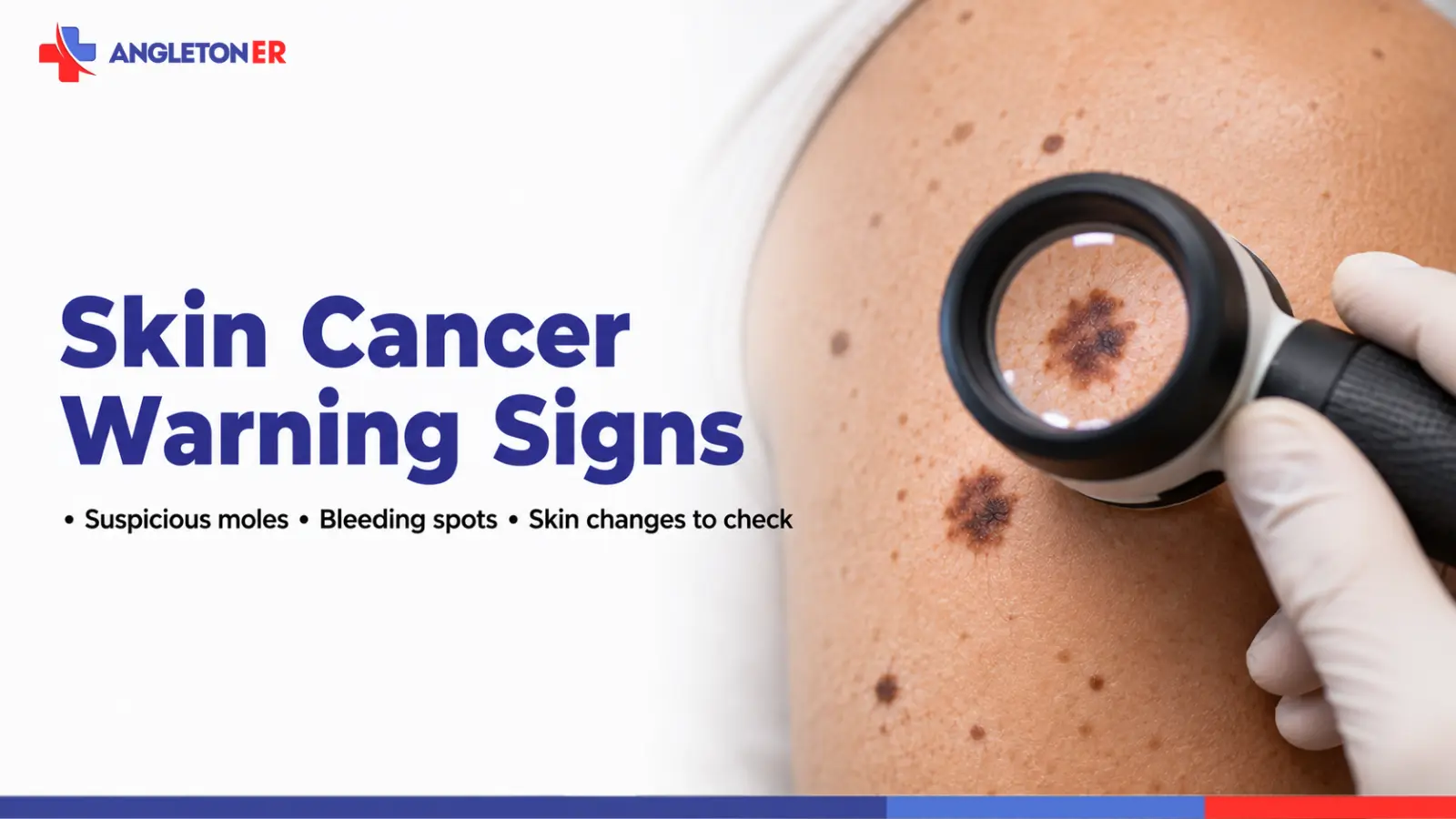
A suspicious skin change is not always a dark mole. Skin cancer can also resemble a sore that will not heal, a rough patch, a shiny bump, a crusted spot, or an area that repeatedly bleeds. Many harmless conditions can look similar, so appearance alone cannot confirm cancer. The most useful question is whether a spot is new, changing, different from the rest, repeatedly irritated, or failing to follow a normal healing pattern.
This guide focuses on the skin changes that deserve medical evaluation and the symptoms that make the situation more urgent. For a broader overview of symptoms involving other parts of the body, see Angleton ER’s guide to cancer warning signs and when to seek care.
Not Every Skin Cancer Warning Sign Looks Like a Dark Mole
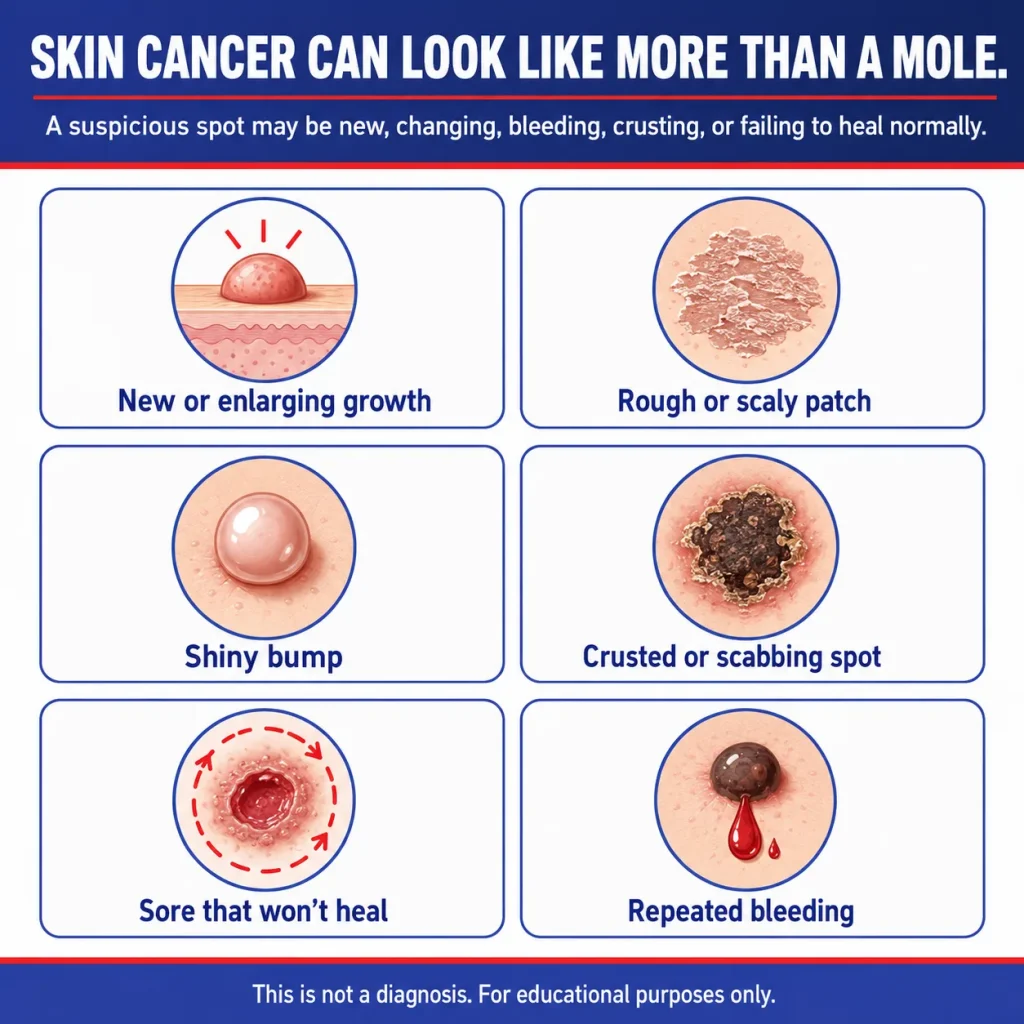
Melanoma is often discussed in relation to changing moles, but basal cell and squamous cell skin cancers can look very different. The American Cancer Society describes non-melanoma warning signs such as a new or enlarging growth, a rough or scaly patch, or a sore that bleeds and does not heal. Some lesions are pink, red, flesh-colored, pearly, firm, or crusted rather than darkly pigmented.
No single color, texture, or shape proves that a lesion is cancerous. A practical reason to schedule an exam is a spot that is new, evolving, noticeably unlike nearby spots, repeatedly bleeding, or still present after ordinary pimples, cuts, bites, and irritated skin would usually be improving.
Use the ABCDE Pattern to Notice Changes in a Mole
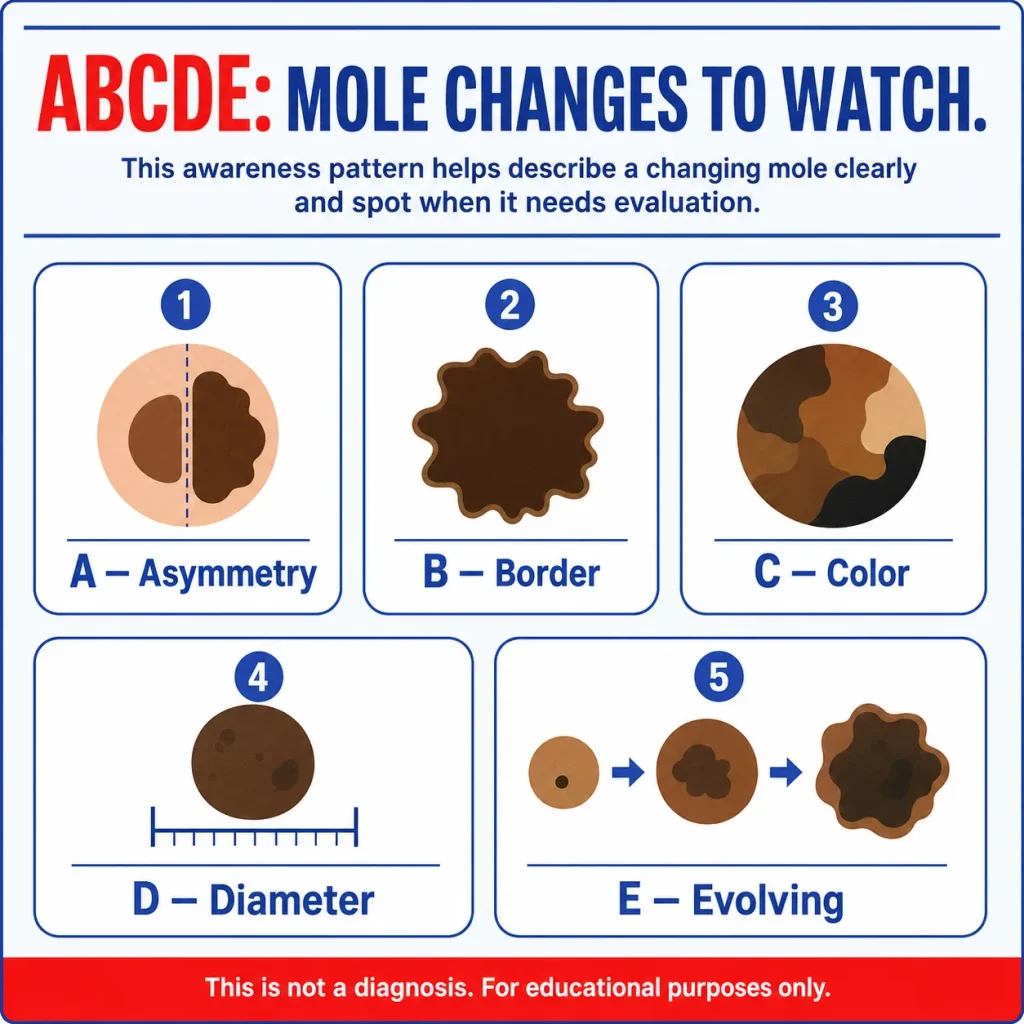
The ABCDE pattern is an awareness tool, not a home diagnostic test. It helps you describe changes clearly and decide when a mole should be examined. The American Academy of Dermatology’s ABCDE guide emphasizes that melanoma can be smaller than a pencil eraser and that a spot that evolves or looks different from the rest deserves attention.
• Asymmetry: One half no longer resembles the other half.
• Border: The edges become irregular, notched, blurred, or poorly defined.
• Color: The mole develops several colors or a meaningful change in color.
• Diameter: The spot grows. Larger size can be concerning, but melanoma can also be small.
• Evolving: The mole changes in size, shape, color, height, sensation, or behavior.
Of these clues, evolving is often the most useful. A mole may not match every textbook feature, but a change over weeks or months, new bleeding, new itching, or a shift in how it feels should be documented and discussed with a clinician.
Bleeding, Crusting, or a Sore That Will Not Heal
A spot that repeatedly bleeds with little or no injury deserves evaluation. The same is true of a sore that appears to heal and then returns, a scab that repeatedly reforms, or a rough or raised area that enlarges or breaks down. These patterns can occur with non-melanoma skin cancers, although irritation and infection can cause similar changes.
• Bleeding after light contact, washing, or no clear injury
• A sore that closes and then reopens
• Persistent scaling, crusting, scabbing, or oozing
• A firm, shiny, rough, or raised area that keeps changing
• A lesion that gradually enlarges, ulcerates, or loses its normal surface
A pimple or minor cut does not have to disappear immediately, but it should generally move toward healing. The concern rises when a spot remains unchanged for several weeks, repeatedly returns, or becomes more abnormal instead of resolving.
Itching, Pain, Texture Changes, and the “Ugly Duckling” Sign
Itching, burning, tenderness, or pain alone is not specific to skin cancer. Those sensations matter more when they are new and occur in the same spot as a visible change. Thickening, elevation, a smooth surface becoming rough, or a mole becoming fragile or crusted can all justify an exam.
Another useful comparison is the “ugly duckling” sign. The American Cancer Society notes that melanoma may look different from a person’s other spots, even when it does not meet every ABCDE feature. A single mole that stands apart from the rest deserves attention.
Do not limit checks to the arms and legs. The AAD skin self-exam guidance includes the scalp, ears, neck, back, palms, soles, between the toes, and around the nails. Skin cancer can occur in any skin tone. Changes on the palms, soles, or nails are mentioned here only as reminders; they may require more focused dermatologic assessment.
Skin Cancer, Infection, or Ordinary Irritation – Why Persistence Matters
Eczema, dermatitis, warts, pimples, insect bites, minor injuries, and skin infections can all resemble a concerning lesion. Patients usually cannot separate these causes safely by comparing photographs or judging color and texture alone.
Infection becomes more likely when redness spreads, the skin feels warm and swollen, pain increases, pus drains, or fever and chills develop. MedlinePlus lists enlarging redness, warmth, tenderness, swelling, and possible drainage among cellulitis findings. A lesion that persists or changes gradually without strong infection signs may fit a different pattern and still needs evaluation.
Angleton ER also explains how to recognize common signs of a skin infection. That distinction is useful when a spot is becoming hot, painful, swollen, or draining, but a medical exam may still be needed because cancer, infection, and inflammatory skin conditions can overlap.
When a Skin Change Needs Medical or Emergency Evaluation
Arrange Timely Medical Evaluation For
• A new or changing mole
• A spot that repeatedly bleeds, crusts, or scabs
• A sore that does not heal normally or repeatedly returns
• A lesion that grows or changes color, shape, height, or texture
• Persistent itching or pain in one visibly changing spot
• A lesion that looks different from your other moles
• A recurring change on the face, scalp, ear, neck, or another hard-to-see area
Most stable suspicious lesions are best evaluated through primary care or dermatology. A scheduled visit allows a complete skin examination and, when needed, a biopsy or specialist follow-up.
Seek Urgent or Emergency Care For
• Bleeding that is heavy or will not stop with firm direct pressure
• Rapidly spreading redness, swelling, or severe pain
• Fever, chills, pus drainage, or red streaking from the area
• Facial swelling affecting the eyes, mouth, breathing, or swallowing
• Severe weakness, confusion, fainting, or feeling seriously ill
The urgent problem in these situations is usually uncontrolled bleeding, a serious infection, airway involvement, or rapid deterioration – not the appearance of a stable mole by itself. For life-threatening bleeding, breathing difficulty, or loss of consciousness, call 911.
What a Skin-Lesion Evaluation May Involve
A clinician may ask when the spot appeared, how it has changed, whether it bleeds or itches, and whether you have a personal or family history of skin cancer or significant sun exposure. The lesion may be examined closely, measured, photographed for comparison, or evaluated with a dermatoscope.
Visual examination can identify concerning features, but it cannot always provide a definitive diagnosis. The American Academy of Dermatology explains that a skin biopsy is needed to know for sure whether a suspicious spot is skin cancer. The tissue is then reviewed under a microscope and documented in a pathology report.
This is consistent with the National Cancer Institute’s overview of cancer diagnosis, which notes that history, physical examination, imaging, laboratory testing, and biopsy may play different roles. Emergency care can control bleeding, assess serious infection, and stabilize severe symptoms, but it does not replace a complete dermatologic evaluation.
Urgent Skin-Lesion Complications in Angleton
For patients in Angleton and nearby Brazoria County communities, a stable but suspicious mole, bleeding spot, or non-healing lesion should be evaluated through primary care or dermatology. When a skin lesion is accompanied by uncontrolled bleeding, fever, spreading redness, severe swelling, rapidly worsening pain, or other serious symptoms, Angleton ER provides 24/7 emergency evaluation. The emergency team can assess urgent complications, provide medically appropriate testing and treatment, and help determine the next step of care.
Frequently Asked Questions
Can skin cancer look like a pimple, scab, or ordinary sore?
Yes. Some skin cancers can resemble a pimple, scaly patch, scab, or sore. The reason to get checked is not the label you give the spot, but whether it persists, changes, repeatedly bleeds, or fails to heal normally.
Does a suspicious mole have to be large or very dark?
No. Melanoma can be small and may be brown, black, tan, red, pink, blue, white, or mixed in color. Change over time and a spot that looks different from the rest can be more useful clues than size or darkness alone.
Can skin cancer itch, hurt, or bleed?
It can. Itching, tenderness, pain, crusting, or bleeding may occur, but these symptoms also happen with many non-cancerous conditions. They are more concerning when they are new, persistent, or paired with a visible change.
How long should a sore take to heal before it needs evaluation?
There is no single deadline for every wound. A sore that is not clearly improving after several weeks, repeatedly heals and returns, or keeps bleeding or crusting should be evaluated rather than watched indefinitely.
Can skin cancer develop on the scalp or other areas that receive less attention?
Yes. Skin cancer can develop on the scalp, behind the ears, on the neck, back, palms, soles, between the toes, and around the nails. Use mirrors or ask someone you trust to help inspect areas that are difficult to see.
Can a doctor confirm skin cancer just by looking at the spot?
A clinician can identify features that make a lesion more or less concerning, but appearance alone may not confirm the diagnosis. A biopsy and microscopic pathology review are commonly needed to determine whether a suspicious lesion is cancerous.