

A weak stream, trouble getting started, frequent trips to the bathroom, pelvic discomfort, or burning with urination can be unsettling. These symptoms may come from benign prostate enlargement, inflammation or infection, prostate cancer, or a condition elsewhere in the urinary tract. The overlap is substantial, so the symptom list alone cannot identify the cause.
The practical question is not which diagnosis you can make at home. It is whether the pattern is gradual or sudden, whether pain or infection symptoms are present, and whether urine flow has become blocked. Those details help determine whether you need routine follow-up, prompt assessment, or emergency care.
The Same Urinary Symptoms Can Have Different Causes
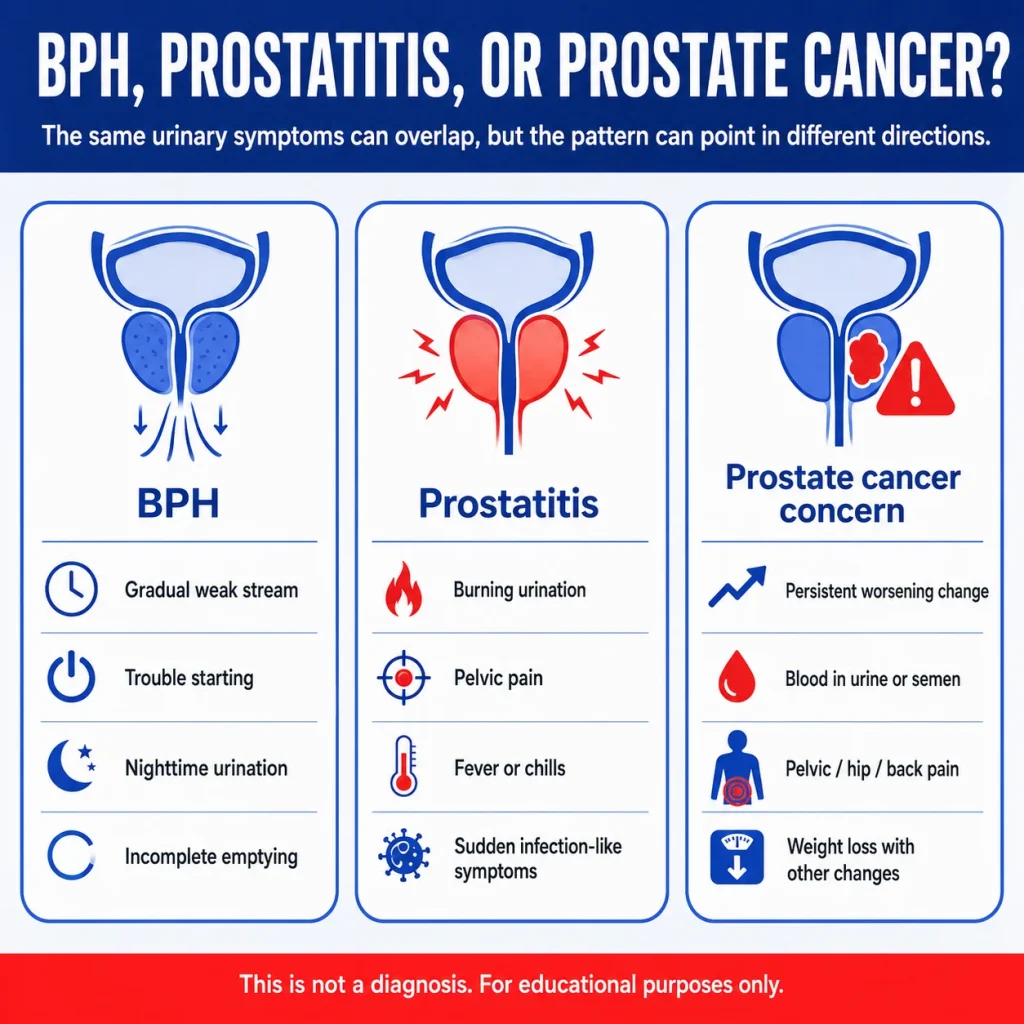
The prostate surrounds the urethra just below the bladder. Enlargement, swelling, or disease in that area can affect urine flow, but similar symptoms can also develop from bladder conditions, urinary tract infections, stones, medications, or nerve problems. The National Cancer Institute’s overview of prostate changes emphasizes that prostatitis, benign prostatic hyperplasia (BPH), and prostate cancer are separate conditions even though their symptoms may overlap.
Weak flow, difficulty starting, urgency, frequent urination, waking at night, and a feeling that the bladder has not emptied are therefore not cancer-specific. In fact, the CDC notes that most men with prostate cancer have no symptoms, and early-stage disease often causes no noticeable urinary change. Gradual obstructive symptoms are commonly associated with BPH, but persistent or worsening symptoms still need an evaluation rather than an assumption.
Symptoms More Commonly Associated With BPH
BPH is a noncancerous enlargement of the prostate. As the gland grows, it can narrow the urethra and make the bladder work harder to move urine. According to NIDDK guidance on benign prostatic hyperplasia, the typical pattern is lower urinary tract obstruction or irritation that develops gradually.
• Difficulty starting urination or needing to strain
• A weak, slow, or interrupted urine stream
• Dribbling after urination
• Frequent or urgent urination
• Waking repeatedly at night to urinate
• Feeling that the bladder has not emptied completely
BPH does not turn into prostate cancer and is not considered a prostate-cancer risk factor. However, both conditions can exist in the same patient. A familiar “enlarged prostate” diagnosis should not be used to explain away a new change, visible bleeding, progressive blockage, or symptoms that no longer follow the usual pattern.
Symptoms That May Point More Toward Prostatitis
Prostatitis involves inflammation of the prostate and may or may not be caused by a bacterial infection. Pain, burning, fever, or a sudden change in how you feel can make prostatitis more likely than uncomplicated BPH, although testing is still needed to determine the cause.
A Sudden Infection-Like Pattern
Acute bacterial prostatitis can begin quickly. The NIDDK prostatitis guidance describes symptoms such as fever, chills, body aches, painful or burning urination, urgency, nausea, pelvic or lower-back pain, and difficulty starting or emptying the bladder. This pattern deserves prompt medical assessment because a prostate or urinary infection can worsen, obstruct urine flow, or spread beyond the urinary tract.
Burning alone is not specific to the prostate. Angleton ER’s guide to painful urination explains other causes that may need to be considered, including bladder infection, stones, irritation, and structural urinary problems.
A Persistent Pelvic-Pain Pattern
Longer-lasting prostatitis or chronic pelvic pain may cause recurring discomfort in the groin, lower abdomen, lower back, penis, scrotum, or the area between the scrotum and anus. Pain during or after ejaculation may occur, sometimes along with urinary frequency, urgency, or a weak stream. A chronic pain pattern may not be an emergency when symptoms are stable, but it still warrants primary-care or urology follow-up.
Fever, chills, vomiting, rapidly worsening pain, pronounced weakness, or increasing difficulty urinating changes the level of concern. Those symptoms are not typical of simple, gradual BPH and should be assessed more quickly.
Which Symptoms Still Raise Prostate Cancer Concern?
Urinary symptoms cannot confirm prostate cancer, and many men with prostate cancer have no symptoms. Even so, a change that persists, progresses, or cannot be readily explained deserves evaluation, particularly when it is accompanied by bleeding or pain outside the usual lower-urinary pattern.
• Progressive difficulty urinating or a steadily weakening stream
• Blood in the urine or semen
• Persistent pelvic discomfort
• Pain in the back, hips, or pelvis that does not resolve
• Unexplained fatigue, appetite loss, or weight loss occurring with other concerning changes
The NCI notes that early-stage prostate cancer usually does not cause symptoms, while more advanced local disease may cause urinary bleeding or pain in the back, hips, or pelvis. These symptoms are still not proof of cancer; they are reasons to identify the cause through appropriate examination and follow-up.
Blood in the Urine Should Not Be Assigned to the Prostate Without Evaluation
Blood in the urine, called hematuria, may occur with prostate enlargement or prostatitis, but it can also begin in the bladder, kidneys, ureters, or urethra. Infection, stones, kidney disease, injury, medications, and urinary-tract cancers are among the possibilities listed in the NIDDK overview of hematuria. Urine color cannot show where the bleeding started.
Visible blood should be medically evaluated even if it occurs once or then disappears. Angleton ER’s focused blood-in-the-urine guide covers hematuria causes and testing in more detail; the key point here is not to label the bleeding as “just the prostate” without assessment.
• Seek faster assessment when blood is accompanied by clots, difficulty or inability to urinate, severe pain, fever, chills, weakness, or vomiting.
• Do not rely on red or brown urine alone to determine that blood is present; foods and medicines can change urine color, while microscopic blood may not be visible.
• Do not delay evaluation because the bleeding was painless. Painless hematuria can still require a structured urinary-tract workup.
When Urinary Symptoms Need Emergency Care
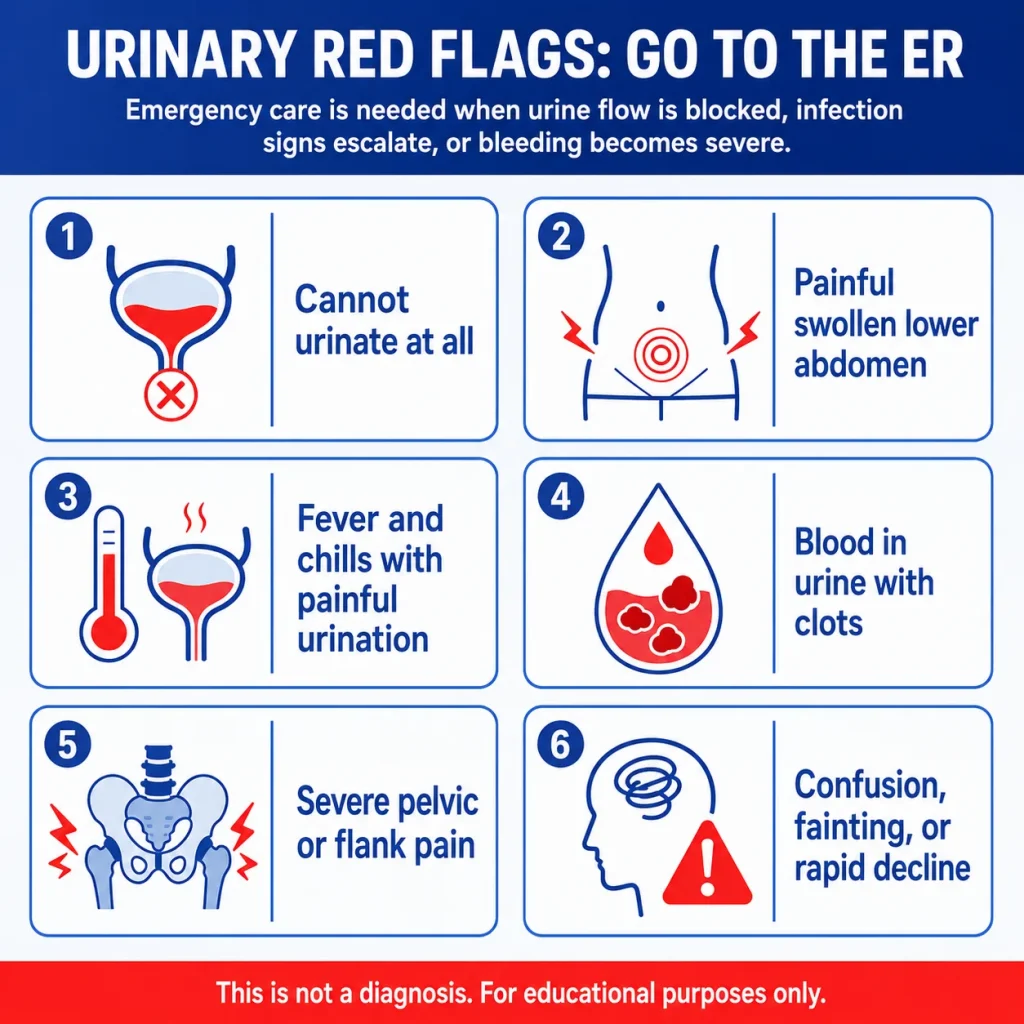
Seek Emergency Evaluation For:
• A complete inability to urinate
• A painfully swollen or severely uncomfortable lower abdomen with little or no urine output
• Painful, frequent, or urgent urination accompanied by fever and chills
• Blood in the urine with clots or inability to pass urine
• Severe pelvic, lower-abdominal, flank, or urinary-tract pain
• Confusion, fainting, pronounced weakness, or rapidly worsening illness
Acute urinary retention means the bladder is full but urine cannot be passed. It can cause severe pain and requires immediate treatment. Fever and chills with painful urinary symptoms can indicate a significant infection rather than uncomplicated BPH. Angleton ER’s guidance on when a UTI needs emergency care provides more detail on infection red flags such as vomiting, dehydration, severe pain, and systemic illness.
Arrange Timely Medical Follow-Up For:
A weakening stream, increasing nighttime urination, persistent urgency, difficulty starting, incomplete emptying, recurring pelvic discomfort, painful ejaculation, or another urinary change that continues or worsens should be discussed with a primary-care clinician or urologist. A scheduled visit is also appropriate for screening questions, stable PSA concerns, and long-term management of BPH or chronic prostatitis symptoms.
How Doctors Distinguish Prostate Cancer, BPH, and Prostatitis
The distinction comes from the full clinical picture, not one symptom or one blood test. Evaluation may include:
• The timing, progression, and severity of urinary or pain symptoms
• A review of medications, prior infections, procedures, and medical history
• A physical examination, which may include a prostate examination
• Urinalysis or urine culture when infection or bleeding is possible
• Blood testing, which may include prostate-specific antigen (PSA)
• Measurement of urine remaining in the bladder after urination
• Imaging, urology referral, or biopsy when the findings justify those steps
The NIDDK summary of prostate tests explains how urine tests, physical examination, ultrasound, and other testing may be used depending on the problem being investigated. No single test is automatically required for every patient.
PSA is not a stand-alone cancer diagnosis. The National Cancer Institute’s PSA fact sheet notes that prostate cancer, BPH, and prostatitis can all raise PSA. The result must be interpreted alongside age, symptoms, examination findings, prior PSA values, recent infection or prostate irritation, and any follow-up testing a clinician recommends.
Urgent Urinary Symptoms in Angleton
For men in Angleton and nearby Brazoria County communities, complete urinary blockage, severe lower-abdominal pressure, blood in the urine with difficulty urinating, or fever and chills with painful urinary symptoms should not wait for a routine appointment. Angleton ER provides 24/7 emergency evaluation for urgent urinary problems, including assessment for retention, infection, bleeding, dehydration, and other immediate complications. On-site lab testing and imaging are available when medically appropriate as part of the emergency plan of care. Stable but persistent symptoms still need follow-up through primary care or urology, where longer-term prostate evaluation and cancer diagnosis can be completed.
Frequently Asked Questions
Are weak urine flow and nighttime urination more likely to be BPH or prostate cancer?
They are more commonly associated with BPH, especially when they develop gradually. However, the same symptoms can occur with prostatitis, bladder problems, medication effects, and occasionally prostate cancer, so a persistent or worsening change should be evaluated.
Can prostate cancer cause urinary symptoms in its early stages?
Usually, early prostate cancer causes no symptoms. Urinary difficulty can occur, but it is not specific enough to identify cancer and is often caused by BPH or another urinary condition.
Does BPH increase the risk of developing prostate cancer?
No. BPH is a benign condition and does not increase prostate-cancer risk. A man can still have both conditions at the same time, which is why new or changing symptoms should not automatically be attributed to an existing BPH diagnosis.
Can prostatitis cause an elevated PSA result?
Yes. Inflammation or infection of the prostate can raise PSA, as can BPH and other prostate irritation. Clinicians interpret PSA in context and may recommend repeat testing or further evaluation after an acute problem has been addressed.
Should blood in the urine be treated as an emergency?
Visible blood should always be medically evaluated, but the urgency depends on accompanying symptoms. Go for emergency assessment when there are clots, inability to urinate, severe pain, fever or chills, fainting, marked weakness, or rapidly worsening illness.
Can a man have BPH and prostate cancer at the same time?
Yes. BPH and prostate cancer are separate conditions, but they can coexist. Symptoms and PSA values may overlap, so examination and appropriate follow-up testing are needed to determine what is happening.