
A cough is easy to explain away after a cold or when allergies, smoking, reflux, asthma, or another lung condition affects breathing. The key question is whether it is new, changing, failing to improve, or appearing with blood, chest symptoms, breathlessness, or other concerning changes.
Many coughs have common non-cancer causes. MedlinePlus lists respiratory infections, allergies, asthma, COPD, reflux, and smoking among possible causes of cough. Still, lung cancer can also cause a cough that worsens or does not go away, along with chest pain, shortness of breath, wheezing, coughing blood, fatigue, or unexplained weight loss, according to CDC lung cancer symptom guidance. Symptoms alone cannot establish the cause, but the pattern can show when follow-up—or emergency care—should not wait.
For broader changes beyond the lungs, see Angleton ER’s guide to cancer warning signs and when to seek care. Here, the focus is cough, chest symptoms, breathing changes, and whether care is urgent.
When a Persistent Cough Deserves Medical Evaluation
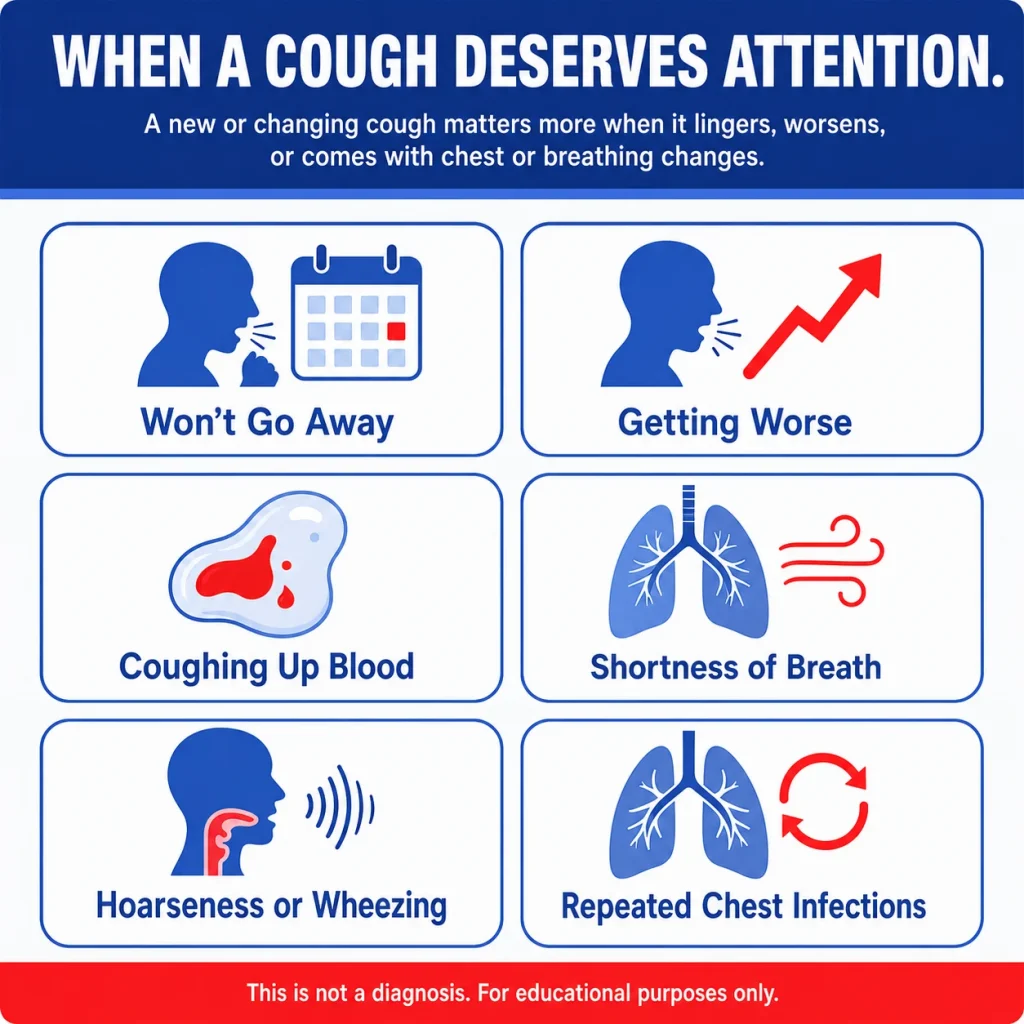
A new cough that lingers, repeatedly returns, or has no clear explanation deserves a medical review. The same is true when coughing is becoming more frequent, more forceful, or disruptive enough to interrupt sleep, work, exercise, or ordinary conversation. There is no single duration that confirms or excludes lung cancer; what matters is whether the symptom is following an expected recovery pattern or continuing without improvement.
A clinician may consider recent infections, allergy symptoms, reflux, asthma, medication effects, smoking or vaping exposure, occupational irritants, and chronic lung disease. Cancer is one possibility among many, not the default assumption. Evaluation becomes more important when the cough is accompanied by blood, progressive breathlessness, chest discomfort, hoarseness, repeated chest infections, loss of appetite, weight loss, or a clear decline in stamina.
Changes in a Chronic or “Smoker’s” Cough Should Not Be Dismissed
People who smoke, have COPD, work around dust or chemicals, or live with another respiratory condition may be used to coughing. Familiarity can make a meaningful change easy to overlook. A known reason for a chronic cough does not automatically explain a cough that suddenly sounds deeper, occurs more often, becomes painful, produces blood, or starts limiting breathing.
Reassessment is also reasonable when a chronic cough appears with new hoarseness, wheezing that is not typical for you, increasing fatigue, appetite or weight loss, or infections that keep returning. The American Cancer Society includes a worsening cough, hoarseness, new wheezing, and bronchitis or pneumonia that does not clear or keeps returning among lung cancer signs and symptoms that warrant medical attention.
Coughing Up Blood Requires Prompt Attention
Blood may appear as thin streaks in mucus, rust-colored sputum, or a larger amount of bright red blood. The medical term is hemoptysis, and MedlinePlus explains that it refers to blood or bloody mucus coming from the respiratory tract. Lung cancer is only one possible cause; infections, irritated airways, blood clots, and other lung conditions can also produce this symptom.
Even a small unexplained or recurring streak should be medically evaluated. Seek emergency care when the bleeding is more than a small streak, is increasing, does not stop, or occurs with shortness of breath, severe chest pain, dizziness, fainting, confusion, or marked weakness. Do not wait to determine whether cancer is responsible—the immediate concern is breathing, blood loss, and the possibility of another urgent lung or heart problem.
Chest and Breathing Symptoms That Can Occur With a Persistent Cough
A persistent or changing cough carries more weight when other chest or breathing symptoms develop at the same time. These symptoms do not identify a tumor or prove cancer, but they help determine how quickly evaluation is needed.
• Ongoing chest discomfort, pressure, or a new sense of heaviness
• Pain that becomes sharper with coughing or a deep breath
• New or progressively worsening shortness of breath
• Wheezing without a familiar trigger or explanation
• Persistent hoarseness or a noticeable voice change
• Bronchitis, pneumonia, or similar chest symptoms that return after treatment or do not resolve as expected
Chest pain has many possible causes, including heart emergencies, blood clots, infection, inflammation, and muscle strain. Severe pressure, crushing pain, or chest symptoms with sweating, nausea, fainting, or significant breathlessness require urgent assessment. Angleton ER’s chest pain emergency guidance explains when chest symptoms should be treated as time-sensitive rather than watched at home.
When Other Changes Strengthen the Need for Follow-Up
Lung cancer concern is rarely based on one isolated symptom. A cough or breathing change deserves closer follow-up when it is paired with unexplained loss of weight or appetite, increasing fatigue or weakness, reduced ability to complete usual activities, repeated fever or respiratory infections, or persistent discomfort in the shoulder, upper back, or chest area.
These combinations still have many possible explanations. Their value is in showing that the problem may be affecting more than one part of daily function and is not settling in the expected way. The location of pain cannot tell you where a lung tumor is, and no symptom cluster can replace imaging, examination, or tissue testing.
When Breathing or Chest Symptoms Need Emergency Care
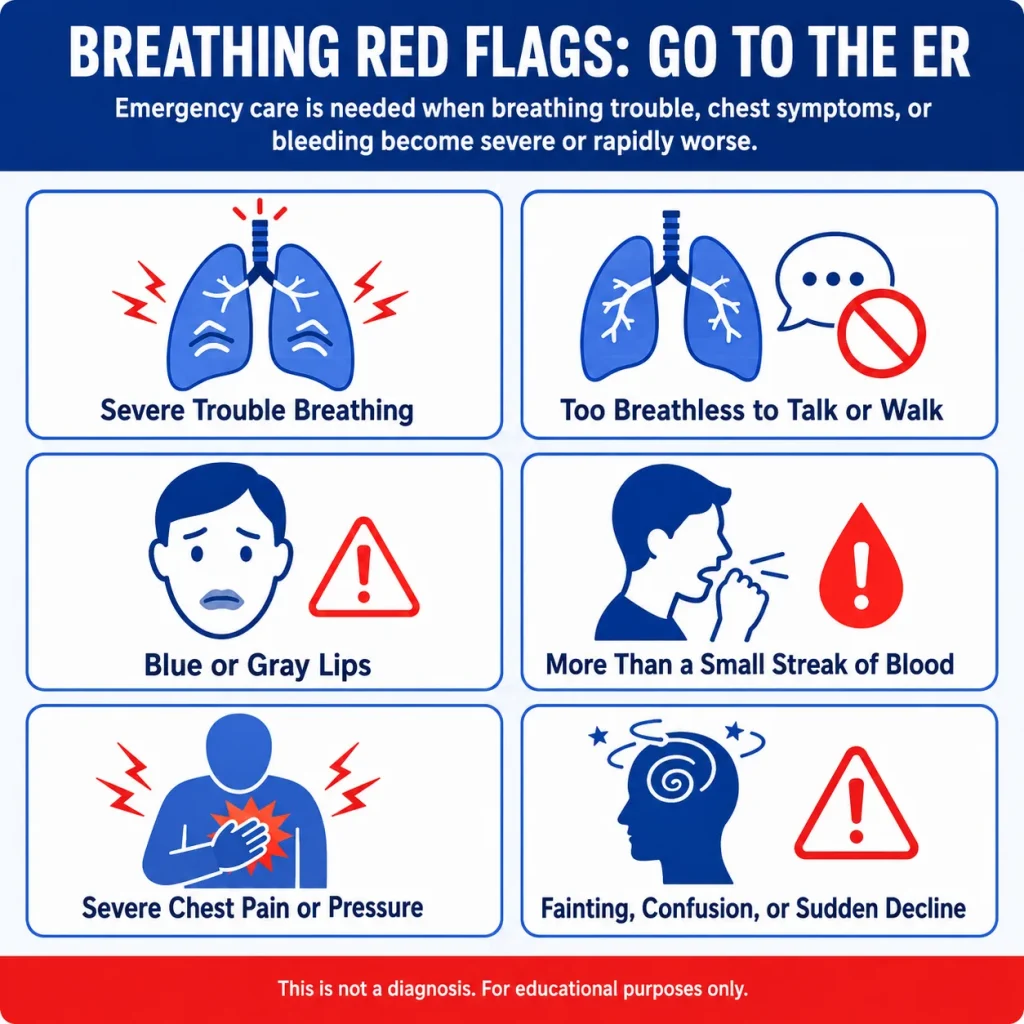
Seek emergency evaluation for:
• Severe or rapidly worsening difficulty breathing
• Breathlessness that makes it hard to speak comfortably or walk a short distance
• Blue or gray lips, face, or fingertips
• Coughing up more than a small streak of blood, or bleeding that is increasing
• Coughing blood with dizziness, fainting, confusion, or severe weakness
• Severe chest pain, crushing pressure, or chest symptoms with sweating or nausea
• Collapse, confusion, unusual sleepiness, or a sudden decline in alertness
• Breathing problems with high fever, rapidly worsening illness, or other signs of a serious infection
MedlinePlus first-aid guidance for breathing difficulty identifies rapid breathing, difficulty speaking, bluish lips or fingers, confusion, chest pain, and coughing blood among concerning signs. Its medical-emergency guidance also lists breathing problems, chest discomfort, coughing blood, fainting, and mental-status changes as reasons for urgent action.
Arrange timely medical follow-up for:
A cough that persists or changes, recurring blood-streaked mucus, unexplained hoarseness, repeated respiratory infections, ongoing chest discomfort, progressive breathlessness, or respiratory symptoms accompanied by weight loss or fatigue should be assessed even when the person is stable. Emergency decisions should be based on current severity—not on whether lung cancer has already been diagnosed.
What Medical Evaluation May Involve
Evaluation usually begins with a symptom timeline and questions about smoking or vaping, secondhand smoke, occupational exposures, prior lung disease, recent infections, medicines, and changes in activity tolerance. A clinician may check vital signs, oxygen level, breathing effort, lung sounds, and whether the patient appears dehydrated, infected, anemic, or unstable.
Testing is selected according to the current problem. Chest X-ray or CT imaging may help identify pneumonia, fluid around a lung, a collapsed lung, a mass, bleeding, or another urgent chest abnormality. Laboratory testing may help evaluate infection, anemia, organ stress, or other complications. A scan can reveal a concerning finding, but it may not confirm—or completely exclude—lung cancer during one emergency visit. Angleton ER’s article on what CT, ultrasound, and MRI can and cannot show about cancer explains those limits in more detail.
When lung cancer is suspected, the diagnostic pathway may include chest imaging, specialist review, and a biopsy. The American Cancer Society notes that the actual diagnosis is made by examining a sample of lung cells in a laboratory. Suspicious findings may therefore lead to outpatient imaging, pulmonology referral, bronchoscopy, or another tissue-sampling procedure.
Emergency Evaluation at Angleton ER for Serious Chest or Breathing Symptoms
For patients in Angleton, Lake Jackson, Clute, Danbury, Richwood, West Columbia, and nearby communities, severe breathlessness, significant coughing of blood, intense chest pain, confusion, fainting, or rapidly worsening respiratory symptoms should not wait for a scheduled appointment. Angleton ER provides 24/7 emergency evaluation for serious chest and breathing concerns, with oxygen assessment, stabilization, on-site laboratory testing, and emergency imaging when medically indicated. If symptoms appear life-threatening or it is unsafe to drive, call 911.
Frequently Asked Questions
How long should a cough last before it needs medical evaluation?
There is no universal cutoff that diagnoses or rules out lung cancer. A cough should be checked when it is not improving as expected, keeps returning, changes noticeably, or begins interfering with sleep or normal activity. Blood, worsening breathlessness, severe chest pain, fainting, confusion, or blue-gray skin coloring requires urgent evaluation regardless of duration.
Can lung cancer cause a cough without chest pain?
Yes. Lung cancer symptoms vary, and a person may have a persistent or worsening cough without chest pain. Other possible symptoms include shortness of breath, wheezing, hoarseness, coughing blood, fatigue, appetite loss, weight loss, or repeated chest infections.
Is blood-streaked mucus always a sign of lung cancer?
No. Infection, airway irritation, blood clots, and other lung conditions can also cause blood-streaked mucus. An unexplained or recurring streak still needs medical evaluation, and heavier or increasing bleeding—especially with breathing difficulty, chest pain, dizziness, or weakness—should be treated as an emergency.
Can lung cancer symptoms resemble pneumonia or bronchitis?
Yes. Cough, chest discomfort, shortness of breath, fatigue, fever, and changes on chest imaging can overlap with respiratory infections. Follow-up becomes especially important when an infection does not clear as expected, symptoms return after treatment, or a cough keeps changing.
Can a person who has never smoked develop lung cancer symptoms?
Yes. People who have never smoked can develop lung cancer, and CDC states that the symptoms are the same whether or not a person has smoked. A smoking history can affect risk, but it should not be used to dismiss a persistent cough, coughing blood, chest symptoms, or progressive breathlessness.
Can an ER diagnose lung cancer during one visit?
Sometimes an ER scan reveals a mass or another finding that raises concern, but a final diagnosis often cannot be completed in one visit. Emergency care focuses on oxygenation, bleeding, infection, chest pain, respiratory distress, and other immediate threats. Definitive diagnosis may require specialist review, additional imaging, bronchoscopy, or biopsy after the urgent problem has been addressed.