
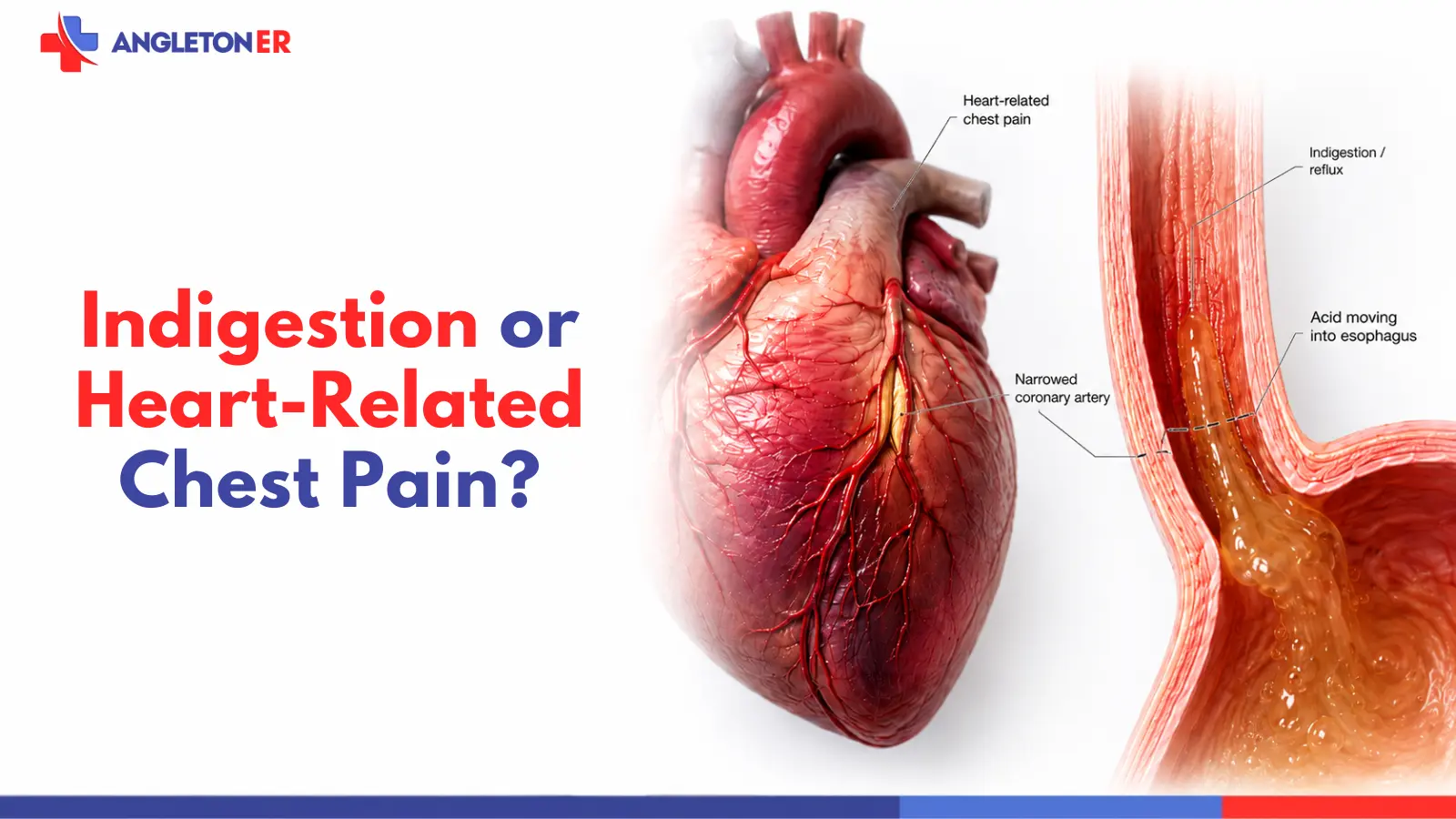
Chest or upper-abdominal discomfort can create a difficult question: is this something digestive, or could it be coming from the heart? The problem is that the sensations can overlap. The American Heart Association explains that heartburn and heart-related chest discomfort can be difficult to distinguish, which is why a familiar-sounding symptom should not automatically be treated as proof of a harmless cause.
The safest way to think about this is not to search for one perfect symptom. A burning feeling, a meal-related episode, belching, or even temporary improvement may offer clues, but none of those details can reliably rule out a heart problem when the overall pattern is concerning. New, unexplained, changing, or exertional discomfort deserves more caution than a symptom that is truly unchanged from a previously evaluated digestive pattern.
Why Indigestion and Heart-Related Chest Pain Can Be Confusing
The chest and upper abdomen are close enough that people do not always experience symptoms in neat categories. Digestive discomfort may be felt behind the breastbone or in the upper abdomen. Heart-related symptoms may also be described as pressure, fullness, burning, nausea, or an “upset stomach” rather than dramatic pain.
That overlap matters because false reassurance can delay care. Someone may think, “This feels like something I ate,” while the more important clue is that the discomfort is new, occurs with activity, or arrives with sweating, breathlessness, weakness, or lightheadedness. The goal is not to label every episode as cardiac; it is to avoid using a digestive explanation as a shortcut when the pattern has not been medically established.
What May Point More Toward Indigestion?
The National Institute of Diabetes and Digestive and Kidney Diseases describes indigestion as upper-abdominal pain, burning, or discomfort that may occur with early fullness, bloating, nausea, or belching. Reflux can create a different but related pattern: NIDDK notes that GERD commonly causes heartburn and regurgitation, including a burning feeling behind the breastbone and an acidic or food-like sensation moving back toward the throat.
• Burning or discomfort that repeatedly follows a familiar meal-related pattern.
• Upper-abdominal or chest discomfort accompanied by belching, bloating, or an acidic taste.
• Symptoms that closely resemble a digestive pattern that has been previously recognized and evaluated.
Important guardrail: these features can lean digestive, but they do not prove the heart is uninvolved. If the episode is new, different, unexplained, or paired with concerning symptoms, the comparison should stop being a home diagnosis exercise.
What Makes Chest Discomfort More Concerning for a Heart Problem?
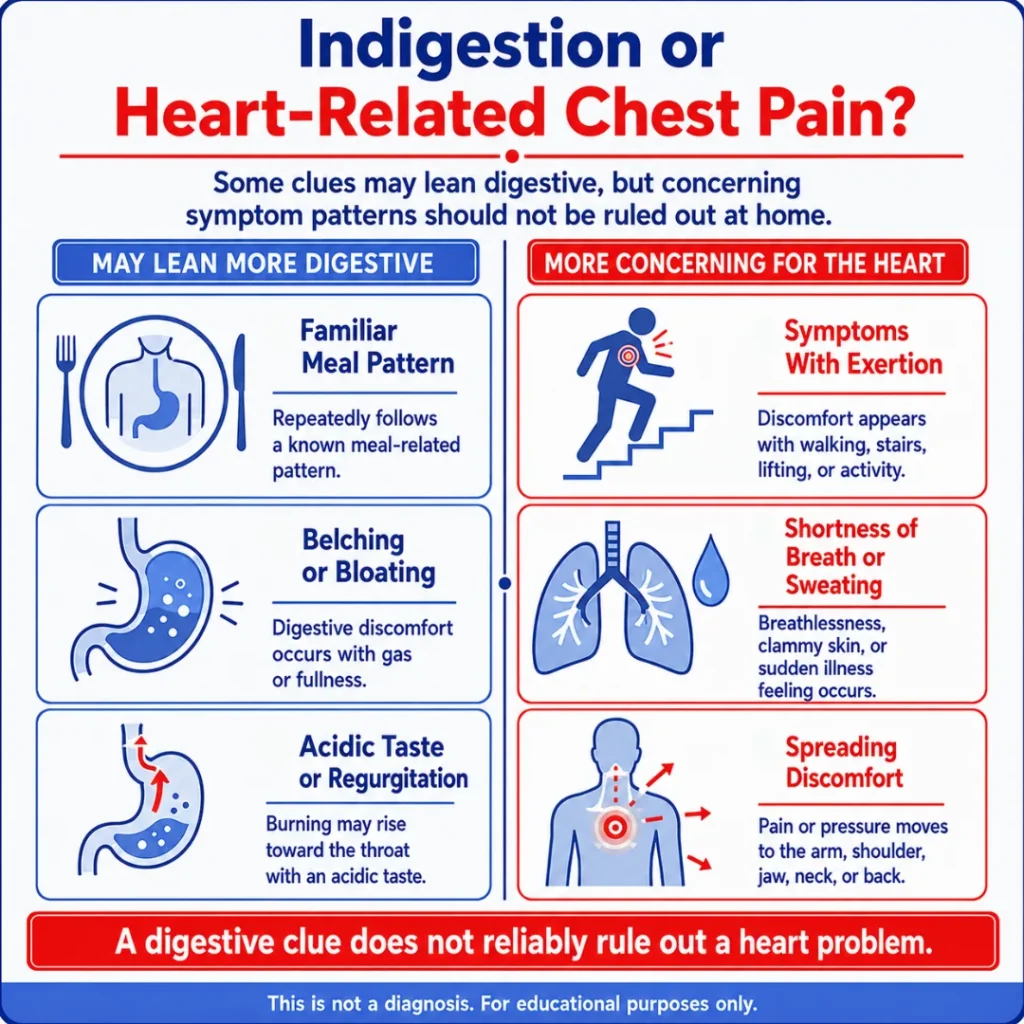
Instead of asking only where the discomfort is located or whether it burns, look at the whole symptom pattern. The American Heart Association lists chest discomfort, shortness of breath, upper-body discomfort, cold sweat, nausea, and lightheadedness among heart-attack warning signs. Heart-related discomfort can also involve the stomach or upper abdomen.
• Shortness of breath, especially if it is new or out of proportion to what you are doing.
• Sweating, clammy skin, nausea, or a sudden sense of being unwell.
• Lightheadedness, faintness, or unusual weakness.
• Discomfort spreading to the arm, shoulder, jaw, neck, back, or another upper-body area.
• Symptoms that appear with walking, stairs, lifting, or other exertion.
• A pattern that is new, worsening, recurring differently, or clearly unlike your usual indigestion.
None of these is a stand-alone diagnostic test. They are warning context. NHLBI notes that heart-attack symptoms can begin slowly, can be mild, and can vary from person to person. That is why waiting for “crushing” chest pain can create a false sense of safety.
If you want more background on the disease process that can reduce blood flow to the heart, Angleton ER’s guide to coronary heart disease covers that topic in more depth without changing the immediate decision here: uncertain chest symptoms still require clinical judgment.
Why One Symptom Usually Cannot Settle the Question
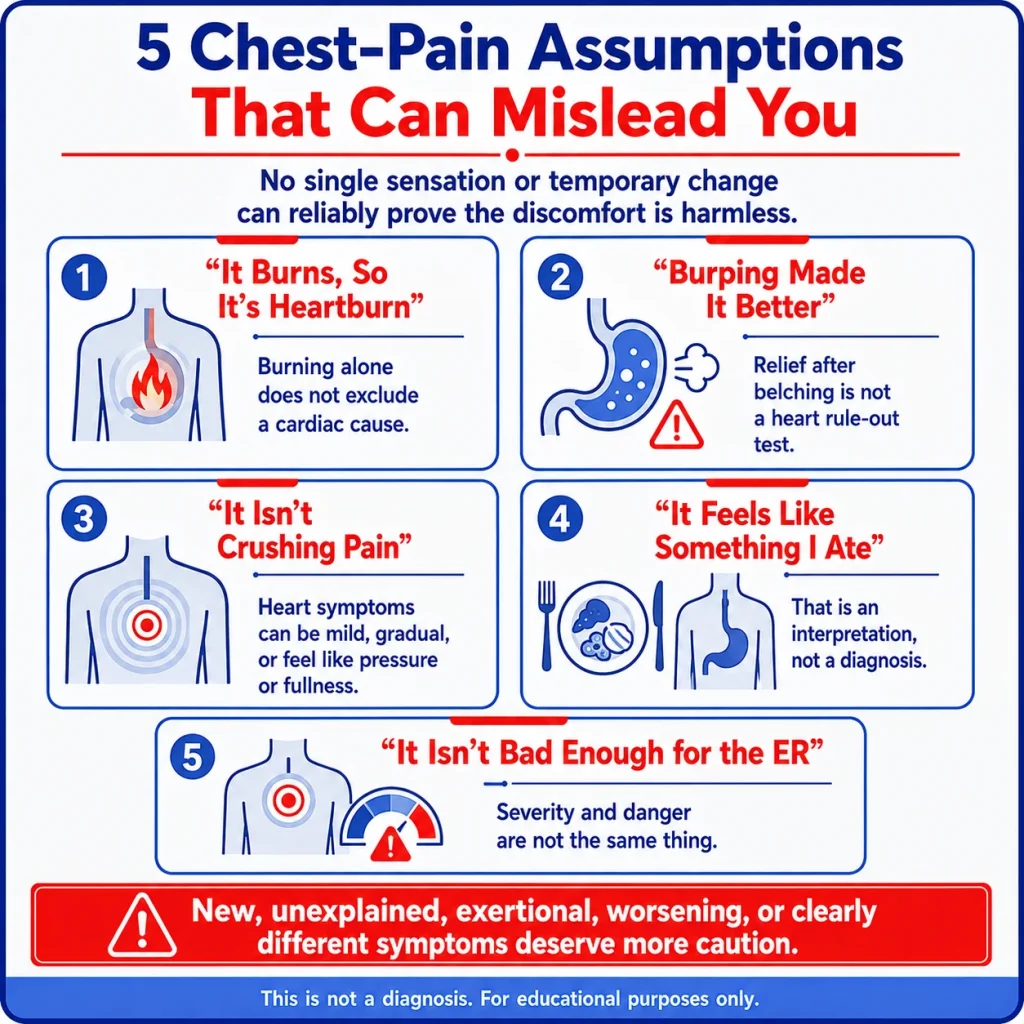
People naturally look for a single feature that will settle the issue. Unfortunately, several popular rules are too simple to be safe.
• “It burns, so it must be heartburn.” Burning can occur with reflux, but the quality of the sensation alone does not exclude a cardiac cause.
• “I burped and felt better, so it cannot be my heart.” Belching may support a digestive explanation, but symptom relief after burping is not a validated rule-out test for a heart problem.
• “I do not have crushing chest pain.” Heart attacks do not always present with severe pain. Mild pressure, fullness, upper-abdominal discomfort, nausea, or breathlessness can be part of the presentation.
• “It feels like something I ate.” That may be true, but it is still an interpretation rather than a diagnosis when the episode is new or unusual.
• “It is not bad enough to be an emergency.” Severity and danger are not the same thing. Some serious cardiac events begin with less dramatic symptoms.
MedlinePlus specifically notes that heart-attack discomfort can feel like heartburn or indigestion. The more reliable takeaway is this: the way discomfort feels may provide clues, but the overall pattern and clinical evaluation determine what is actually happening.
What If You Have Had Indigestion Before?
A history of reflux or indigestion can make a new episode easier to dismiss because the brain reaches for the explanation it already knows. The key question is not simply whether you have had indigestion before; it is whether this episode is genuinely the same as your usual pattern.
Is This Actually Your Usual Pattern?
Think about what has been consistent in the past: where the discomfort starts, what usually triggers it, what other digestive symptoms come with it, and how the episode typically behaves. Familiarity can be useful only when the current symptoms truly match that established baseline.
What Is Different This Time?
A meaningful change should carry more weight than the fact that you have experienced indigestion before. New exertional discomfort, stronger or longer-lasting symptoms, shortness of breath, sweating, faintness, unusual weakness, pain spreading beyond the chest, or a general sense that the episode is unlike your normal digestive symptoms are reasons not to keep testing the theory at home.
How Emergency Evaluation Helps Tell the Difference
There is no dependable home test that can answer “indigestion or heart attack?” Emergency evaluation works differently: clinicians combine the symptom story with the person’s medical history, vital signs, examination, and targeted testing.
The AHA/ACC chest-pain guideline emphasizes structured evaluation of acute chest pain and chest-pain equivalents and identifies high-sensitivity cardiac troponin as the preferred biomarker for detecting heart-muscle injury. Depending on the situation, an emergency assessment may include an EKG/ECG, blood testing such as troponin, and other testing when the clinical picture warrants it.
The point is not that every person with indigestion-like discomfort needs every cardiac test. The point is that clinicians have tools to evaluate risk and look for objective evidence; the sensation alone cannot do that work.
When Chest or Indigestion-Like Symptoms Should Not Wait
Emergency evaluation becomes especially important when chest or upper-abdominal discomfort is new, unexplained, worsening, associated with exertion, or clearly different from your usual digestive pattern. The same is true when discomfort occurs with shortness of breath, sweating, nausea, faintness, unusual weakness, or pain involving the arm, shoulder, jaw, neck, or back.
Do not wait for severe pain to prove that the situation is serious. If you think you may be having a heart attack, call 911. The American Heart Association advises emergency action even when you are not sure the symptoms are a heart attack. For a broader local decision guide, Angleton ER also explains when chest pain warrants ER evaluation.
Emergency Evaluation in Angleton When the Cause Is Unclear
For people in Angleton and nearby Brazoria County communities, Angleton ER provides 24/7 cardiac emergency evaluation for chest pain and heart-related symptoms. Based on the ER physician’s assessment, evaluation may include an EKG, cardiac lab testing, imaging, monitoring, medication, or stabilization when medically appropriate. If your symptoms may represent a heart attack or feel severe or life-threatening, call 911 rather than trying additional digestive remedies at home to see whether the symptoms change.
Frequently Asked Questions
Can a heart attack feel like indigestion or heartburn?
Yes. Heart-attack discomfort can sometimes be described as indigestion, heartburn, pressure, fullness, or upper-abdominal discomfort. Because the overlap can be substantial, a new or unexplained episode should not be labeled digestive based on sensation alone.
Can heart-related discomfort feel like an upset stomach?
Yes. Nausea, upper-abdominal discomfort, and an upset-stomach feeling can occur with heart-related symptoms, sometimes with chest discomfort and sometimes alongside other warning signs such as sweating or shortness of breath.
Does burping or having gas mean chest discomfort is not from the heart?
No. Burping or gas can fit a digestive pattern, but they do not reliably rule out a cardiac problem. The overall pattern, associated symptoms, and medical evaluation matter more than one digestive clue.
Can heart-related chest discomfort be mild rather than severe?
Yes. Heart-attack symptoms can be mild, develop gradually, or come and go. You do not need crushing pain before a new or concerning symptom pattern deserves emergency attention.
What if I regularly have indigestion but this episode feels different?
Treat the change from your baseline as meaningful. New exertional symptoms, unusual weakness, sweating, breathlessness, faintness, spreading discomfort, or a clearly different pattern should not be assumed to be your usual indigestion.
When should indigestion-like chest discomfort be evaluated as an emergency?
Seek emergency evaluation when the discomfort is new, unexplained, worsening, exertional, significantly different from your normal pattern, or accompanied by shortness of breath, sweating, nausea, faintness, weakness, or upper-body pain. If you think you may be having a heart attack, call 911.