
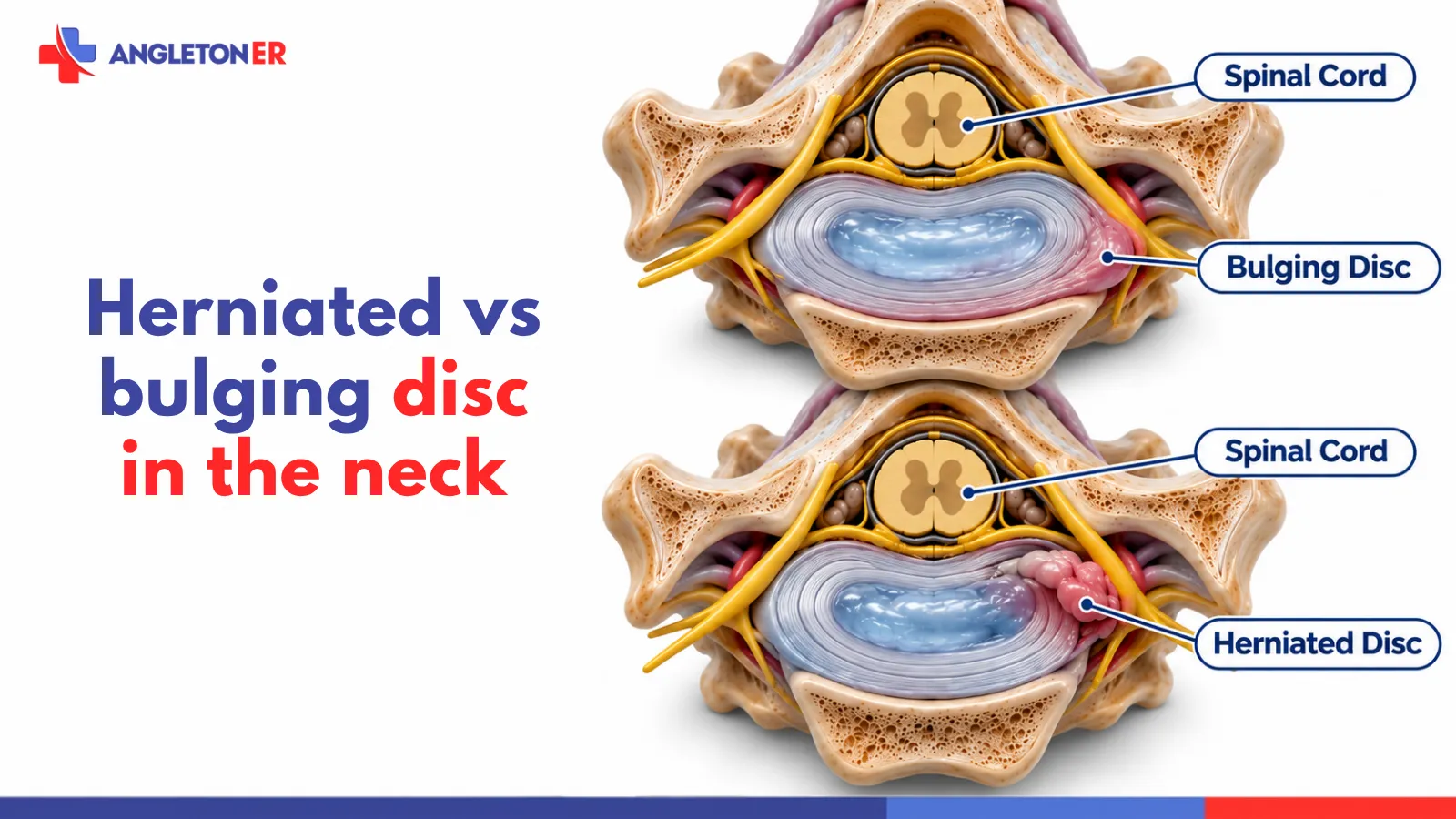
You open a cervical spine MRI report and see “disc bulge” or “disc herniation.” Both phrases can sound alarming, especially if your neck already hurts. But the wording describes how a disc looks on a scan; it does not, by itself, measure pain, establish nerve damage, or tell you whether emergency treatment is needed.
The next questions are where the disc finding sits, whether it affects nearby nerves, and whether it matches your symptoms. New weakness, altered sensation, or a change in how you move may matter more than the label on the report.
What Is the Difference Between a Herniated and Bulging Disc in the Neck?
The cervical spine contains discs between its vertebrae. These flexible structures help cushion movement and distribute forces. A bulge and a herniation both involve disc tissue extending beyond its usual boundary, but they describe different shapes of displacement.
What Is a Bulging Disc in the Neck?
A bulging disc extends more broadly around part of the disc’s outer edge. This may accompany age-related wear, but the word “bulge” does not tell you whether a nerve is compressed. A person may have pain, or discover a bulge incidentally without symptoms.
What Is a Herniated Disc in the Neck?
A herniated disc describes a more localized area of displaced disc material. Its position and size determine whether it contacts nearby nerve structures. A herniation may cause symptoms or none at all. The AO Foundation’s cervical disc reference distinguishes a broad bulge from focal protrusions and extrusions without treating every herniation as a complete rupture.
Is a Herniated Disc Always Worse Than a Bulging Disc?
No. A small herniation in a sensitive location may cause substantial arm symptoms, while a larger-looking bulge may cause none. The reverse can also occur. Clinicians consider location, nerve pressure, examination findings, and function rather than automatically ranking one term as more severe.
How Do Bulging and Herniated Discs Appear on Imaging Reports?
Understanding Common MRI Terms
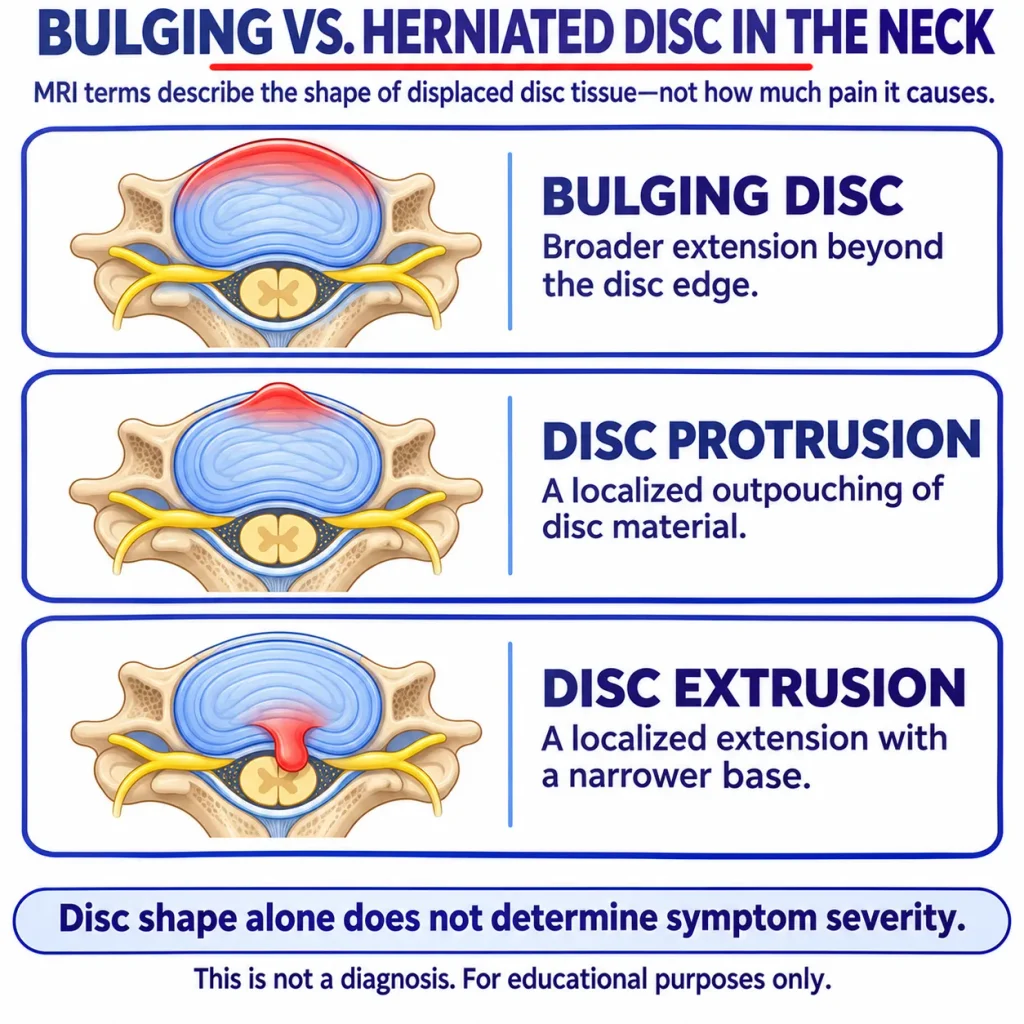
A cervical report may describe a “disc bulge,” “disc protrusion,” or “disc extrusion.” A bulge is the broader extension; a protrusion and an extrusion are two forms of more localized herniation, differentiated by their shape. These are imaging descriptions, not separate measures of pain. The University of Washington’s radiology terminology guide illustrates those distinctions.
Other phrases describe nearby anatomy. “Nerve-root contact” means the disc reaches a nerve; “compression” indicates pressure or displacement. “Spinal canal narrowing” refers to reduced space around the spinal cord. A report may list several changes at different levels, and not all of them necessarily explain a person’s symptoms.
Why the Location of the Disc Finding Matters
Doctors look at which neck level is involved, whether tissue extends centrally or toward one side, and which nerve structures lie nearby. A finding near an exiting nerve root may correspond with arm symptoms; a central finding can raise different questions about the spinal cord. Because symptoms and scans do not always match, identifying the responsible level requires clinical interpretation.
Can a Bulging or Herniated Disc Cause Neck and Arm Symptoms?
Neck Pain and Stiffness
Either finding may occur alongside neck soreness, stiffness, or discomfort when turning the head. Yet muscles, joints, and other structures can also produce neck pain. Finding a disc abnormality does not prove it is the source of every ache.
Pain, Tingling, or Numbness Traveling Into the Arm
A cervical nerve root that is irritated or compressed can produce pain that travels toward the shoulder, arm, or hand. People may describe burning or shooting pain, pins and needles, numbness, or altered touch. The American Academy of Orthopaedic Surgeons’ explanation of cervical radiculopathy describes why clinicians compare these symptoms with strength, sensation, and reflex testing rather than relying on the MRI alone.
Weakness or Changes in Arm Function
Pain is different from a new inability to use a limb normally. If grip strength declines, an arm becomes difficult to lift, or ordinary tasks suddenly become harder, arrange prompt medical assessment. New or progressively worsening weakness is more concerning than stable discomfort without loss of function.
Why Can Someone Have a Disc Bulge or Herniation Without Symptoms?
Imaging Findings Do Not Always Explain Pain
An MRI records anatomy, including changes that have not caused symptoms. A study of cervical MRI findings in symptom-free volunteers documented disc bulges and protrusions in people without cervical symptoms. This is why a scan finding needs to be interpreted alongside the patient’s history and examination; the presence of an abnormality alone cannot identify the cause of pain.
Why Symptoms Can Change After an Older Report
A report reflects your neck when the scan was performed. If you had an MRI months ago and now have a newly weak hand or expanding numbness, the old result does not settle what is happening today. Explain when the change began and whether it is progressing. Reassessment does not automatically mean another scan.
When Do Symptoms From a Cervical Disc Problem Need Urgent Attention?
New or Progressively Worsening Arm Weakness
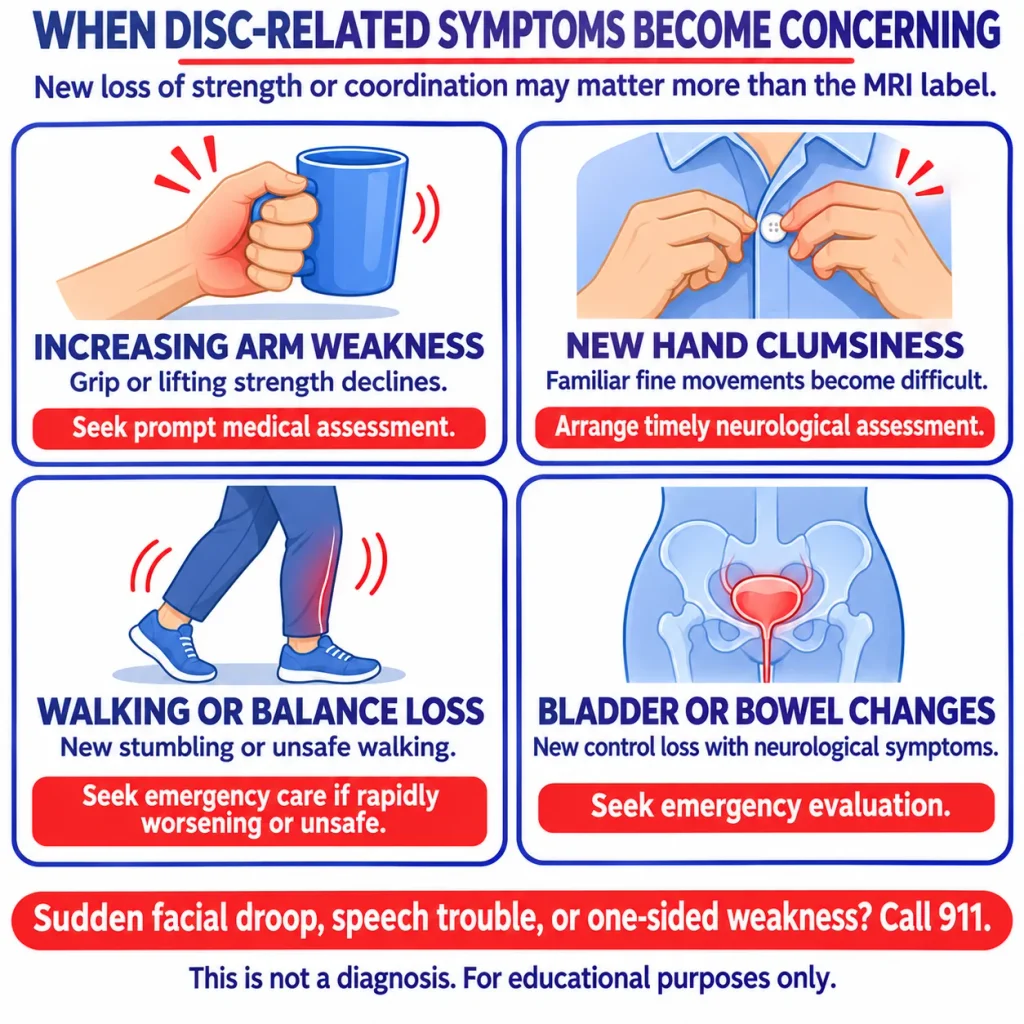
Contact a medical professional promptly for noticeable loss of strength, a weaker grip, or increasing difficulty using the arm or hand. If weakness is rapidly worsening or causes major loss of function, seek emergency evaluation. Do not assume the previously reported disc finding fully explains a new deficit.
New Walking, Balance, or Coordination Problems
Trouble walking steadily, repeated unexplained stumbling, or newly clumsy hands can signal a problem beyond an isolated neck-to-arm nerve symptom. Significant cervical spinal cord involvement can affect these functions. The NHS guidance on cervical myelopathy identifies these changes as reasons for timely assessment, particularly when symptoms are new or worsening.
Symptoms That Require Emergency Evaluation
Go to an emergency department for rapidly worsening limb weakness, sudden inability to walk safely, major new neurological loss, or new bladder or bowel dysfunction together with weakness, numbness, or walking changes. These are symptoms to evaluate urgently, not findings to sort out by comparing “bulge” with “herniation.” For a broader view of neck-pain warning signs, see Angleton ER’s neck pain emergency guidance.
If symptoms begin suddenly and resemble a stroke—such as facial drooping, difficulty speaking, or abrupt one-sided weakness—call 911 immediately, even if you already have a disc diagnosis. The CDC’s stroke warning-sign guidance emphasizes emergency response rather than driving yourself.
How Do Doctors Determine Whether a Disc Finding Is Causing Symptoms?
Comparing Symptoms With Imaging Findings
The assessment starts with the pattern and timing: where pain or altered feeling occurs, whether one or both arms are involved, whether strength has changed, and how quickly symptoms developed. The clinician then asks whether the level and direction of the disc finding fit that pattern. Similar scans can have different clinical meanings.
Physical and Neurological Examination
A clinician may check arm and hand strength, sensation, reflexes, neck movement, and sometimes walking or coordination. The MedlinePlus herniated-disc clinical overview explains why the physical examination is central and imaging is used selectively to clarify the cause of symptoms.
When Additional Imaging or Specialist Assessment May Be Needed
Further imaging or specialist evaluation depends on the history, examination, and severity or progression of symptoms. The American College of Radiology’s cervical imaging criteria distinguish situations in which MRI may help from those where routine imaging is unnecessary. A bulge or herniation alone does not automatically require repeat MRI, surgery, or an emergency scan.
What Questions Should You Ask About Your Cervical Disc Report?
Bring the report to your follow-up appointment, along with a short timeline of your symptoms. Useful questions include:
- Does the scan describe a broad bulge, a protrusion, or an extrusion?
- Is a nerve root or the spinal cord compressed, or merely contacted?
- Do the imaging findings match my symptoms and examination?
- Which changes should lead to earlier reassessment or emergency evaluation?
- Would additional testing or a specialist consultation change my care?
“My MRI showed a herniated disc” is a starting point. “Since Tuesday, my right hand has become weaker and I keep losing my grip” gives the clinician more actionable information. Changes in what you can feel or do help put the report in context.
Emergency Evaluation for Concerning Neck Symptoms in Angleton
For patients in Angleton and nearby Brazoria County communities, a cervical disc finding alone does not require an ER visit. When severe symptoms, new weakness, or other neurological changes raise concern, Angleton ER provides 24/7 emergency evaluation. Its emergency physicians assess the clinical problem and may order appropriate testing; the facility’s imaging services are used when medically indicated, not as routine MRI screening for a known disc finding. Call 911 for sudden stroke-like symptoms or another major neurological emergency.
Frequently Asked Questions
What is the difference between a herniated disc and a bulging disc in the neck?
A bulge describes broader disc extension, while a herniation describes more localized displacement. Neither term alone tells you whether the finding causes symptoms.
Is a herniated disc in the neck more serious than a bulging disc?
Not necessarily. Location, involvement of nerve structures, and your symptoms and examination determine the clinical significance more than the label.
Can a bulging disc in the neck cause arm pain or numbness?
Yes, if it contributes to irritation or compression of a cervical nerve root. However, arm symptoms may have other causes, and the disc finding needs clinical correlation.
Can a cervical disc herniation appear on an MRI without causing symptoms?
Yes. Some people have cervical disc abnormalities on MRI despite having no neck or arm complaints. A report should not be interpreted in isolation.
Does a herniated or bulging disc in the neck always require surgery?
No. Many people do not need surgery. The plan depends on symptoms, neurological findings, and possible nerve or spinal cord compromise.
When should I seek emergency care for a cervical disc problem?
Seek emergency evaluation for major or rapidly worsening weakness, suddenly unsafe walking, or new bladder or bowel dysfunction with other neurological changes. Call 911 for sudden stroke-like symptoms.
Do I need another MRI if my symptoms change after a cervical disc diagnosis?
Not always. A clinician first reassesses what changed and checks for neurological deficits, then decides whether repeat imaging or specialist evaluation is warranted.