
A headache, brief staring spell, new vision problem, or change in balance does not automatically mean a brain tumor. These symptoms have many possible causes. Brain-tumor symptoms also vary widely because they depend on the tumor’s location, size, and speed of growth, as well as whether it is pressing on brain tissue or disrupting a specific function.
The decision that matters first is not whether you can identify a tumor from symptoms. It is whether a new or worsening neurologic change could represent an emergency. A first seizure, sudden one-sided weakness, speech difficulty, loss of consciousness, sudden vision loss, or an extremely severe headache needs urgent evaluation even when a tumor is only one of several possible explanations.
A Headache Becomes More Concerning When Its Pattern Changes
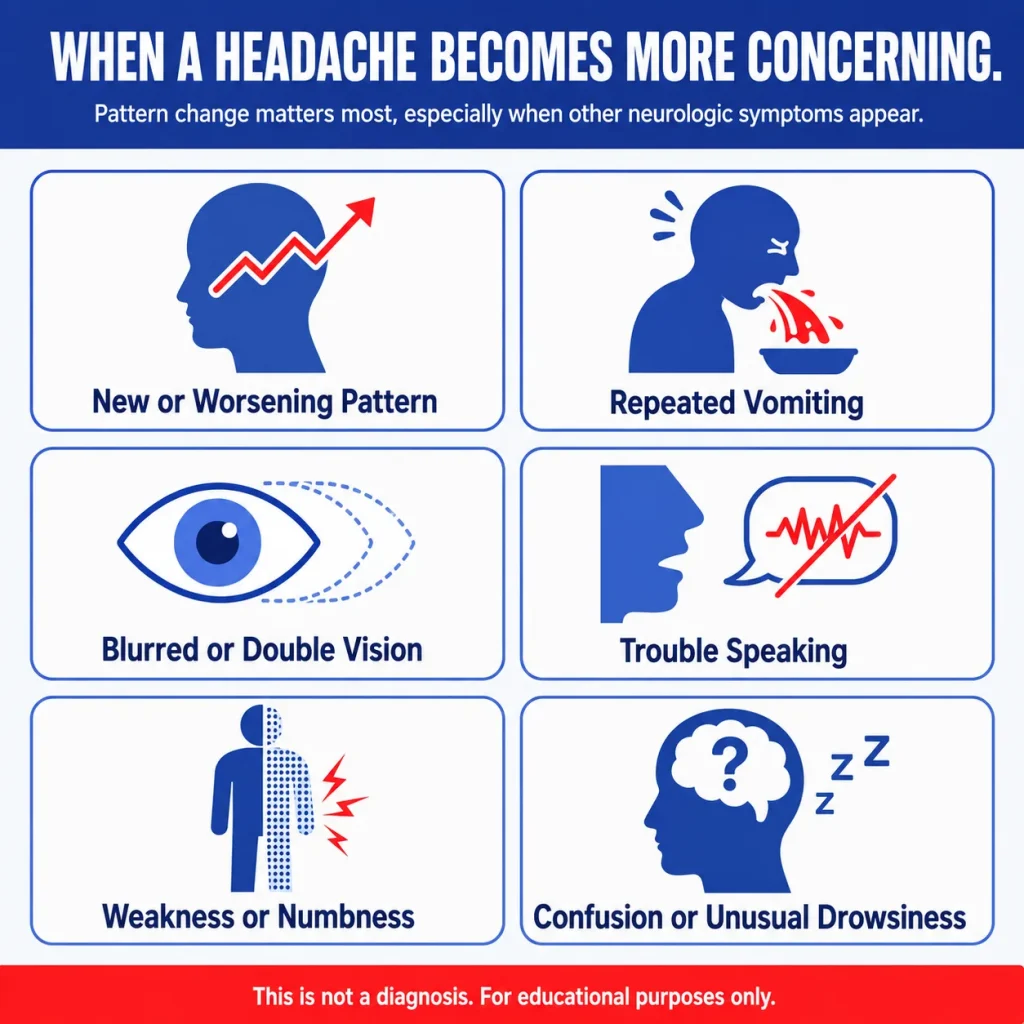
Headaches are common, and headache by itself is not a reliable sign of a brain tumor. The NHS brain-tumor symptom guidance notes that new or worsening headaches linked to a malignant brain tumor usually occur with other symptoms. The overall pattern matters more than one feature such as the time of day, the exact location of pain, or whether vomiting changes the pain.
Medical evaluation becomes more important when the headache is distinctly unfamiliar, is recurring more often, is progressively worsening, or is accompanied by repeated vomiting. Neurologic symptoms raise the level of concern further: blurred or double vision, trouble speaking, weakness, numbness, poor coordination, confusion, unusual drowsiness, or a meaningful change in behavior.
A headache that follows a seizure, collapse, or loss of consciousness should not be managed as an ordinary headache. A sudden headache that reaches severe intensity rapidly is also an emergency warning sign because bleeding, stroke, infection, or another time-sensitive condition may be responsible. For broader guidance that is not limited to tumor concern, see Angleton ER’s explanation of when a headache warrants ER evaluation.
A First Seizure or New Seizure Pattern Needs Urgent Evaluation
A seizure does not always involve full-body shaking. MedlinePlus explains that some seizures cause mild or focal symptoms rather than convulsions. A person may stare and stop responding, lose awareness, experience an unusual smell or sensation, have one-sided jerking, appear suddenly confused, repeat automatic movements, or have a memory gap.
Call 911 for a first known seizure. Emergency help is also needed when a seizure lasts more than five minutes, another seizure begins before the person returns to normal, breathing is difficult, a serious injury occurs, or the person does not wake normally afterward. These are among the emergency situations identified in the CDC’s seizure first-aid guidance.
During a seizure, protect the person from nearby hazards, turn them gently onto their side when possible, and time the event. Do not restrain them or place anything in their mouth. A tumor can cause seizures, but so can stroke, head injury, infection, metabolic problems, medication effects, and other conditions; emergency evaluation is needed to identify the urgent cause.
Vision, Thinking, and Personality Changes Can Be Neurologic Symptoms
Changes may be noticed first by the patient, but family members or coworkers sometimes recognize them earlier. Concerning examples include:
– Blurred or double vision, or loss of part of the visual field
– Increasing confusion, forgetfulness, or difficulty following a conversation
– Trouble concentrating, planning, or completing familiar tasks
– Unusual sleepiness, reduced alertness, or a marked drop in activity
– A meaningful change in personality, mood, judgment, or behavior
The National Cancer Institute lists vision, speech, concentration, personality, balance, weakness, and unusual sleepiness among possible brain-tumor symptoms. None of these changes is specific to a tumor. They become harder to dismiss when they are new, progressive, unexplained, or occurring together with headaches, vomiting, seizures, or other neurologic deficits.
Weakness, Numbness, Speech Changes, and Balance Problems Are Red Flags
Functional changes deserve attention because they show that the nervous system may not be working normally. Warning signs include new weakness or numbness, especially on one side; facial drooping; slurred speech; difficulty finding words; loss of coordination; new stumbling; trouble using a hand, arm, or leg; or new difficulty swallowing.
If these symptoms begin suddenly, do not try to decide whether a tumor is responsible. The CDC identifies sudden one-sided weakness, speech trouble, vision changes, severe headache, and loss of balance as stroke warning signs and advises calling 911 immediately. Angleton ER also outlines the practical response to possible stroke symptoms. A slower progression still needs prompt medical review, but sudden onset is a time-sensitive emergency.
When Neurologic Symptoms Need Emergency Care
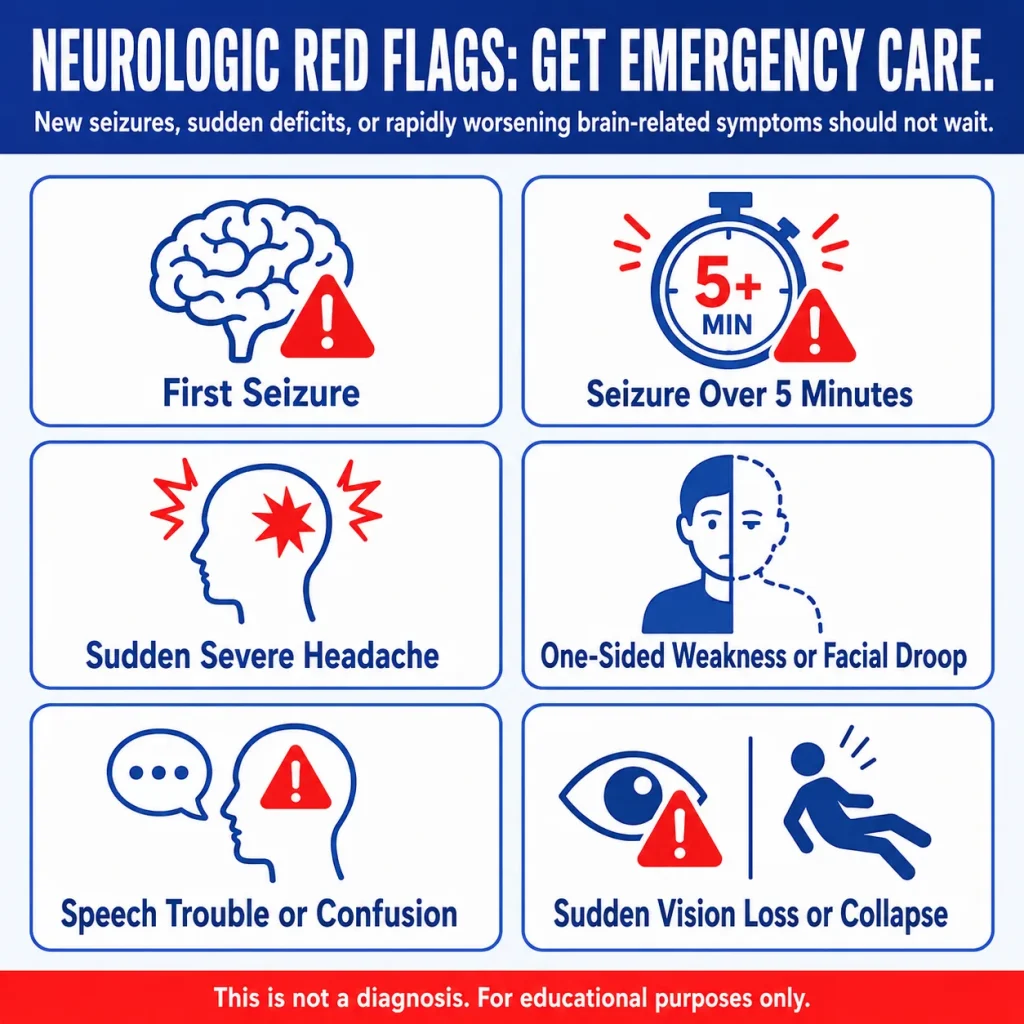
Seek emergency evaluation now for:
– A first seizure
– A seizure lasting more than five minutes
– Repeated seizures without normal recovery between them
– A sudden, extremely severe headache
– Sudden weakness, numbness, facial drooping, or speech difficulty
– New confusion, collapse, or loss of consciousness
– A severe headache with repeated vomiting or marked drowsiness
– Sudden vision loss or rapidly worsening vision
– Trouble breathing during or after a seizure
Call 911 when the person may be having a stroke, is unconscious, cannot breathe normally, is actively seizing for more than five minutes, or cannot be transported safely. Do not drive someone who is severely confused, unstable, or having rapidly worsening neurologic symptoms.
Arrange prompt medical follow-up for:
A recurring or progressively worsening headache, persistent vision changes, unexplained memory or personality changes, gradual balance problems, or neurologic symptoms that continue even when they are not sudden or severe. These symptoms may be caused by migraine, eye problems, medication effects, infection, metabolic disorders, a neurologic condition, a tumor, or another cause. A clinician can determine whether a neurologic examination, imaging, or specialist referral is appropriate.
Children may not describe symptoms clearly. Repeated vomiting, new balance problems, seizures, vision changes, unusual sleepiness, a clear behavioral change, or a decline in school functioning deserves medical assessment. MedlinePlus notes that childhood brain-tumor symptoms may be subtle and can include frequent vomiting, balance difficulty, weakness, vision problems, seizures, and changes in concentration or behavior. Severe or rapidly worsening symptoms require emergency care.
What an Emergency Neurologic Evaluation May Involve
The evaluation starts with the immediate safety questions: Is the person breathing normally? Are vital signs stable? Is there evidence of stroke, bleeding, infection, severe pressure in the brain, or another emergency? A clinician may assess alertness, speech, pupils, eye movements, facial symmetry, strength, sensation, reflexes, coordination, walking, and vision. Blood tests may be used to look for glucose, electrolyte, infection, medication, or organ-related problems that can produce neurologic symptoms. The National Institute of Neurological Disorders and Stroke explains that testing is guided by the neurologic examination and the patient’s symptoms.
A head CT may be used quickly to look for bleeding, swelling, a mass, hydrocephalus, or another urgent abnormality. MRI can show more detail in some situations, but it is not automatically the first emergency test. The choice depends on the symptom pattern, urgency, examination findings, safety considerations, and what the emergency physician needs to rule out first.
Imaging can reveal an abnormal area without proving what it is. A mass may be benign, malignant, inflammatory, infectious, vascular, or something else. The National Cancer Institute explains that imaging is used to identify a brain or spinal tumor, while tissue evaluation may still be needed for an accurate diagnosis. For a fuller explanation of these limits, review Angleton ER’s guide to what CT, ultrasound, and MRI can and cannot show about cancer.
24/7 Neurologic Symptom Evaluation in Angleton
For patients in Angleton and nearby Brazoria County communities, a first seizure, sudden severe headache, one-sided weakness, speech difficulty, new confusion, vision loss, or rapidly worsening neurologic symptoms should not wait for a routine appointment. Angleton ER provides 24/7 emergency evaluation, including vital-sign assessment, neurologic examination, laboratory testing, stabilization, and on-site CT imaging when the ER physician determines it is medically appropriate. Findings that require hospital-level or specialty care can then be directed to the appropriate next setting.
Frequently Asked Questions
Can a brain tumor cause headaches without any other symptoms?
It can, but headache alone is not a dependable way to identify a brain tumor. Most headaches have other causes, and tumor-related headaches commonly become more concerning because the pattern changes or neurologic symptoms, vomiting, seizures, vision changes, or altered alertness appear with them.
How are brain-tumor headaches different from migraines?
Can a brain tumor cause headaches without any other symptoms?
It can, but headache alone is not a dependable way to identify a brain tumor. Most headaches have other causes, and tumor-related headaches commonly become more concerning because the pattern changes or neurologic symptoms, vomiting, seizures, vision changes, or altered alertness appear with them.
Can a brief staring spell or memory gap be a seizure?
Yes. Some focal or absence seizures may cause staring, impaired awareness, automatic movements, confusion, unusual sensations, or a short memory gap without full-body shaking. A first suspected seizure should be evaluated urgently, particularly when the person has not returned fully to normal.
Can a benign brain tumor cause serious neurologic symptoms?
Yes. A benign tumor is not cancer, but it can still press on or disrupt an important part of the brain. The National Cancer Institute notes that both benign and malignant brain tumors can cause symptoms and require treatment because location and pressure may matter as much as whether the tumor is cancerous.
Can a normal CT scan rule out a brain tumor?
No. A CT scan may be reassuring for the emergency question being evaluated, but it does not exclude every small, subtle, or difficult-to-see abnormality. Persistent or progressive neurologic symptoms may require follow-up, MRI, specialist assessment, or other testing based on the clinical findings.
Can brain-tumor symptoms appear differently in children?
Yes. Children may show repeated vomiting, balance problems, seizures, vision changes, weakness, unusual sleepiness, behavior changes, or declining school performance rather than giving a clear symptom history. A child with a first seizure, loss of consciousness, breathing trouble, severe headache, sudden weakness, or rapidly worsening symptoms needs emergency care.