
Your MRI report says cervical stenosis. The wording may be alarming, even when you feel fine. Months later, though, you struggle to carry a grocery bag or feel unsteady walking. Does the old scan explain what has changed?
Cervical stenosis describes narrowing in the neck, not how well your nerves or spinal cord function. New weakness or loss of everyday abilities may change the urgency of assessment.
What Does Cervical Stenosis Mean on an Imaging Report?
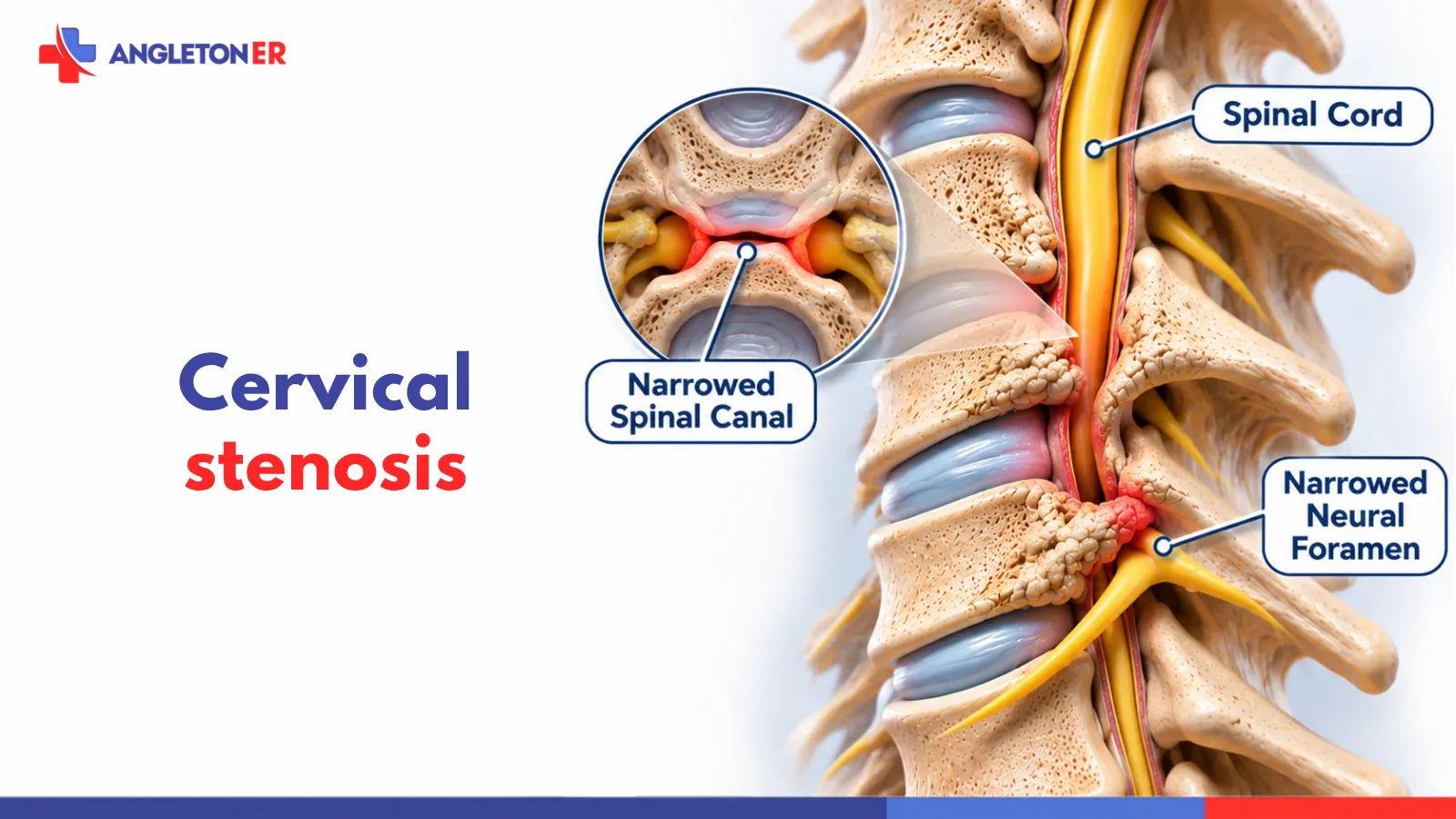
The cervical spine is the part of your spine in the neck. Cervical spinal stenosis means that one or more spaces around the spinal cord or the nerves leaving it have narrowed. The National Institutes of Health explains these spaces as the central spinal canal and the smaller openings through which nerve roots travel.
Understanding Narrowing in the Cervical Spine
A report may describe central canal stenosis, which involves the passageway containing the spinal cord, or foraminal stenosis, which involves an opening where a nerve exits. The location helps clinicians compare scan findings with symptoms and examination.
Does Mild, Moderate, or Severe Stenosis Always Cause Symptoms?
No. Radiologists use words such as mild, moderate and severe to describe what appears on imaging. Those grades are useful but cannot determine, by themselves, how much weakness, numbness or disability someone has—or whether emergency care or surgery is needed.
Why Cervical Stenosis Scan Results Do Not Always Match Symptoms
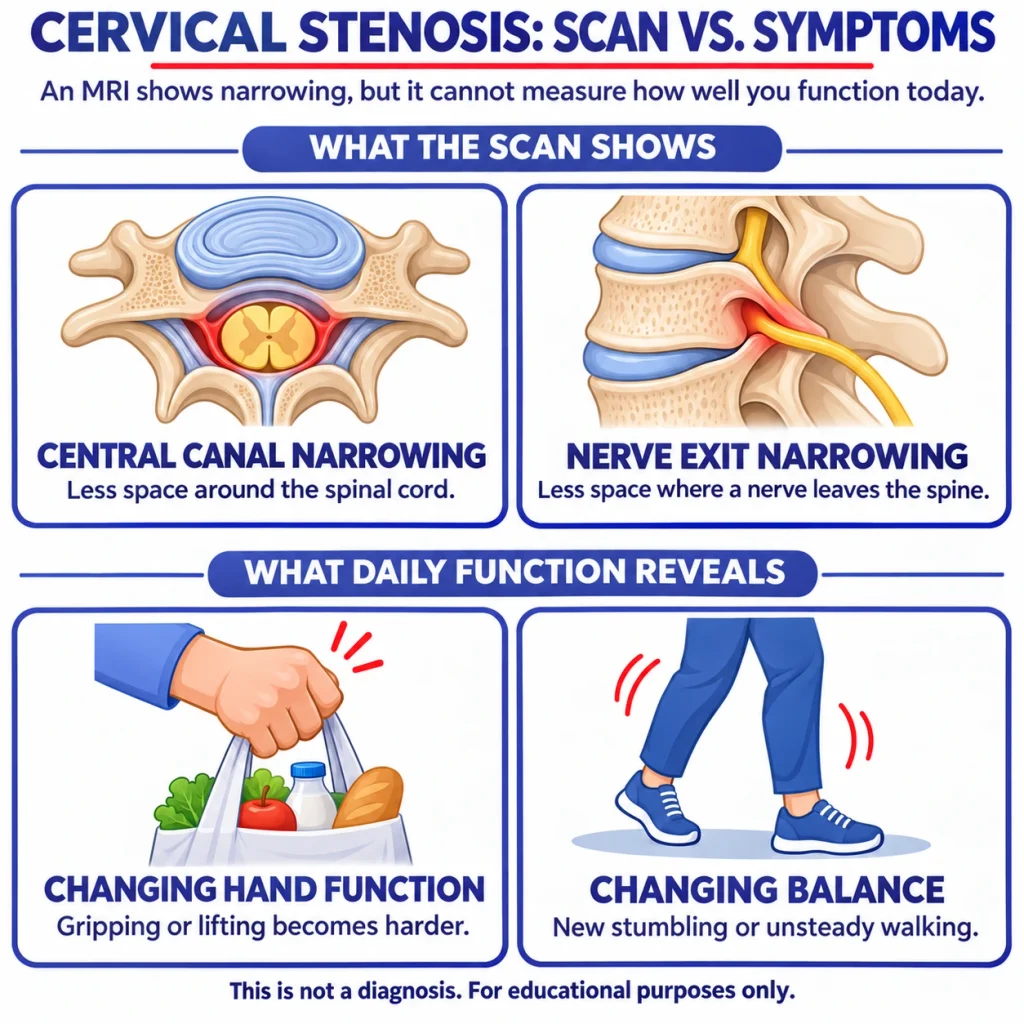
A scan records anatomy at one moment. It cannot show whether you can fasten buttons today or whether a new problem comes from your neck. People with similar reports can function differently because the structures involved and their clinical findings vary.
Cervical Stenosis Without Noticeable Symptoms
Sometimes cervical narrowing appears on a scan obtained for another reason. As Mayo Clinic notes in its spinal stenosis guidance, some people have no symptoms. That does not make every scan finding an emergency, but the clinician who ordered it should still explain what it means and whether monitoring is appropriate.
Guidelines for people with spinal cord compression but no myelopathy support individualized follow-up rather than automatic preventive surgery.
When Symptoms Matter More Than Report Wording
An earlier report may say “mild,” yet you now struggle to grip a mug. That change needs attention regardless of the label. Equally, serious-sounding wording does not necessarily mean a stable person requires emergency intervention. The change since your previous examination matters.
What New Symptoms Should You Watch for After a Cervical Stenosis Diagnosis?
Compare today’s abilities with those you had when the scan was taken. New symptoms may have causes other than cervical narrowing.
New Arm Weakness, Numbness, or Tingling
An arm may tire unexpectedly, lifting may become harder, or tingling may spread into a hand. Narrowing around a nerve root can contribute to these symptoms. New weakness is especially important to report.
Changes in Hand Strength or Coordination
You may drop keys, lose your grip on a bag, or struggle with familiar finger movements. The American Academy of Orthopaedic Surgeons describes reduced hand dexterity as a possible sign of spinal cord involvement. Hand clumsiness needs assessment; it does not confirm a cause.
New Walking or Balance Difficulties
New stumbling, unsteadiness or needing support to walk warrants prompt assessment. Spinal cord involvement is one possibility, even without much neck pain, but other conditions can cause balance changes.
When Do New Cervical Stenosis Symptoms Require Medical Attention?
Stable Symptoms Without New Functional Problems
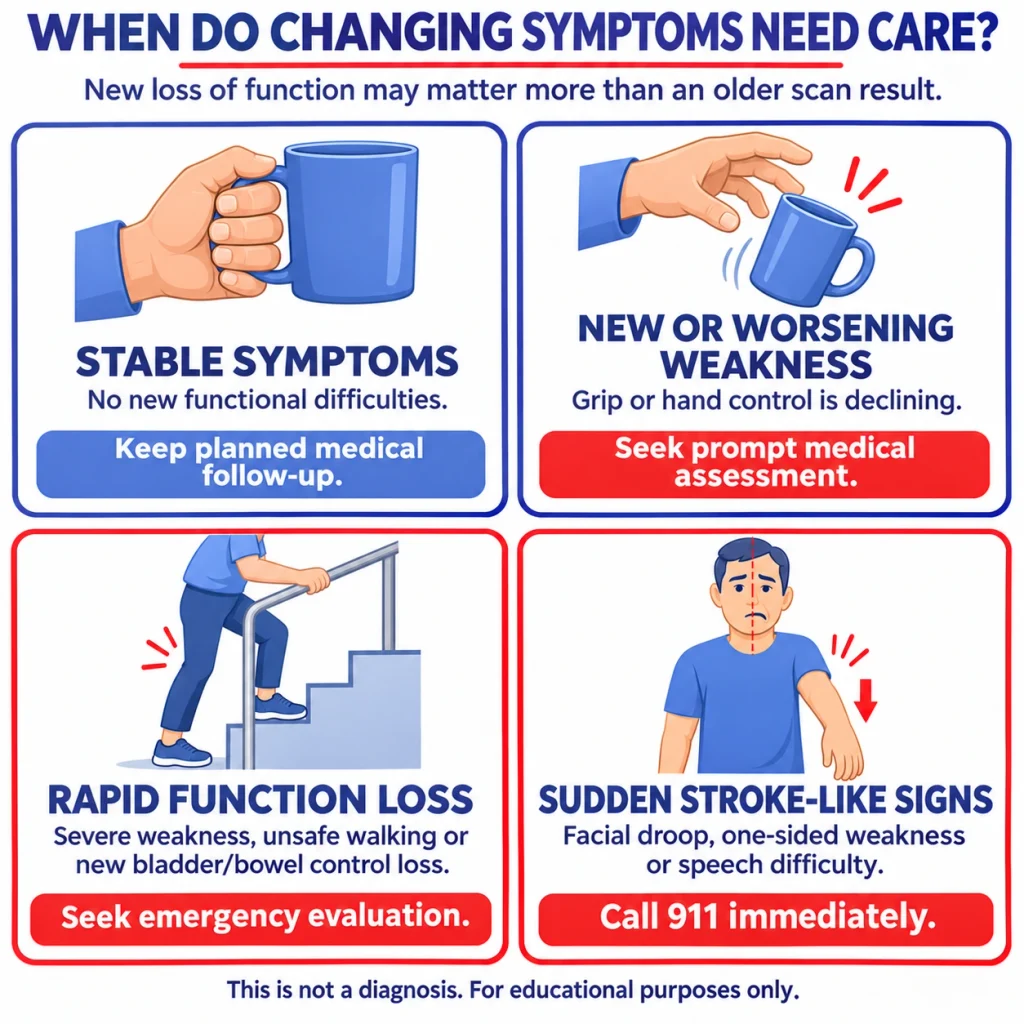
Unchanged symptoms without loss of function may allow planned follow-up under your clinician’s advice. Keep those visits and report new developments.
New or Progressively Worsening Neurological Symptoms
Report new weakness, increasing numbness, reduced hand control or worsening balance promptly. Do not wait for a routine scan when function is declining. The American Association of Neurological Surgeons recommends consultation for progressing weakness or numbness.
Sudden or Severe Neurological Changes
Seek emergency evaluation for rapidly worsening weakness, major loss of limb function, sudden inability to walk safely, or new loss of bladder or bowel control with neurological changes. Call 911 if symptoms are severe or transport is unsafe.
Sudden one-sided weakness, facial drooping or difficulty speaking could be a stroke—not a flare of known stenosis. CDC stroke warning-sign guidance says to call 911 immediately for these symptoms, even if they begin to improve. Do not drive yourself when a stroke is possible.
How Doctors Evaluate New Symptoms When Cervical Stenosis Is Already Known
Comparing Current Symptoms With Previous Findings
Clinicians compare the date of the old scan, previous symptoms, onset of new changes and their progression. Bring the report and images if available. Current findings determine urgency.
Checking Strength, Sensation, and Movement
An examination may check strength, sensation, reflexes, coordination and walking. NIH diagnostic guidance for spinal stenosis emphasizes using medical history, examination and imaging together.
When Repeat Imaging or Specialist Review May Help
Possible nerve or spinal cord dysfunction may prompt repeat imaging or a specialist referral. MRI shows soft tissues and the cord; CT helps assess bone. The American College of Radiology’s cervical imaging criteria tailor testing to the clinical situation, not a scan label alone.
What Should You Tell Your Doctor When Symptoms Change?
Explain what changed since the previous scan: the affected limb, onset, progression and activities that are harder. Mention falls, unsteadiness or bladder and bowel changes. Bring the report and medication list if available.
“My MRI showed cervical stenosis” gives little context. “Since Tuesday I’ve started dropping things with my left hand” identifies a specific, dated loss of function.
For broader neck-pain warning signs, see Angleton ER’s guide to when neck pain may need emergency care.
Emergency Evaluation for Changing Symptoms in Angleton
For Angleton and nearby Brazoria County communities, Angleton ER provides 24/7 emergency evaluation for severe or concerning neurological symptoms. Its clinicians can assess weakness or major coordination changes and determine appropriate testing, treatment or transfer. Stable symptoms may be better addressed through planned follow-up. Call 911 for stroke-like or life-threatening symptoms.
Frequently Asked Questions
What does cervical stenosis mean on an MRI report?
It means a space within the cervical spine has narrowed, either around the spinal cord or where nerves leave the spine. The location and degree of narrowing need to be interpreted alongside your symptoms and examination.
Can cervical spinal stenosis be present without symptoms?
Yes. Cervical narrowing can be found on imaging even when a person feels well. Discuss the finding with the clinician who ordered the scan to understand whether any follow-up is needed.
Does severe cervical stenosis on an MRI always mean surgery is needed?
No. Treatment decisions are based on the full clinical picture, not one adjective in a report. A specialist may recommend different approaches depending on neurological findings and other individual factors.
Can cervical stenosis cause new arm weakness or numbness?
It can, particularly if narrowing affects a nerve root or spinal cord. But new arm symptoms can have other causes, so a clinician needs to assess them rather than attributing them automatically to the scan.
What does it mean if walking or balance problems develop after a cervical stenosis diagnosis?
These changes may raise concern about spinal cord function and deserve prompt evaluation. Their cause cannot be confirmed from an old neck scan alone.
When should I seek emergency care for cervical stenosis symptoms?
Get emergency evaluation for sudden or rapidly worsening weakness, severe loss of function, inability to walk safely, or new bowel or bladder control problems with neurological changes. Call 911 for stroke-like symptoms or an immediately dangerous situation.
Do I need another MRI if my cervical stenosis symptoms change?
Not necessarily. A clinician first considers the new symptoms and examination findings, then determines whether repeat MRI, another test or specialist assessment is appropriate.