
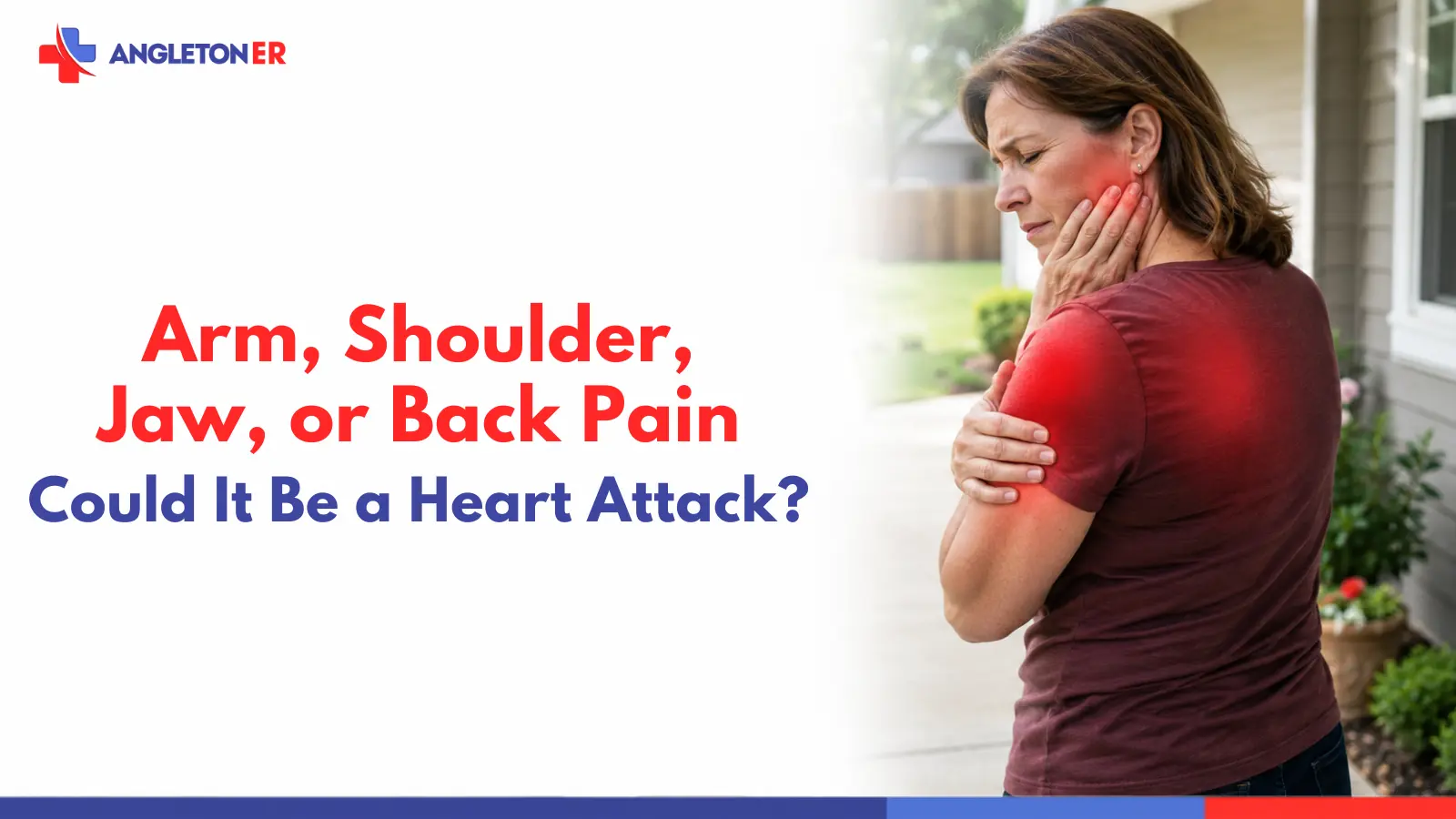
Pain in your arm, shoulder, jaw, or back is not automatically a heart attack. But heart-related discomfort can be felt outside the chest, and sometimes the outside-the-chest symptom is what gets a person’s attention first. The American Heart Association and the National Heart, Lung, and Blood Institute both include discomfort in the arms, back, shoulders, neck, or jaw among possible heart attack warning signs.
The safest way to interpret that pain is not to ask, “Is it in the right body part?” The more useful question is whether the overall pattern suggests a possible cardiac emergency—especially when the discomfort is new or unexplained and appears with chest pressure, shortness of breath, sweating, nausea, faintness, marked weakness, or symptoms brought on by exertion.
Can a Heart Attack Cause Pain Outside the Chest?
Yes. A heart attack occurs when part of the heart muscle is not receiving enough blood, usually because blood flow through a coronary artery has become blocked. CDC heart attack guidance lists pain or discomfort in the jaw, neck, back, one or both arms, or shoulders among the major warning symptoms, along with chest discomfort, shortness of breath, weakness, light-headedness, faintness, and cold sweating.
One reason heart pain can be felt elsewhere is a phenomenon called referred pain. In simple terms, the nervous system does not always localize signals from the heart to one precise spot. Research on the neural pathways involved in cardiac pain describes how heart-related sensory signals converge with pathways that also help carry sensation from areas such as the chest, arm, neck, and jaw. The result is that reduced blood flow to the heart can sometimes be perceived as discomfort away from the heart itself.
That does not mean every ache in those areas is cardiac. It means the absence of dramatic chest pain does not, by itself, make a heart attack impossible. If you want the broader background on how artery disease can reduce blood flow to the heart, Angleton ER’s guide to coronary heart disease covers that topic in more depth.
What Can Heart-Related Arm, Shoulder, Jaw, or Back Pain Feel Like?
There is no single sensation that proves the pain is coming from the heart. Heart-related discomfort may be described as pressure, heaviness, aching, tightness, burning, or simply an unusual discomfort. It may involve one area or more than one area, and symptoms may be mild, severe, sudden, gradual, or intermittent. MedlinePlus notes that heart attack discomfort can involve the upper body and may occur along with nausea, dizziness, light-headedness, cold sweating, or shortness of breath.
The pattern matters more than a perfect description. Pain that seems “not that bad” can still be concerning when it is new, unexplained, occurs with exertion, or arrives with other symptoms suggesting that the heart or circulation may be under stress. Conversely, a strong pain sensation by itself still cannot tell you whether the cause is cardiac.
Does It Have to Be the Left Arm?
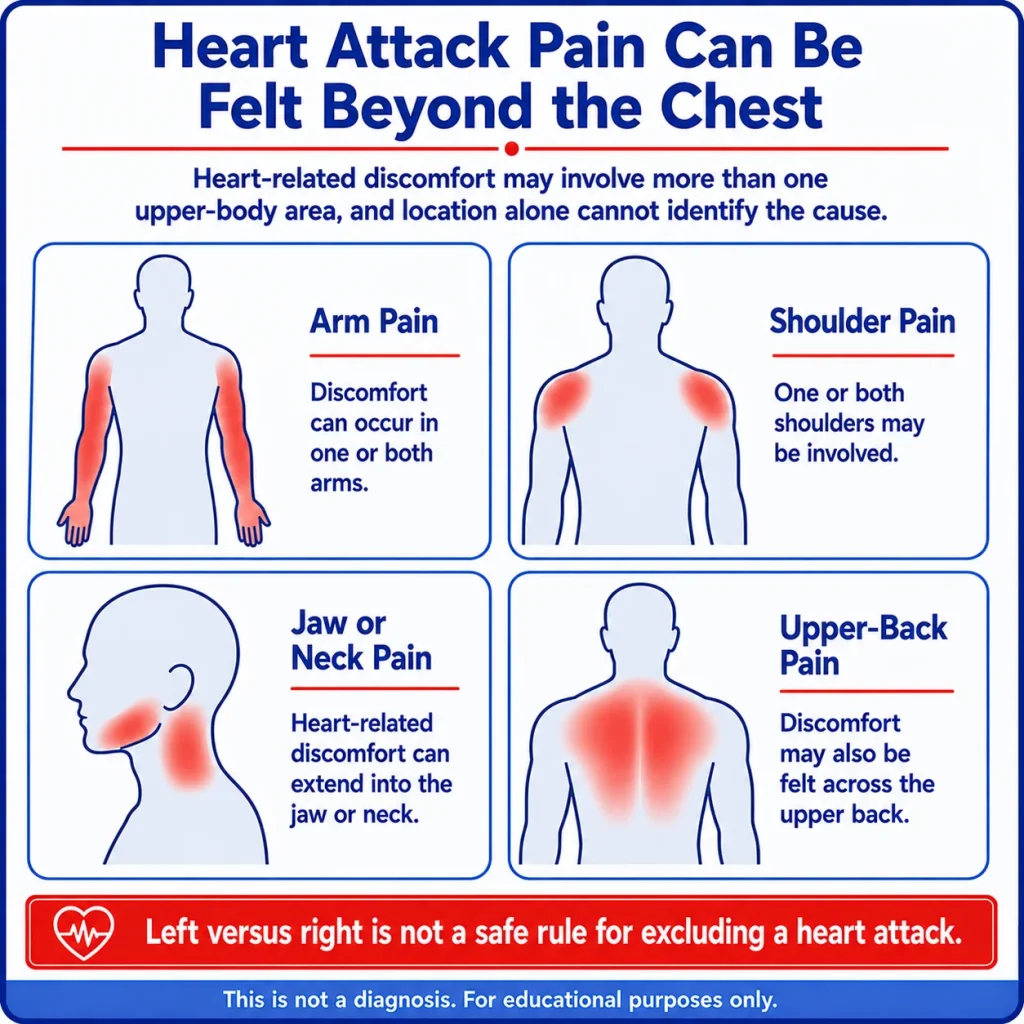
No. The familiar idea that a heart attack always causes left-arm pain is too narrow. The NHLBI symptom guidance specifically lists pain or discomfort in one or both arms as possible heart attack symptoms and also includes the shoulders, back, neck, and jaw.
That is why “left versus right” is not a safe home diagnostic rule. Right-sided shoulder or arm discomfort can occur in a heart attack, just as left-sided discomfort can occur for many non-cardiac reasons. The location should be interpreted together with the timing, whether the symptom is new, what you were doing when it started, and what else is happening at the same time.
What Makes Pain Outside the Chest More Concerning?
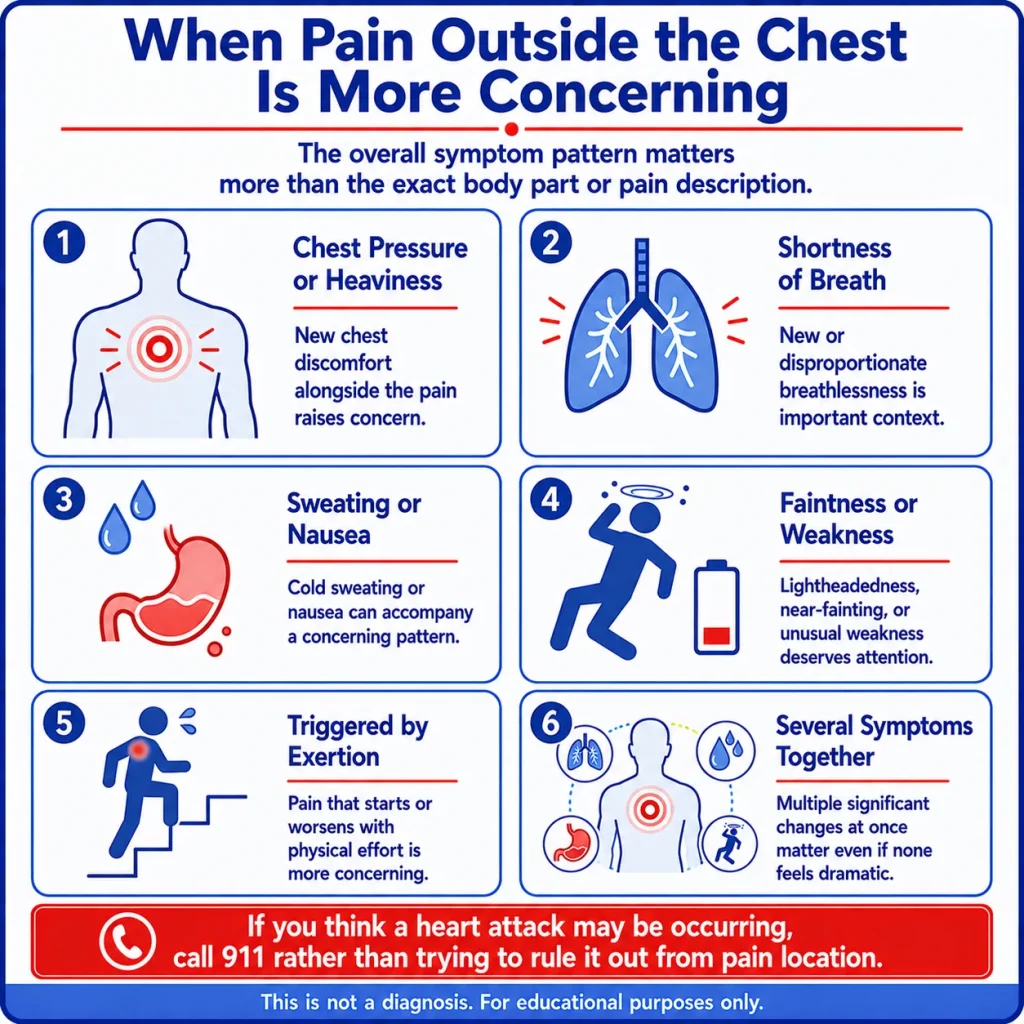
Concern rises when arm, shoulder, jaw, or back discomfort appears as part of a larger symptom pattern. The American Heart Association’s acute coronary syndrome guidance describes symptoms such as chest discomfort, pain spreading to the neck, jaw, shoulders, arms, stomach, or back, shortness of breath, dizziness or light-headedness, nausea, and sweating.
Features that should lower your threshold for emergency evaluation include:
• chest pressure, squeezing, heaviness, or other new chest discomfort;
• new or worsening shortness of breath, including breathlessness that seems out of proportion to the activity;
• sweating, nausea, light-headedness, faintness, or unusual weakness;
• pain or discomfort that starts with physical effort or becomes more noticeable with exertion;
• several concerning symptoms occurring together, even if no single symptom feels dramatic.
These are context signals, not a scoring system. A person can have a heart attack without every item on the list, and having one of these symptoms does not establish the diagnosis. The 2021 AHA/ACC chest pain guideline emphasizes that discomfort in the shoulders, arms, neck, back, upper abdomen, or jaw can represent an “anginal equivalent” that warrants appropriate evaluation when the clinical picture is concerning.
Could the Pain Be From Something Other Than the Heart?
Absolutely. Muscles, joints, tendons, nerves, posture, overuse, and injuries can all produce pain in the arm, shoulder, jaw, or back. Those causes are common. The difficulty is that pain location alone cannot reliably separate a musculoskeletal problem from reduced blood flow to the heart.
For example, a sore shoulder after lifting or a back ache after an awkward movement may have a straightforward mechanical explanation. But if the discomfort is new and hard to explain—especially if it is paired with chest pressure, shortness of breath, sweating, nausea, faintness, or a sudden sense that you are significantly unwell—it should not be dismissed simply because the pain is outside the chest.
When Should This Kind of Pain Not Wait?
Do not wait for “classic crushing chest pain” if the overall symptom pattern could represent a heart attack. The American Heart Association advises calling 911 for heart attack warning signs even when you are not sure. Heart attacks can begin gradually, symptoms can be milder than expected, and discomfort outside the chest can occur with or without the chest pain a person imagined they would have.
New or unusual arm, shoulder, jaw, or back pain needs urgent attention when it occurs with chest pressure, breathing difficulty, cold sweating, nausea or vomiting, fainting or near-fainting, marked weakness, or several significant changes at once. The 2025 acute coronary syndrome patient guidance likewise stresses acting quickly when chest pain or another symptom of acute coronary syndrome occurs.
If you are trying to decide what chest or heart-related symptoms warrant emergency care, Angleton ER’s page on when chest pain needs emergency evaluation explains the local ER role and the types of cardiac assessment that may be used based on the physician’s evaluation. For a broader review of heart attack warning signs, you can also read Signs of a Heart Attack. Neither resource should be used to delay 911 when symptoms may be life-threatening.
Emergency Evaluation in Angleton When the Pattern Is Concerning
For people in Angleton and nearby Brazoria County communities, Angleton ER provides 24/7 emergency evaluation for chest pain and heart-related symptoms. Depending on the ER physician’s assessment, evaluation may include an EKG, cardiac lab testing, imaging, monitoring, medication, and stabilization. If unexplained arm, shoulder, jaw, or back discomfort is occurring with symptoms that could indicate a heart attack—and especially if the situation feels severe, sudden, or unsafe to drive with—call 911 rather than trying to diagnose the pain from its location.
Frequently Asked Questions
What does heart attack arm pain feel like?
There is no one definitive feeling. It may be pressure, aching, heaviness, tightness, burning, or other discomfort, and it can occur with chest discomfort or with symptoms such as shortness of breath, sweating, nausea, or light-headedness. The overall pattern matters more than the exact sensation.
Does heart attack pain always occur in the left arm?
No. Heart attack discomfort may occur in one or both arms, and it may also involve the shoulders, back, neck, or jaw. Left-versus-right location should not be used as a home rule to exclude a heart attack.
Can right shoulder pain be a sign of a heart attack?
It can be, but right shoulder pain by itself does not diagnose a heart attack. It becomes more concerning when it is new or unexplained and appears with chest discomfort, shortness of breath, sweating, nausea, faintness, marked weakness, or other significant changes.
Can jaw pain happen during a heart attack without severe chest pain?
Yes. Heart attacks do not always begin with severe chest pain, and some people have milder chest symptoms or prominent discomfort elsewhere. New jaw pain with breathing difficulty, sweating, nausea, light-headedness, weakness, or other concerning symptoms deserves prompt evaluation.
Can upper back pain be related to a heart attack?
Yes. Upper-back discomfort is a recognized possible heart attack symptom, but it has many non-cardiac causes as well. The decision to seek emergency evaluation should be based on the complete symptom pattern, not the back-pain location alone.
How can I tell whether arm, shoulder, jaw, or back pain needs emergency evaluation?
Treat the pattern as urgent when the pain is new or unusual and occurs with chest pressure, shortness of breath, sweating, nausea, fainting or near-fainting, marked weakness, exertional symptoms, or several concerning symptoms together. If you think a heart attack may be occurring, call 911 rather than trying to rule it out at home.