
A sudden episode of face drooping, arm numbness, trouble speaking, vision change, or loss of balance can be frightening. It can also be confusing when the problem clears within minutes and you feel normal again. That improvement does not reliably tell you that the danger has passed. The American Stroke Association describes a transient ischemic attack (TIA) as a temporary interruption of blood flow to the brain and advises getting help immediately, even when symptoms go away.
This article focuses on that specific decision point: what to do when stroke-like symptoms were sudden but temporary. For a broader review of face drooping, arm weakness, speech difficulty, vision changes, balance problems, and other warning signs, see Angleton ER’s stroke emergency guide.
Why a “Mini-Stroke” Should Not Be Treated as a Minor Event
“Mini-stroke” is a common name for a transient ischemic attack, but the word “mini” can be misleading. A TIA can produce the same kinds of sudden neurologic symptoms associated with stroke, except the symptoms resolve. The National Institute of Neurological Disorders and Stroke explains that a TIA is caused by a temporary interruption of blood flow and that stroke symptoms can disappear after the blockage clears.
The temporary nature of the symptoms is exactly why people may underestimate the event. A person can be talking normally again, walking normally again, or moving an arm normally again and still need urgent medical assessment. A TIA is not diagnosed simply because symptoms disappeared; clinicians must evaluate what happened and consider stroke and other possible causes.
What Can TIA Symptoms Look Like?
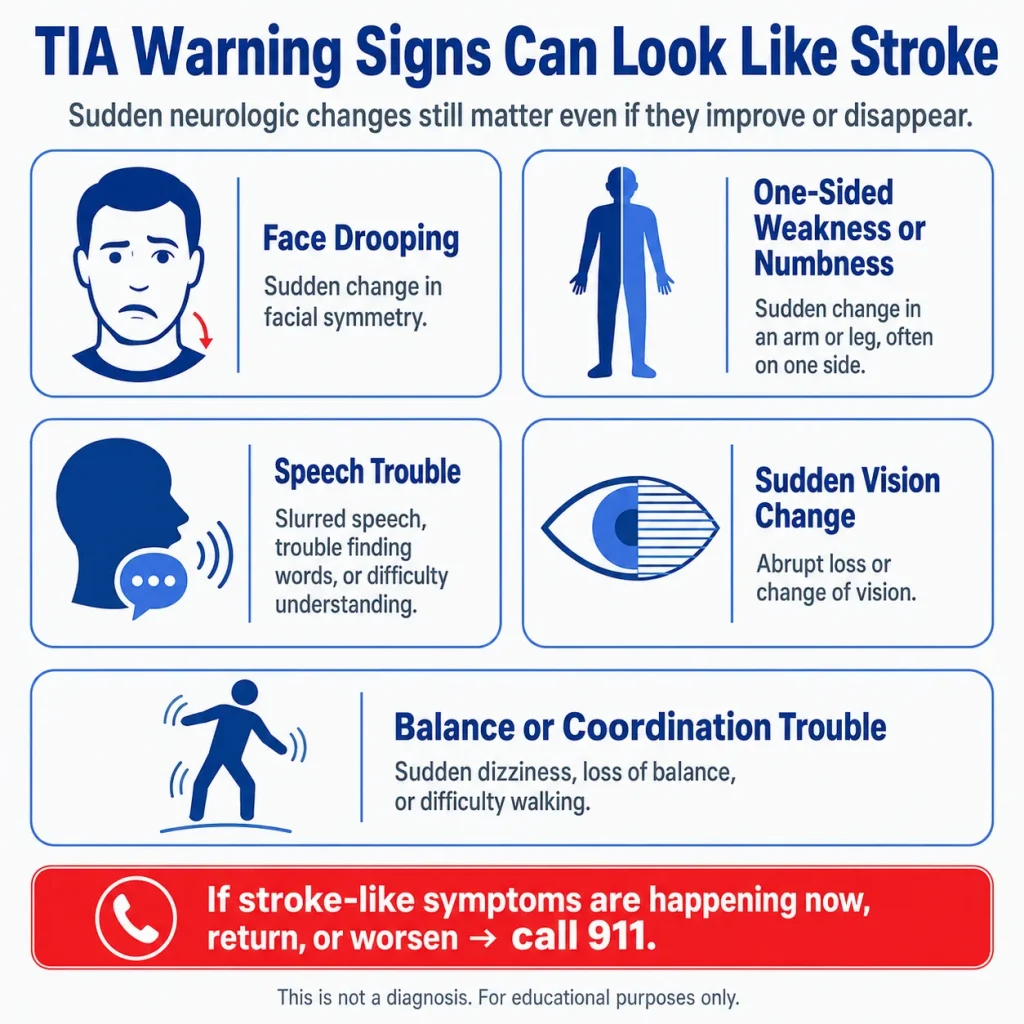
TIA symptoms are typically sudden neurologic changes. The CDC stroke warning-sign guidance includes sudden numbness or weakness, confusion or trouble speaking, vision problems, difficulty walking, dizziness, loss of balance or coordination, and severe headache with no known cause.
– Face drooping or a sudden change in facial symmetry
– Weakness or numbness in an arm or leg, often on one side
– Slurred speech, difficulty finding words, or trouble understanding speech
– Sudden loss or change of vision
– Abrupt trouble with balance, coordination, or walking
These signs can have more than one cause, so symptoms alone cannot confirm a TIA. The distinctive concern for this article is what happens next: if one of these neurologic changes appears suddenly and then disappears, it still deserves prompt attention rather than being written off as a fluke.
Can TIA Symptoms Really Go Away Completely?
Yes. A person may feel substantially better or even completely back to normal by the time they decide whether to seek care. The NINDS stroke signs and symptoms resource specifically notes that stroke symptoms that disappear after a few minutes may represent a TIA and should be reported to a healthcare team right away.
That means statements such as “my speech is normal again,” “the numbness stopped,” or “I can move my arm now” do not provide medical clearance. Nor does feeling well afterward prove that the episode was imagined. A transient neurologic deficit can be real even when the examination later looks normal.
This is one of the harder features of TIA for patients: the event can leave no obvious symptom to point to when the decision to get evaluated is being made. The history of what happened – how suddenly it began, which function changed, and how long it lasted – becomes especially important.
Why Symptoms Going Away Does Not Make It Safe to Wait
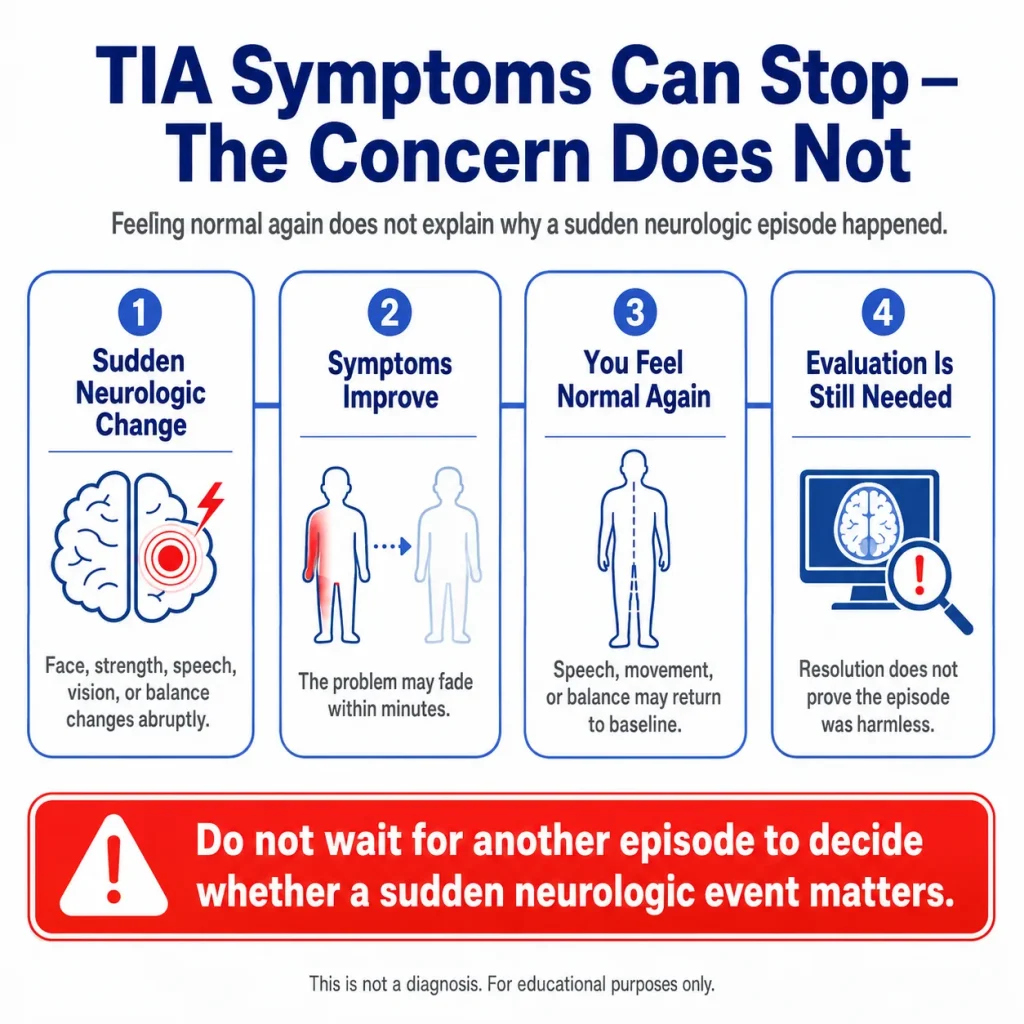
The disappearance of the symptom changes what you feel; it does not necessarily change the medical importance of what happened. The American Heart Association scientific statement on TIA in the emergency department emphasizes rapid evaluation because TIA can be difficult to diagnose after symptoms resolve and because the risk of stroke is concentrated soon after the event.
The purpose of urgent evaluation is not to assume that every brief episode was a TIA. It is to determine whether the episode may have represented temporary brain ischemia, an actual stroke, or another condition that can mimic stroke-like symptoms. That distinction can change what testing, monitoring, treatment, or follow-up is appropriate.
If you are currently having stroke-like symptoms, if they return, or if they are getting worse, call 911. Do not wait to see whether they disappear again. The same applies to sudden one-sided weakness; Angleton ER’s guidance on when weakness needs emergency evaluation reinforces that new one-sided weakness with stroke signs should be treated as an emergency.
What If the Symptoms Lasted Only Briefly?
A very short episode should not be dismissed solely because it ended quickly. There is no safe at-home rule that says a sudden neurologic symptom must last a certain number of minutes before it “counts.” The practical question is not only how long the symptom lasted, but whether there was a sudden, unexplained change in neurologic function.
MedlinePlus describes TIA as a brief interruption of blood flow that produces stroke-like symptoms and specifically advises not to ignore symptoms just because they go away. Its TIA medical encyclopedia guidance treats TIA as a medical emergency.
How Is a Possible TIA Evaluated After the Symptoms Are Gone?
There is still a great deal for clinicians to evaluate after symptoms resolve. A careful history can help reconstruct the episode: what changed, when it started, which side or function was affected, whether the symptoms fully resolved, and whether there are relevant medical risks or prior events.
The neurologic examination may be normal by then, but that does not end the evaluation. The National Heart, Lung, and Blood Institute overview of stroke diagnosis describes evaluation using the symptom history, physical examination, imaging, blood tests, and tests such as an electrocardiogram when appropriate. The exact combination depends on the clinical situation.
Imaging and other testing can help clinicians look for evidence of stroke, bleeding, blood-vessel problems, heart rhythm issues, or other explanations for the episode. The point is not that every patient receives the same workup; it is that symptom resolution does not mean there is “nothing left to evaluate.”
What Should You Do If Stroke-Like Symptoms Have Already Stopped?
If a sudden neurologic episode has already stopped, do not simply resume normal activities and plan to mention it at a routine visit weeks later. Prompt medical assessment is still warranted. If symptoms are happening now, recur, or worsen, call 911 immediately rather than self-monitoring or driving yourself.
When you speak with emergency clinicians, describe the episode as precisely as you can: the time it began, the last time the person was known to be normal, what function changed, whether one side was affected, how long it lasted, and whether anything similar has happened before. Even if you feel normal at that moment, that history can guide the evaluation.
Emergency Evaluation in Angleton When the Symptoms Have Passed
For people in Angleton and nearby Brazoria County communities who have experienced sudden stroke-like symptoms – even if those symptoms improved or disappeared – Angleton ER provides 24/7 emergency evaluation with board-certified emergency physicians and on-site lab testing, CT, and X-ray support. Its emergency conditions and capabilities page includes stroke warning signs among the time-sensitive neurologic concerns it evaluates. For active stroke symptoms or any life-threatening neurologic emergency, call 911 first.
Frequently Asked Questions
What are the warning signs of a TIA or mini-stroke?
TIA warning signs can look like stroke symptoms: sudden face drooping, one-sided weakness or numbness, speech or understanding problems, vision changes, or abrupt balance and coordination trouble. A TIA cannot be confirmed from symptoms alone, so sudden neurologic changes require medical evaluation.
Can TIA symptoms disappear completely?
Yes. TIA symptoms can resolve so fully that a person feels normal again. Resolution does not prove the episode was harmless or remove the need for prompt assessment.
Can a mini-stroke last only a short time?
Yes. A TIA can be brief, and a short duration should not be used as a reason to dismiss a sudden neurologic event. There is no reliable minimum symptom duration you can use at home to rule a TIA in or out.
Can you feel normal after having a TIA?
Yes. People may return to their usual speech, strength, sensation, vision, or balance after a transient episode. Clinicians can still evaluate the history, examination, risk context, and appropriate testing even after the symptoms have stopped.
Why is a TIA considered a warning sign for a possible future stroke?
A TIA suggests that blood flow to part of the brain was temporarily disrupted and can signal a higher near-term risk of stroke. That is why authoritative guidance recommends urgent evaluation rather than waiting for another episode.
Should I seek emergency evaluation if stroke-like symptoms have already gone away?
Yes. Sudden stroke-like symptoms that have resolved still warrant prompt medical assessment. If symptoms are occurring now, return, or worsen, call 911 immediately.