
A skipped beat, flutter, pause, pounding sensation, or suddenly uneven heartbeat can be unsettling. But the feeling alone does not tell you which rhythm is happening or whether it is dangerous. MedlinePlus explains that an arrhythmia can involve a heartbeat that is too fast, too slow, or irregular, and some rhythm changes cause few or no symptoms. The practical question is not simply, “Does my heartbeat feel unusual?” It is: “Is this new, persistent, changing, or happening with symptoms that suggest my breathing or circulation may be affected?”
An occasional familiar skipped beat is a different situation from a new irregular rhythm that continues or appears with chest pressure, major shortness of breath, fainting, severe dizziness, confusion, or marked weakness. If symptoms are severe or life-threatening, call 911.
Does an Irregular Heartbeat Always Mean Something Is Wrong?
Not always. People use “irregular heartbeat” to describe several different sensations: a skipped beat, fluttering, pounding, a pause followed by a stronger beat, or a rhythm that simply feels uneven. The National Heart, Lung, and Blood Institute (NHLBI) notes that it can be normal to notice an occasional skipped-beat sensation, while frequent irregular rhythms can sometimes reduce how effectively the heart pumps blood.
The sensation alone is not enough to classify risk. A brief, isolated sensation without other symptoms may be less concerning than a rhythm change that is new, sustained, recurrent, or paired with a significant change in how you feel.
What Makes an Irregular Heartbeat More Concerning?
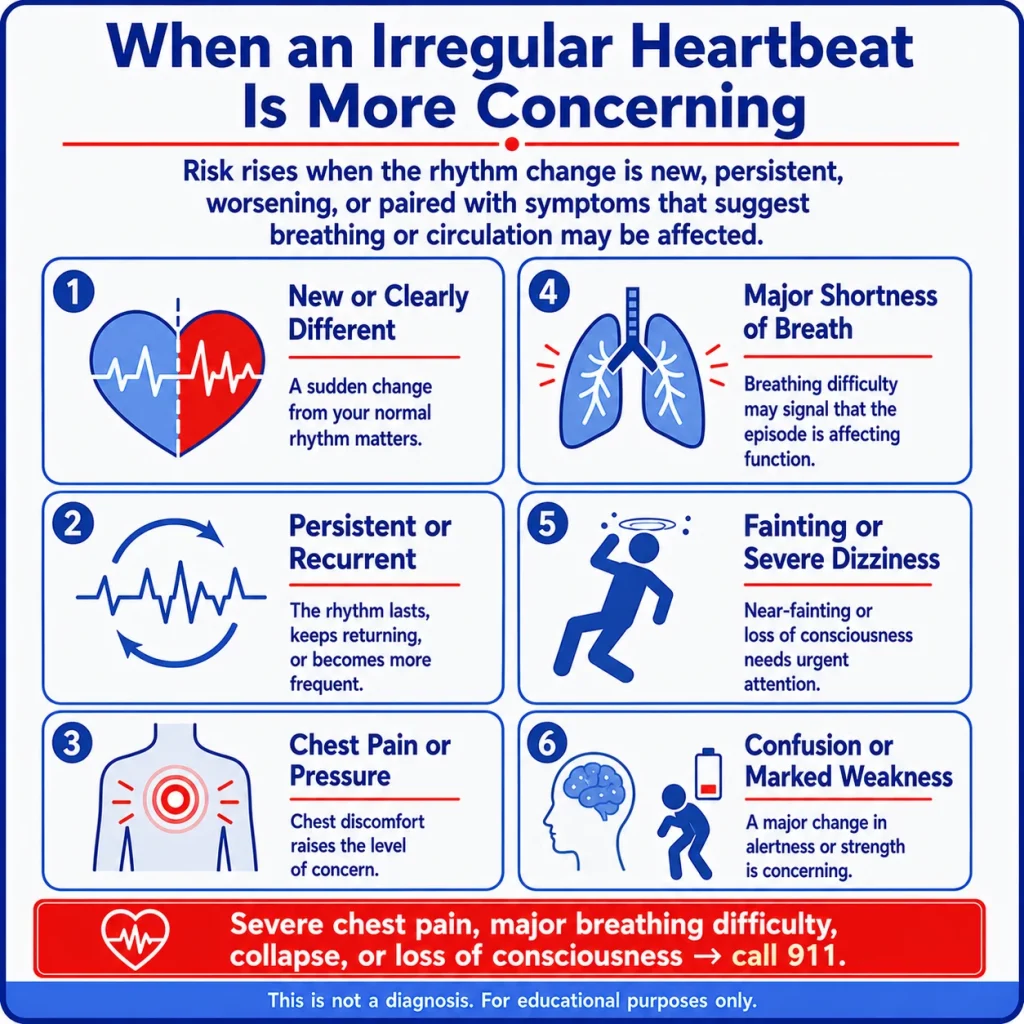
Concern rises when the rhythm change is accompanied by symptoms that may reflect reduced blood flow, impaired breathing, or another acute heart problem. The American Heart Association’s arrhythmia guidance lists dizziness, fainting or near-fainting, shortness of breath, chest pain or pressure, weakness, and collapse among the more serious symptoms that can occur when an arrhythmia affects how well the heart is working.
• The rhythm change is sudden and clearly different from your usual pattern.
• It persists, lasts longer than expected, or repeatedly returns over a short period.
• It occurs with chest pain, pressure, tightness, or other concerning chest discomfort.
• You have major or worsening shortness of breath.
• You faint, nearly faint, or feel as if you may lose consciousness.
• You develop severe dizziness, marked weakness, confusion, or a strong sense that you are seriously unwell.
• The overall symptom pattern is escalating quickly rather than settling.
If chest discomfort is part of the episode, the decision should be based on the whole symptom pattern rather than on whether the discomfort seems “mild.” Angleton ER’s chest-pain emergency guidance specifically treats chest pain with an irregular heartbeat, dizziness, fainting, shortness of breath, or extreme weakness as a combination that warrants urgent attention.
Why a Sudden Change From Your Normal Rhythm Matters
Your baseline provides useful context. A familiar brief skipped-beat sensation is different from a heartbeat that suddenly becomes irregular for the first time, stays abnormal, or feels dramatically different from previous episodes.
A recent American Heart Association review of heart palpitations emphasizes that a change from baseline should prompt evaluation, particularly when palpitations last longer or come with new lightheadedness, dizziness, shortness of breath, chest pain, or near-fainting. You do not need to identify the rhythm yourself to recognize that the pattern has changed.
Ask: Is this new? Is it lasting longer or happening more often? Is it different from usual? Has my overall condition changed with it? These questions are more useful than trying to label the rhythm by sensation.
What If the Irregular Heartbeat Comes and Goes?
An episode that stops before you are examined can still matter. Intermittent arrhythmias may be difficult to capture during a single office or ER tracing, especially if the abnormal sensation has already ended. The NHLBI’s arrhythmia diagnosis guidance explains that longer-term monitors may be used when symptoms such as palpitations or fainting do not happen continuously.
What happened during the episode still matters: how suddenly it started, how long it lasted, whether it recurred, and whether chest discomfort, breathing difficulty, fainting, or severe dizziness occurred with it. Resolution does not automatically prove the episode was harmless.
Can a Smartwatch or Home Pulse Reading Tell You Whether It Is Dangerous?
A smartwatch, home heart-rate monitor, or manual pulse check can provide useful observations, but it should not become the final decision-maker. The U.S. Food and Drug Administration notes that consumer wearables that assess heart rate or rhythm are not intended to provide a medical diagnosis. A notification can be helpful information, but a normal-looking number or the absence of an alert does not rule out every rhythm problem.
A single wearable ECG tracing may capture information worth showing a clinician, but it cannot replace evaluation when chest pressure, serious breathing difficulty, fainting, marked weakness, confusion, or rapid worsening is present. Treat the device as a clue, not as clearance.
Why the Exact Type of Arrhythmia Cannot Be Diagnosed From the Feeling Alone
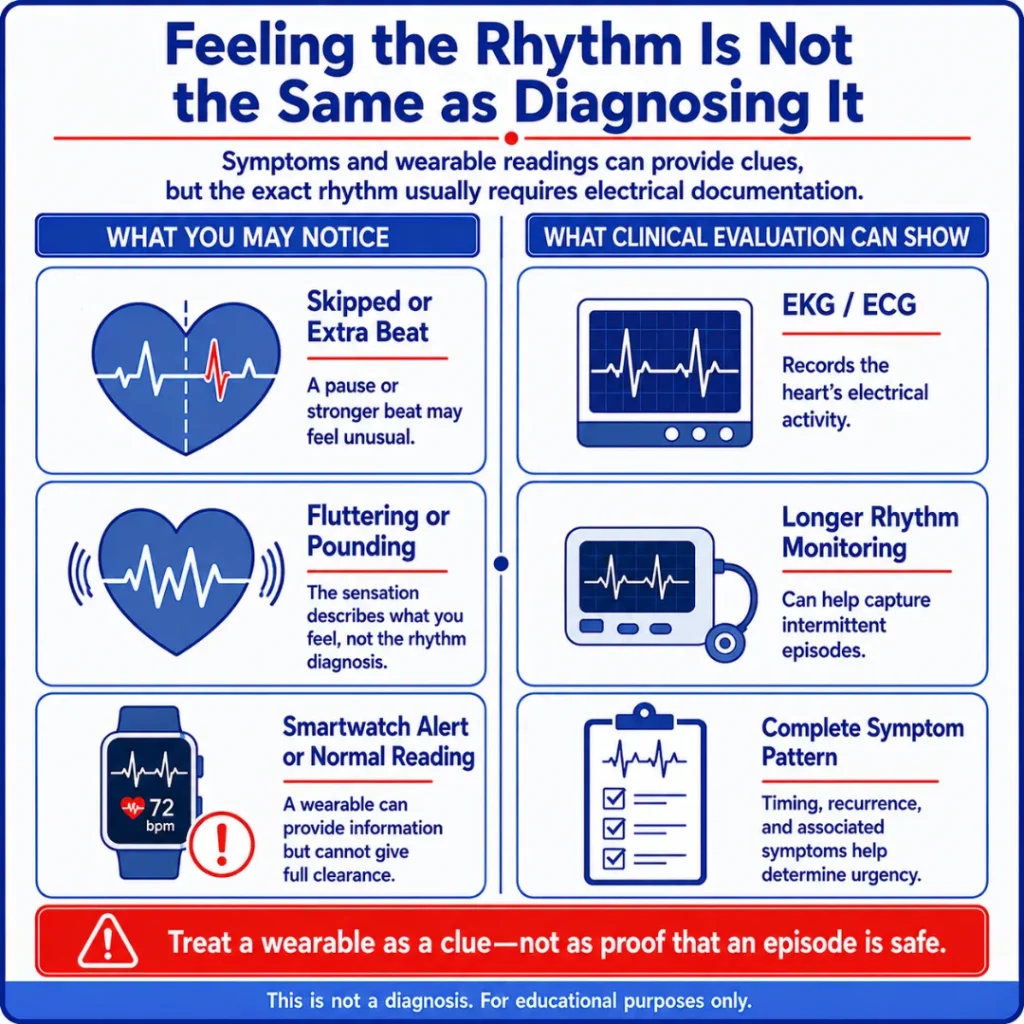
“Palpitations,” “skipped beats,” “racing heart,” and “irregular heartbeat” describe what a person notices. They are not the same as a documented rhythm diagnosis. The NHLBI identifies an electrocardiogram (ECG or EKG) as the most common test used to diagnose arrhythmias because it records the heart’s electrical activity.
If the rhythm problem is intermittent, clinicians may use additional monitoring. The American Heart Association’s overview of arrhythmia tests describes tools such as Holter and other ambulatory monitors that record rhythm over a longer period. How the heartbeat feels can guide the history, but the exact rhythm usually requires electrical documentation.
When an Irregular Heartbeat Should Not Wait
An irregular heartbeat should be treated as more urgent when it is new, persistent, rapidly changing, or accompanied by signs that circulation or breathing may be affected. The NHLBI advises emergency medical care for very serious arrhythmia symptoms such as chest pain or difficulty breathing, and fainting deserves particular attention because it can sometimes reflect a serious cardiac cause. The American Heart Association’s syncope guidance notes that abnormal fast or slow rhythms are among the heart conditions that can cause loss of consciousness.
• Call 911 for severe or life-threatening symptoms, especially chest pressure or pain, major breathing difficulty, collapse, or loss of consciousness.
• Seek urgent evaluation when a new or unusual irregular rhythm continues, keeps recurring, or is paired with near-fainting, severe dizziness, confusion, marked weakness, or a rapidly worsening overall condition.
• Do not use one heart-rate number, one wearable tracing, or the fact that symptoms briefly improved as proof that the episode is safe.
If dizziness is a prominent part of the episode, Angleton ER’s dizziness emergency guidance also flags rapid or irregular heartbeat, trouble breathing, fainting, chest pain, and severe weakness as combinations that should not be watched casually at home.
Emergency Heart-Rhythm Evaluation at Angleton ER
For people in Angleton and nearby Brazoria County communities with a new or concerning irregular heartbeat, Angleton ER is open 24/7 for emergency evaluation. Its cardiac emergency care information confirms that evaluation may include EKG/ECG testing, cardiac lab testing, monitoring, treatment or stabilization based on the ER physician’s findings, with transfer coordination when hospital-level or specialized care is required. Angleton ER also provides on-site emergency lab testing when medically appropriate. The goal is to assess the complete clinical picture rather than assume the rhythm from symptoms or a home device.
Frequently Asked Questions
When should I worry about an irregular heartbeat?
Worry more when the rhythm is new, persistent, repeatedly returning, or clearly different from your usual pattern—especially if it comes with chest discomfort, major shortness of breath, fainting, severe dizziness, confusion, or marked weakness. Severe or life-threatening symptoms warrant 911.
Can an irregular heartbeat sometimes be harmless?
Yes. Some people notice occasional skipped or extra beats without an emergency. The safer distinction is not “irregular equals dangerous,” but whether the rhythm change is new, frequent, sustained, worsening, or associated with significant symptoms.
Why does my heart sometimes feel like it skips a beat?
A skipped-beat sensation can occur when a beat happens early and is followed by a pause or stronger beat, but the feeling alone cannot identify the exact rhythm. If it is new, frequent, persistent, or accompanied by concerning symptoms, it should be evaluated.
Should I worry if an irregular heartbeat keeps coming and going?
Intermittent symptoms still matter, particularly when episodes are new, prolonged, recurrent, or paired with chest pain, breathing difficulty, fainting, or severe dizziness. A rhythm can stop before evaluation and still warrant medical assessment.
Can a smartwatch tell whether an irregular heartbeat is dangerous?
Not by itself. Wearable devices can provide useful observations, but they do not replace a clinical evaluation, and a normal reading or lack of an alert does not prove that every serious rhythm problem is absent.
Can you have a serious irregular heartbeat without severe chest pain?
Yes. Some concerning arrhythmias may cause fainting, severe dizziness, shortness of breath, weakness, confusion, or other signs of poor circulation without dramatic chest pain. The absence of severe chest pain should not override other significant warning symptoms.