
A normal pulse or blood-pressure reading can feel reassuring when you are worried about a heart attack. But those numbers cannot answer the most important question: is heart muscle being injured because its blood supply is reduced or blocked? MedlinePlus notes that during a heart attack, blood pressure may be normal, high, or low, and the pulse may be fast or uneven. In other words, there is no single home vital-sign pattern that proves – or excludes – a heart attack.
Heart rate and blood pressure are useful clinical information. They help show how the cardiovascular system is responding at that moment. But the American Heart Association describes vital signs as only one part of acute coronary syndrome assessment, alongside the symptom history and diagnostic testing. A normal-looking number should never overrule a concerning symptom pattern.
Can Your Heart Rate or Blood Pressure Be Normal During a Heart Attack?
Yes. A person can be having a heart attack while the pulse and blood pressure still fall within a range that looks normal for them. A heart attack, or myocardial infarction, is an injury to heart muscle caused by inadequate blood flow; it is not defined by one pulse rate or one blood-pressure value. If you want a deeper explanation of the artery disease that often underlies heart attacks, Angleton ER also explains coronary heart disease and how reduced coronary blood flow develops.
This is why checking a cuff or smartwatch can provide information without providing a diagnosis. The reading tells you what the device measured at that moment. It does not measure whether heart cells are being injured.
What Can Happen to Heart Rate During a Heart Attack?
There is no “heart attack BPM.” Heart rate can be faster than usual, slower than usual, irregular, or remain near a person’s usual range. The direction of the change depends on many factors, including which part of the heart is affected, the body’s stress response, pain, medications, electrical conduction changes, and whether complications are developing.
A fast pulse may occur during a heart attack, but a fast pulse also occurs in many situations that are not heart attacks. Likewise, a normal pulse does not show that coronary blood flow is normal. The practical answer to searches such as “how many beats per minute is a heart attack?” is simple: there is no diagnostic BPM threshold that can be used at home to rule a heart attack in or out.
What Can Happen to Blood Pressure During a Heart Attack?
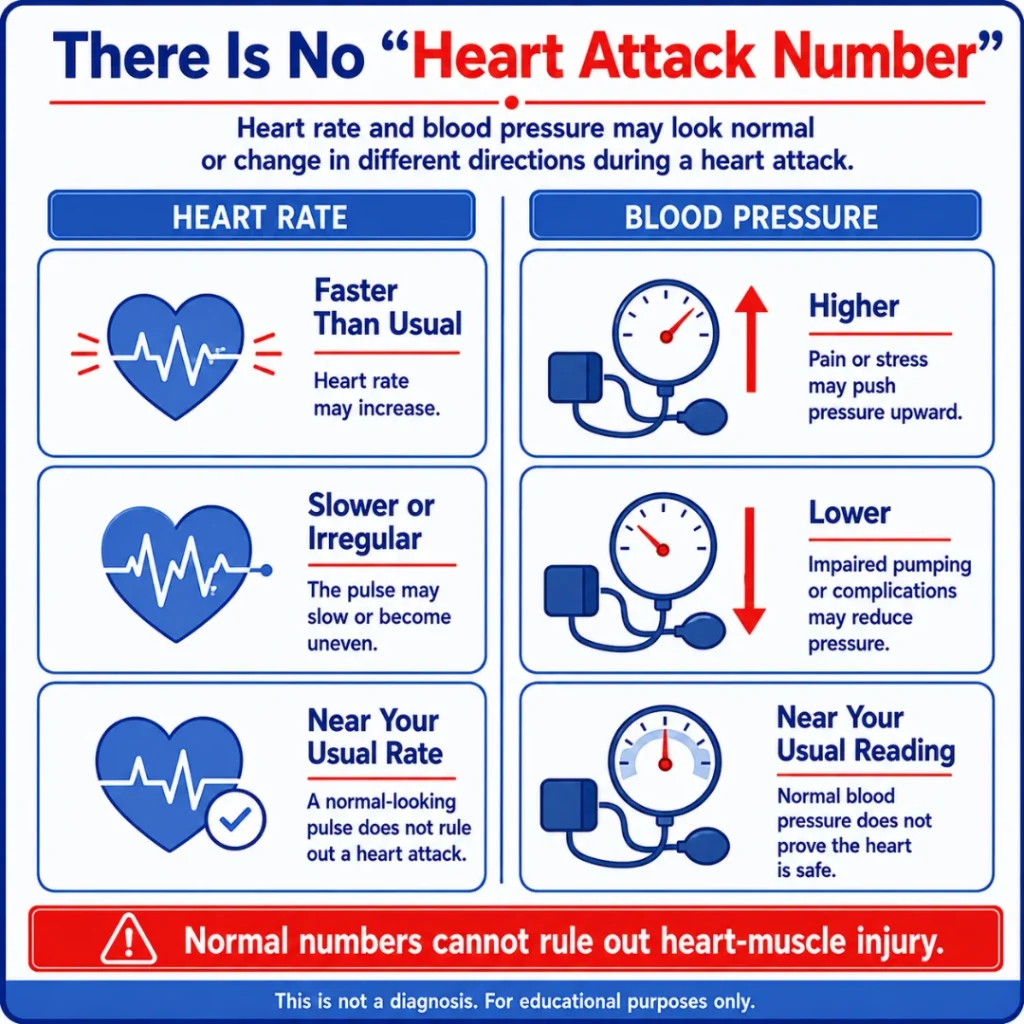
Blood pressure is variable for the same reason. It may rise, fall, or stay relatively close to a person’s usual reading. Pain and stress can push pressure upward; impaired pumping or serious complications can pull it downward; and some people may show neither pattern early on. The MedlinePlus heart attack reference specifically describes blood pressure as potentially normal, high, or low during the event.
That means a high reading does not prove that a heart attack is occurring, and a normal reading does not make a heart attack impossible. Chronic blood-pressure targets and long-term hypertension treatment are separate questions from the emergency decision being discussed here.
Why a Normal Home Reading Can Give False Reassurance
The problem is not that home devices are useless. The problem is asking them to answer a question they were never designed to answer. A blood-pressure cuff measures pressure. A smartwatch may show heart rate or rhythm information. Neither one directly measures myocardial injury.
Common thoughts such as “my blood pressure is normal, so it cannot be a heart attack,” “my pulse is normal, so my heart must be okay,” or “I checked twice and the numbers have not changed” confuse a partial snapshot with a diagnostic test. The National Heart, Lung, and Blood Institute explains that suspected heart attacks are evaluated with an EKG and blood testing such as troponin, interpreted with the clinical picture. Repeating a home reading does not replace that evaluation.
The same limitation applies to a normal smartwatch heart rate. A steady rate can be reassuring about the rate itself, but it cannot show whether a coronary artery is blocked or whether heart muscle is being damaged.
Symptoms and the Overall Pattern Still Matter More Than One Number
When heart attack is a possibility, the key question is not whether one number looks acceptable. It is whether symptoms are new, unexplained, worsening, or occurring together. Concerning patterns can include chest pressure or discomfort, shortness of breath, faintness or lightheadedness, unusual weakness, sweating, nausea, or a meaningful change from your normal baseline.
The CDC lists chest discomfort, weakness or faintness, arm or shoulder discomfort, jaw/neck/back discomfort, and shortness of breath among major heart attack symptoms. The American Heart Association also advises calling 911 when heart attack warning signs are present, even when symptoms start mildly or come and go. A normal pulse or blood-pressure reading should not be used to cancel out that symptom pattern.
How a Possible Heart Attack Is Actually Evaluated
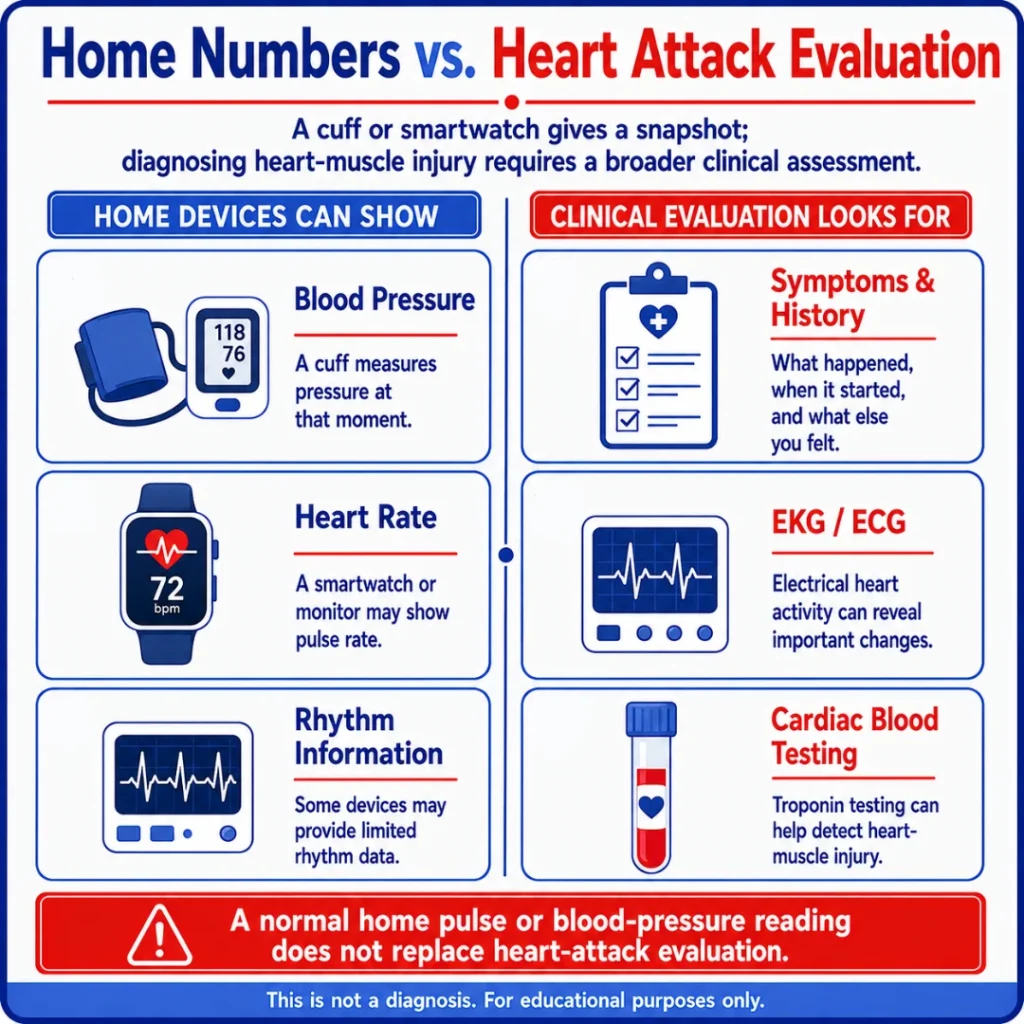
Clinicians do use heart rate and blood pressure, but they use them as part of a much larger assessment. The symptom history, physical examination, EKG/ECG, and appropriate blood tests are interpreted together. Additional testing may be needed depending on what those findings show.
The American Heart Association describes blood tests and cardiac testing as central parts of heart attack diagnosis, while the AHA/ACC chest-pain guideline identifies high-sensitivity cardiac troponin as the preferred biomarker for detecting or excluding myocardial injury. That is the core distinction: heart rate and blood pressure are useful clinical information; heart rate and blood pressure alone are not a heart attack test.
For people in Angleton and nearby communities, a normal home pulse or blood-pressure reading should not be used as a reason to postpone emergency evaluation when symptoms could represent a heart attack. If symptoms feel severe, sudden, or life-threatening, call 911 rather than driving yourself. MedlinePlus likewise advises calling emergency services even when you are not sure it is a heart attack.
When Concerning Heart Symptoms Need Evaluation in Angleton
Angleton ER provides 24/7 cardiac emergency evaluation for chest pain and heart-related symptoms. Based on the ER physician’s assessment, evaluation may include an EKG, cardiac lab testing, imaging, monitoring, stabilization, and transfer coordination when hospital-based care is required. The purpose of that evaluation is to interpret the complete clinical picture – not to decide from one home blood-pressure or pulse reading.
Frequently Asked Questions
Can you have a heart attack with normal blood pressure?
Yes. Blood pressure can be normal, high, or low during a heart attack. A normal reading does not rule out myocardial infarction when symptoms or other findings are concerning.
Can your heart rate be normal during a heart attack?
Yes. Heart rate can remain near a person’s usual range during a heart attack. It may also become faster, slower, or irregular, so the rate by itself is not a diagnostic test.
Is there a certain BPM that means you are having a heart attack?
No. There is no diagnostic heart-attack BPM cutoff. Heart attacks are evaluated from the overall clinical picture, including symptoms, EKG findings, blood testing, and other assessment when needed.
Does high blood pressure mean a heart attack is happening?
No. Blood pressure can rise for many reasons, including pain and stress. A high reading may matter clinically, but it does not by itself establish that a heart attack is occurring.
Does a normal smartwatch heart rate rule out a heart attack?
No. A smartwatch can report heart-rate information, but a normal rate does not show whether heart muscle is receiving enough blood or whether injury is occurring. Concerning symptoms still require the appropriate clinical response.
Should I seek emergency evaluation if my pulse and blood pressure are normal but I have concerning symptoms?
Yes. If symptoms could represent a heart attack, normal home readings should not be used as a reason to wait. For severe, sudden, or life-threatening symptoms, call 911.