
Yes. Possible heart attack symptoms can come and go, remain present, or change in intensity. A period of feeling better does not tell you why the symptoms happened, and it does not reliably rule out a heart problem. The American Heart Association specifically notes that heart-attack-related chest discomfort may last more than a few minutes or may go away and return.
The practical point is not to start a stopwatch. There is no single symptom duration that can safely confirm or exclude a heart attack at home. If new or unusual chest discomfort, shortness of breath, fainting or near-fainting, or a concerning combination of symptoms makes you wonder whether your heart could be involved, timing alone should not be the reason you wait.
Can Heart Attack Symptoms Come and Go?
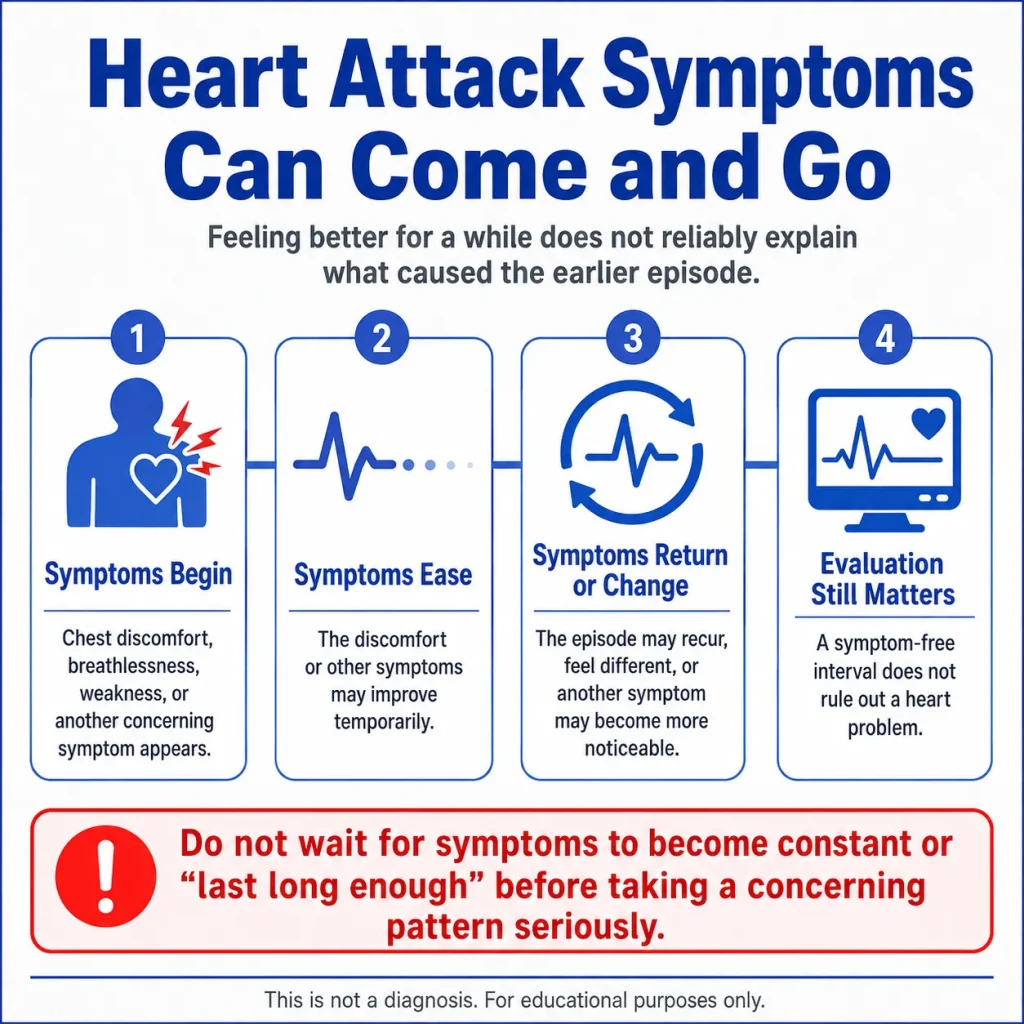
They can. The National Heart, Lung, and Blood Institute explains that heart attack symptoms can start slowly, may be mild or more serious, and may come and go over several hours. That variability is one reason a heart attack does not always match the dramatic, constant chest pain people expect from movies or television.
Intermittent symptoms are not proof of a heart attack, but they are also not proof that everything is fine. Chest pressure or discomfort may ease, breathing may feel better for a while, or one symptom may fade while another becomes more noticeable. What matters is the overall clinical picture: what happened, whether it was new or unusual, what other symptoms occurred, and whether the pattern is recurring or changing.
How Long Can Heart Attack Symptoms Last?
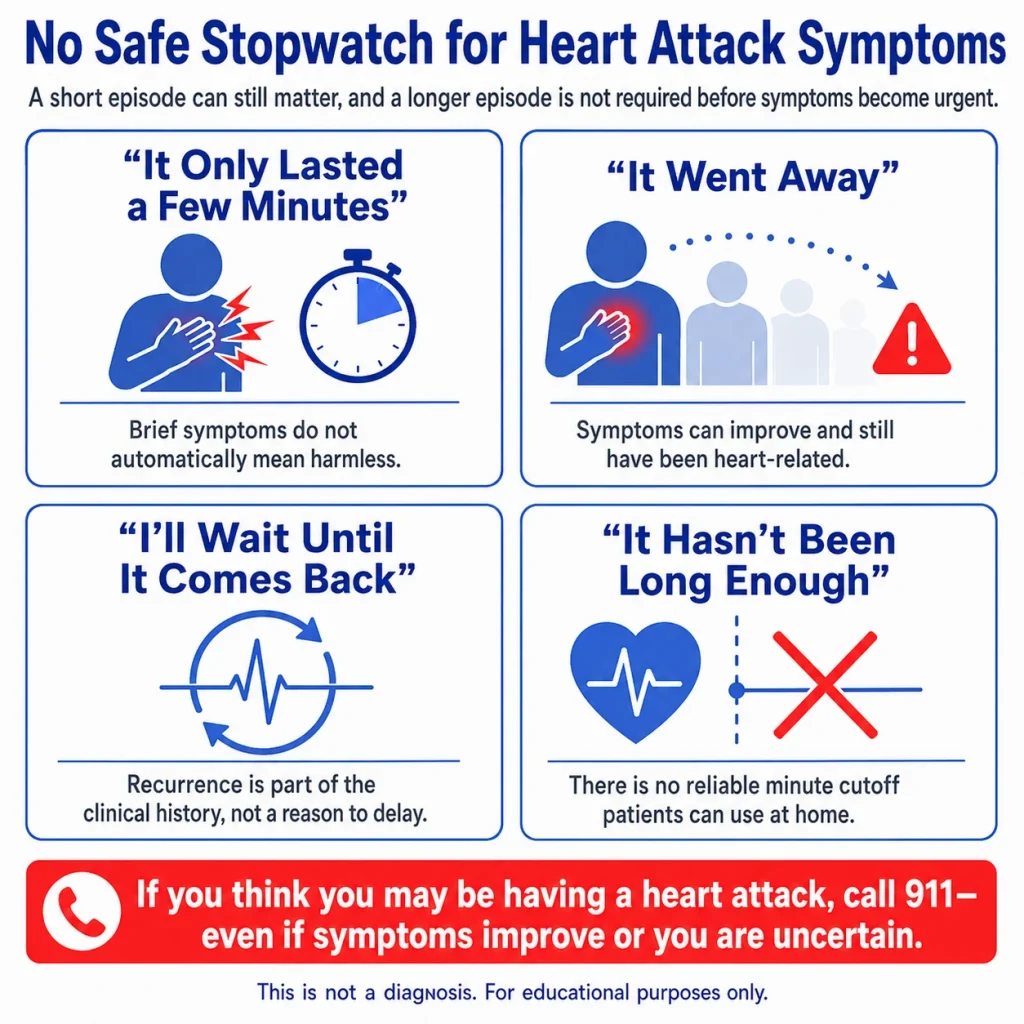
There is no reliable number of minutes that patients can use as a diagnostic cutoff. The CDC describes heart attack chest discomfort as something that may last more than a few minutes or may go away and come back. MedlinePlus gives similar guidance and emphasizes calling 911 when a heart attack is suspected.
Those descriptions should not be turned into a waiting rule. A short episode is not automatically harmless, and a longer episode is not required before the situation becomes urgent. The question is not, “Has this lasted long enough to count?” The safer question is, “Is this a new, unexplained, or concerning pattern that could represent an acute heart problem?”
Why Symptoms May Feel Different Over Time
Possible heart-related symptoms can evolve instead of following one fixed pattern. The 2021 AHA/ACC chest pain guideline summary treats a new onset or a change in a symptom’s pattern, intensity, or duration as part of how acute chest pain is assessed. In everyday terms, that means the story can change while the underlying concern still deserves evaluation.
• Discomfort may ease and then return.
• The intensity may rise, fall, or feel different from one episode to the next.
• Shortness of breath, weakness, nausea, or another symptom may become more noticeable than the chest sensation.
• Symptoms may seem mild at first and later feel more concerning.
• A person may feel temporarily normal and assume the danger has passed.
None of those patterns can diagnose a heart attack by themselves. Their value is in showing why symptom timing should be interpreted in context rather than used as a home rule-out test. If you want the artery-disease background without expanding this timing discussion, Angleton ER covers it separately in its coronary heart disease guide.
Why “It Went Away” Can Create False Reassurance
A symptom-free interval can be psychologically convincing. People understandably think, “The discomfort stopped, so maybe it was nothing,” or “If this were a heart attack, wouldn’t the pain stay constant?” But symptom resolution is information, not a diagnosis.
MedlinePlus first-aid guidance specifically advises people not to wait to see whether suspected heart attack symptoms go away. The reason is simple: symptoms can fluctuate, and the absence of symptoms at one moment does not explain what caused the episode that occurred earlier.
The same caution applies when discomfort lasts only a short time or repeatedly settles between episodes. Timing can help clinicians understand the pattern, but timing by itself cannot confirm or exclude myocardial infarction, unstable angina, or another urgent cause of chest or breathing symptoms.
What If the Symptoms Have Already Stopped?
Symptoms That Resolved but Were Concerning
If a concerning episode has stopped, the disappearance of symptoms does not retrospectively identify the cause. A recent episode of new chest pressure or discomfort, shortness of breath, near-fainting, unusual weakness, or several concerning symptoms together still deserves prompt clinical attention when a heart problem is possible.
If you want a broader review of the symptom patterns that can occur, Angleton ER’s heart attack warning-sign guide covers that topic in more detail. This article stays focused on the timing question: feeling better now is not the same as knowing the episode was harmless.
Symptoms That Keep Returning
Repeated unexplained chest or breathing symptoms should not become “normal” simply because each episode settles. Recurrence is part of the history a clinician uses to judge urgency and decide what testing is appropriate.
Evaluation may include the symptom history together with an EKG and blood testing such as troponin when appropriate. The American Heart Association’s 2025 acute coronary syndrome patient guidance emphasizes both the timing of symptoms and treatment and the role of ECG and blood tests in evaluating suspected acute coronary syndrome.
When Timing Should Not Delay Emergency Evaluation
Do not wait for a symptom to become constant, unbearable, or long enough to cross an imagined threshold. New or concerning chest pressure or discomfort, shortness of breath, fainting or near-fainting, unusual weakness, or several concerning symptoms occurring together should be taken seriously. If you think you may be having a heart attack, call 911; the American Heart Association advises getting emergency help even when you are not sure.
This is especially important when symptoms are recurring, changing from your usual baseline, or returning after a symptom-free interval. For more general chest-pain decision guidance, Angleton ER also explains when chest pain needs emergency evaluation.
For people in Angleton and nearby Brazoria County communities, the decision should be based on the concerning clinical picture—not on whether symptoms lasted a particular number of minutes or temporarily went away. If symptoms are severe, sudden, or may be life-threatening, call 911 rather than driving yourself.
Emergency Heart Evaluation in Angleton
Angleton ER provides 24/7 cardiac emergency evaluation for chest pain and heart-related symptoms. Based on the ER physician’s evaluation, care may include an EKG, cardiac lab testing such as troponin, monitoring, medication, imaging when medically appropriate, and stabilization; if hospital admission, cardiac catheterization, surgery, or other higher-level cardiac care is required, the facility states that transfer can be coordinated. The goal in a possible heart emergency is to evaluate the problem promptly—not to use symptom duration as reassurance.
Frequently Asked Questions
Can heart attack symptoms stop and then come back?
Yes. Heart attack symptoms can improve and then return, and some people experience symptoms in waves rather than as one constant episode. A symptom-free interval does not by itself rule out a heart attack.
How long can heart attack symptoms last before a heart attack happens?
There is no reliable countdown that tells you when a heart attack will happen. Symptoms that seem like “warning symptoms” may represent an active acute coronary problem already, so new or concerning symptoms should not be timed at home to decide when they become serious.
Can heart attack pain last only a few minutes?
A brief episode cannot safely rule out a heart-related problem. Some authoritative sources describe heart attack discomfort as lasting more than a few minutes, but they also note that symptoms may go away and return; duration alone is not a safe diagnostic test.
If chest discomfort goes away, could it still have been heart-related?
Yes. Chest discomfort can stop even when the earlier episode still requires medical evaluation. If the episode was new, unusual, or accompanied by other concerning symptoms, feeling better afterward should not be the only reason to dismiss it.
Can heart attack symptoms come and go over several hours?
They can. The NHLBI notes that heart attack symptoms may come and go over several hours. That pattern is possible, but it is not specific enough to diagnose a heart attack without clinical evaluation.
Should I seek emergency evaluation if the symptoms have stopped but were unusual or concerning?
Yes, if the episode could have represented a heart emergency, it should not be dismissed solely because it resolved. If symptoms are severe, recur, or you think you may be having a heart attack, call 911.