
Yes. COPD can occur in people who have never smoked. Cigarette smoking remains the leading COPD risk factor in the United States, but secondhand smoke, long-term workplace or environmental exposures, genetic susceptibility, and other factors can also contribute.
The key distinction is risk versus cause. An exposure can raise COPD risk without proving that it caused one person’s disease. Never smoking lowers an important risk but does not make COPD impossible. For broader background, see Angleton ER’s chronic lower respiratory disease overview. Here, the focus is COPD risk in nonsmokers and when that history deserves medical evaluation.
Can You Have COPD If You Have Never Smoked?
Yes. The CDC notes that as many as 1 in 4 Americans with COPD have never smoked cigarettes. COPD is a chronic lung disease in which airflow becomes persistently limited, and smoking history is only one part of the clinical picture.
That corrects a common misconception: “I never smoked, so COPD cannot explain my breathing problems.” A nonsmoker with ongoing breathlessness, cough, wheezing, or reduced exercise tolerance may still need evaluation. Conversely, having a COPD risk factor does not mean someone has or will develop COPD.
Why Smoking Is Strongly Associated With COPD—but Is Not the Only Risk
Smoking is strongly linked to COPD because repeated tobacco-smoke exposure can damage the lungs and airways over many years. The National Heart, Lung, and Blood Institute identifies cigarette smoking as the most common cause of COPD in the United States and also recognizes long-term exposure to other inhaled irritants as a risk.
COPD risk reflects cumulative lung injury and individual susceptibility. Tobacco smoke is a major source, but duration, intensity, timing, and a person’s underlying susceptibility also shape risk.
What Can Cause or Increase COPD Risk Besides Smoking?
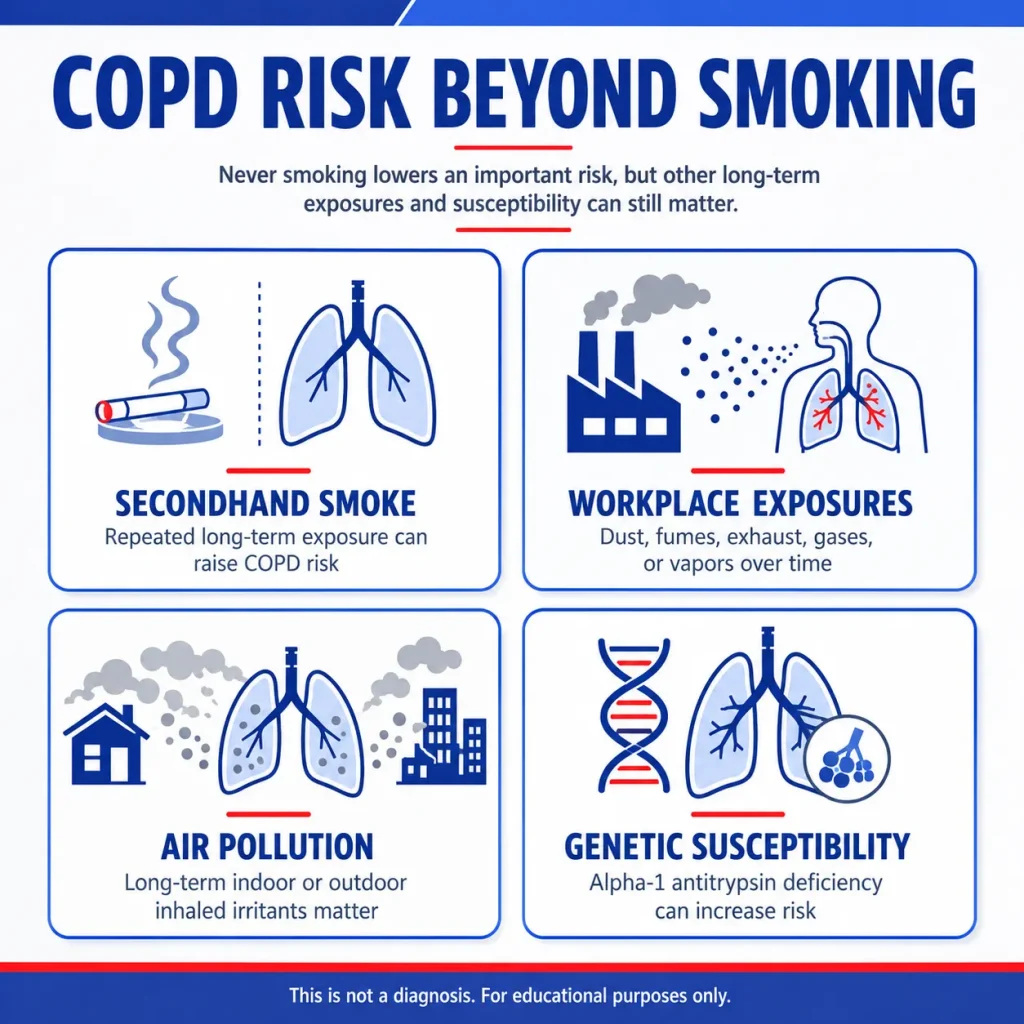
For nonsmokers, it is more useful to consider broad patterns of long-term exposure and susceptibility than to search for one event that “must have” caused COPD.
Long-Term Secondhand Smoke Exposure
Repeated exposure to other people’s tobacco smoke can contribute to COPD risk even when the exposed person does not actively smoke. The CDC lists secondhand smoke among recognized COPD risk factors. Exposure during childhood and adolescence may also affect lung growth and development, which can matter later in life.
Risk depends on the broader exposure pattern; a brief or occasional exposure does not establish that secondhand smoke caused COPD.
Workplace Dust, Fumes, and Chemical Exposure
Some jobs involve repeated inhalation of dust, fumes, smoke, gases, vapors, or exhaust. CDC’s National Institute for Occupational Safety and Health describes occupational exposures as an important contributor to COPD and identifies examples such as mineral and organic dusts, welding or metal fumes, diesel or engine exhaust, smoke, and other chemical gases or vapors.
Cumulative exposure matters most. Years around respiratory pollutants may be clinically relevant; one short workplace exposure does not establish COPD.
Air Pollution and Other Long-Term Environmental Exposures
Long-term exposure to polluted air and certain inhaled irritants can also increase COPD risk. The World Health Organization lists outdoor and indoor air pollution among COPD risk factors, including sustained exposure to smoke from biomass fuels or coal used for cooking or heating in poorly ventilated settings.
A bad-air day may aggravate breathing, but COPD risk is more closely tied to long-term exposure patterns and overall respiratory history. One pollutant should not automatically be labeled the cause.
Genetics and Alpha-1 Antitrypsin Deficiency
Genetics can influence how susceptible someone is to COPD. One established inherited condition is alpha-1 antitrypsin deficiency, or AAT deficiency. MedlinePlus explains that AAT deficiency is inherited and increases the risk of lung disease, including COPD. It can contribute to COPD developing at a younger age than is typical.
COPD is not simply inherited in a predictable pattern. A parent or sibling with COPD does not guarantee disease, while AAT deficiency is a specific genetic risk clinicians can evaluate when appropriate.
Can Family History Increase COPD Risk?
Family history can matter without proving hereditary COPD. Relatives may share genes, tobacco-smoke exposure, environments, occupations, or early-life conditions that affect lung health.
If a parent had COPD and you never smoked, that means family history belongs in the risk assessment—not that you will inevitably develop COPD.
Can COPD Develop Without One Obvious Cause?
Yes. COPD does not always reduce to one clear exposure. The WHO describes COPD as often developing from a combination of risk factors, which can include tobacco or secondhand smoke, occupational exposures, air pollution, factors that limit lung growth, childhood asthma, severe respiratory infections earlier in life, and genetic susceptibility.
A person may accumulate several risks over decades, or have no obvious exposure history and still develop persistent airflow limitation. When symptoms and clinical findings suggest chronic lung disease, never smoking should not end the investigation.
Exposure History Is Not the Same as a COPD Diagnosis
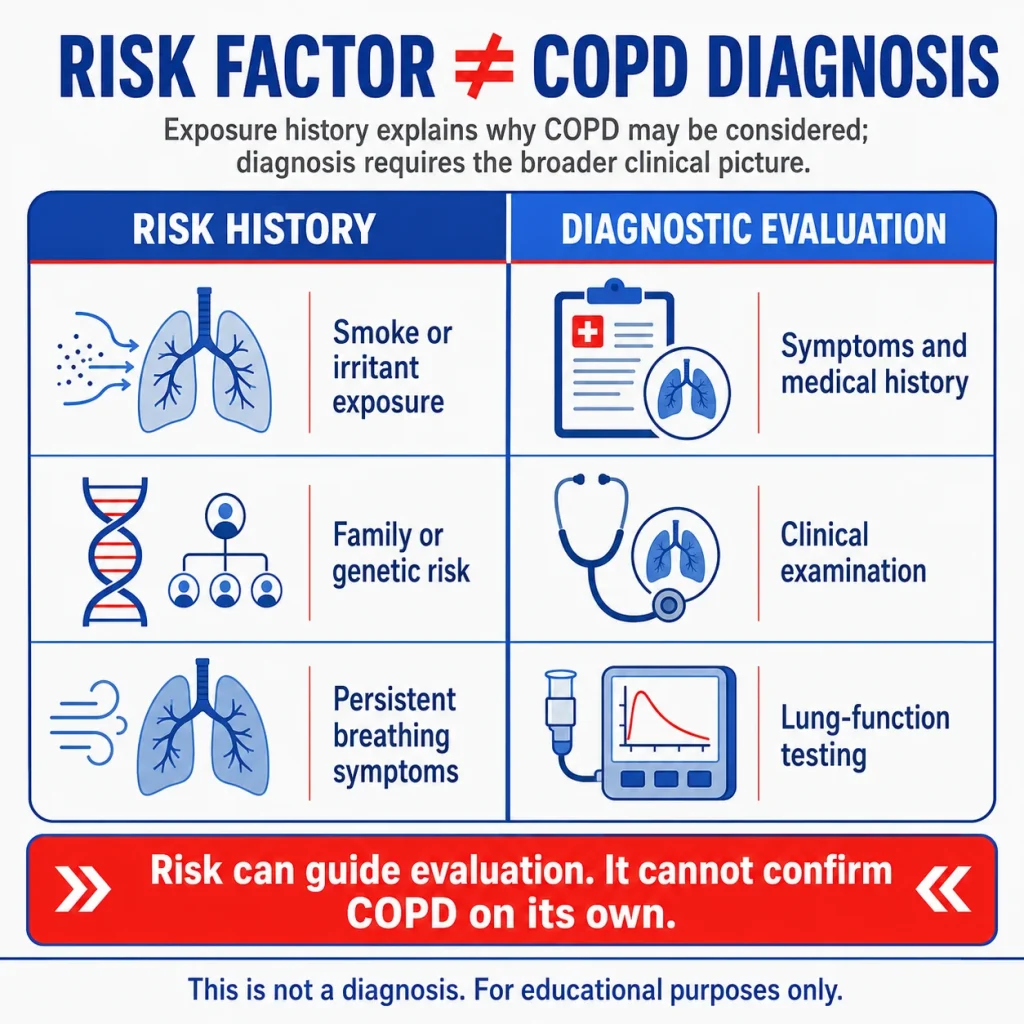
Neither smoking history nor nonsmoking risk factors diagnose COPD. Years of dust exposure or a family history may exist without disease, and chronic cough or breathlessness can have other causes.
According to the NHLBI’s COPD diagnosis guidance, clinicians consider symptoms, medical and family history, exposure history, examination findings, and test results. Spirometry is the main lung-function test used to confirm persistent airflow obstruction, but the important point for patients is simpler: an exposure history may explain why COPD is considered; it cannot confirm the diagnosis on its own.
When Should a Nonsmoker With Breathing Symptoms Talk to a Healthcare Professional?
Discuss breathing symptoms with a healthcare professional when they are ongoing, recurring, or clearly different from your normal. NHLBI lists shortness of breath, ongoing cough, wheezing, chest tightness, and fatigue among common COPD symptoms while also emphasizing that not everyone with these symptoms has COPD.
Evaluation is especially worth discussing when symptoms occur alongside a history such as:
• substantial or prolonged secondhand smoke exposure
• years of workplace exposure to dust, fumes, smoke, exhaust, or chemicals
• significant long-term environmental or household smoke exposure
• COPD in close family members
• known or suspected alpha-1 antitrypsin deficiency or another relevant genetic risk
The combination of symptoms and risk history is a reason for proper evaluation—not a shortcut to self-diagnosis.
The Most Important Question Is Not Just “Did You Smoke?”
Smoking history matters, but COPD risk assessment should consider the person’s lifetime respiratory history, including:
• current or past smoking and secondhand smoke exposure
• workplace dust, fumes, smoke, exhaust, and chemical exposure
• long-term indoor or outdoor environmental exposures
• family history and known genetic risks
• childhood and previous respiratory health
• persistent or changing breathing symptoms
Never smoking lowers a major COPD risk, but it does not make COPD impossible—and exposure history alone cannot prove COPD or identify its cause.
Emergency Evaluation for Serious Breathing Symptoms in Angleton
For Angleton-area patients, persistent breathing symptoms deserve evaluation even without a smoking history. If breathing becomes severe, rapidly worsens, or turns into an acute respiratory problem, Angleton ER provides 24/7 emergency care for breathing concerns. Depending on the symptoms, examination, and suspected cause, emergency assessment may include oxygen evaluation, imaging, or on-site lab testing when medically appropriate to identify an acute condition requiring immediate treatment or higher-level care.
Frequently Asked Questions
Can you really get COPD if you have never smoked?
Yes. Smoking is the leading COPD risk factor in the United States, but COPD also occurs in people who have never smoked. Long-term inhaled exposures, genetics, lung development, and other factors can contribute.
What causes COPD in nonsmokers?
Possible contributors include secondhand smoke, workplace dust or fumes, environmental and household air pollution, alpha-1 antitrypsin deficiency, and other factors that affect lung growth or susceptibility. Often there is not one single identifiable cause.
Can secondhand smoke cause COPD?
Long-term secondhand smoke exposure can increase COPD risk. That does not mean every exposure leads to COPD or that a person can identify the cause of COPD from exposure history alone.
Is COPD hereditary?
COPD is not usually inherited in a simple, predictable pattern. Genetics can affect susceptibility, and alpha-1 antitrypsin deficiency is a specific inherited condition that can increase COPD risk.
Can workplace dust or chemical fumes contribute to COPD?
Yes. Repeated occupational exposure to certain dusts, fumes, exhaust, smoke, gases, or vapors can contribute to long-term COPD risk. Duration and cumulative exposure are more meaningful than one brief workplace event.
Can air pollution increase the risk of COPD?
Yes. Long-term exposure to outdoor air pollution and, in some settings, indoor smoke from cooking or heating fuels can contribute to COPD risk. Air quality is one part of a broader lifetime exposure history.
How do doctors know whether a nonsmoker has COPD?
Clinicians consider symptoms, medical and family history, exposure history, examination findings, and lung-function testing. Spirometry is commonly used to confirm persistent airflow obstruction rather than relying on smoking history alone.
Should I be evaluated for COPD if I have breathing symptoms but never smoked?
If shortness of breath, cough, wheezing, or reduced activity tolerance is persistent or recurring, discuss it with a healthcare professional. Never smoking does not rule out COPD, and the same symptoms can also come from other conditions that need evaluation.