

Finding a Breast Lump Can Feel Scary
Finding a lump in your breast can stop you in your tracks. For many people, the first thought is cancer, and that fear is completely understandable. But it is important to know that not every breast lump is cancer. Breast lumps can happen for many reasons, including cysts, hormonal changes, infections, inflammation, injuries, or benign breast conditions.
Still, a breast lump should not be ignored simply because it might be harmless. The goal is not to diagnose yourself by touch. The goal is to recognize when a new or changing lump deserves medical evaluation so you can get the right next steps.
Why breast lump symptoms should not be ignored
A new, changing, persistent, hard, fixed, or unexplained breast lump should be checked by a medical provider, even if it does not hurt. Some breast changes are temporary or benign, but others need imaging, follow-up, or additional testing to understand what is happening.
Waiting too long can make the situation more stressful and may delay care if the lump needs attention. Getting evaluated does not mean something serious is definitely wrong. It means you are taking the change seriously and giving yourself the best chance for clarity.
What Does a Breast Cancer Lump Feel Like?
A breast cancer lump can sometimes feel hard, firm, fixed, irregular, or different from the tissue around it. However, feel alone cannot diagnose breast cancer. Some cancerous lumps may not match the “classic” description, and many non-cancer lumps can feel concerning.
The safest approach is this: any new, persistent, growing, or unusual breast lump should be evaluated rather than judged only by how it feels.
Hard or firm lump
Some concerning breast lumps may feel firm or hard, almost like a knot or dense area within the breast tissue. They may feel noticeably different from the surrounding breast tissue.
But a hard lump is not automatically cancer. Cysts, scar tissue, benign growths, and other conditions can sometimes feel firm. Because touch is not reliable enough to tell the difference, a hard lump should be checked instead of watched indefinitely.
Fixed or less movable lump
A lump that feels attached, deep, or difficult to move may need prompt evaluation. Some benign lumps can feel less movable depending on their location, but a lump that seems fixed in place deserves medical attention.
If the lump feels stuck to the skin, chest wall, or deeper breast tissue, or if it seems different from anything you have felt before, it is better to have it assessed.
Painless lump
A breast lump does not have to hurt to be important. In fact, one common misunderstanding is that pain is the main warning sign. A painless lump can still need evaluation if it is new, persistent, growing, hard, fixed, or unusual for you.
Pain can be helpful information, but the absence of pain does not automatically make a lump harmless.
Irregular or uneven feeling
Some concerning lumps may feel uneven, rough, or irregular rather than smooth and round. But patients cannot reliably identify cancer by shape or texture alone.
If a lump feels different from the rest of the breast, seems to have uneven edges, or continues to be noticeable over time, it should be discussed with a medical provider.
Can Breast Cancer Lumps Hurt?
Breast pain can happen for many reasons and does not automatically mean cancer. Hormonal changes, cysts, inflammation, muscle strain, infection, and benign breast conditions can all cause pain or tenderness.
However, a painful breast lump should still be evaluated if it is new, persistent, worsening, associated with redness or fever, or different from your usual breast changes.
Painful lumps may have non-cancer causes
Painful breast lumps are often related to non-cancer causes. These may include fluid-filled cysts, fibrocystic breast changes, hormonal shifts, infection, inflammation, injury, or abscess.
For example, a cyst may feel tender or smooth. An infection may cause pain, warmth, swelling, and redness. A hormonal lump may feel more noticeable before a menstrual period and improve afterward.
Even when a non-cancer cause is possible, new or unusual symptoms should not be dismissed without proper evaluation.
Pain should not be the only deciding factor
Pain alone does not tell you whether a lump is serious. Both painful and painless lumps can need medical evaluation depending on the full picture.
A lump that hurts but improves with your normal cycle may be less concerning than a lump that is hard, growing, fixed, or paired with skin changes. On the other hand, a painless lump that stays or grows should not be ignored just because it does not hurt.
Breast Lump Features That Should Be Checked
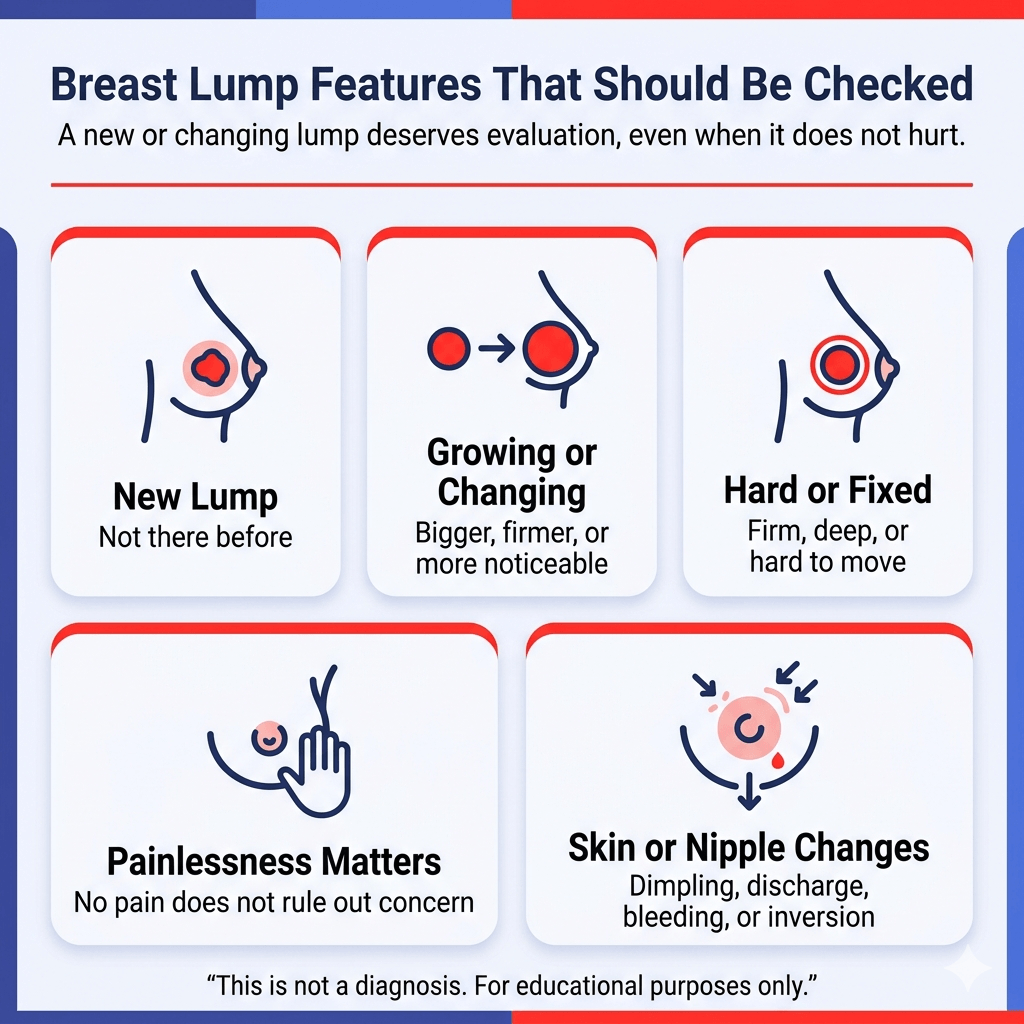
The most important question is not “Can I tell what this is by touch?” The better question is “Does this change need medical evaluation?”
Several breast lump features should be checked by a provider.
A new lump
Any new breast lump should be taken seriously enough to discuss with a medical provider, especially if it does not clearly go away. This is true even if you are young, healthy, breastfeeding, or have had benign breast changes before.
New does not always mean dangerous, but it does mean the lump should be understood.
A lump that is growing or changing
A lump that changes in size, shape, firmness, tenderness, or how it feels compared with nearby tissue should be evaluated. Changes over time can help a provider decide whether imaging, follow-up, or additional testing is needed.
If the lump seems to be getting larger or more noticeable, do not wait for months hoping it will disappear.
A hard lump in the breast
A hard lump should be checked rather than watched indefinitely, especially if it feels different from the rest of your breast tissue. While some hard lumps are benign, firmness can be one reason a provider recommends imaging or closer evaluation.
The key is not to panic, but also not to ignore it.
A lump that does not move easily
A fixed or deep-feeling lump deserves medical attention. If the lump does not move easily under your fingers, feels attached, or seems to sit deeper in the breast, it should be evaluated.
This does not prove cancer, but it is a feature that should not be brushed aside.
A lump with skin or nipple changes
These symptoms can have different causes, including infection or inflammation, but they should be evaluated rather than treated as minor irritation.
Common Non-Cancer Reasons for Breast Lumps
Many breast lumps are not cancer. Knowing this can help reduce fear, but reassurance should not replace evaluation when a lump is new, persistent, or changing.
Cysts or fluid-filled lumps
Breast cysts are fluid-filled areas that may feel round, smooth, tender, or movable. Some cysts become more noticeable or painful around the menstrual cycle.
Even if a cyst is suspected, a new or symptomatic lump may still need evaluation to confirm what it is.
Fibrocystic or hormonal breast changes
Some people experience breast lumpiness, tenderness, or swelling that changes with hormonal cycles. These changes may feel worse before a period and improve afterward.
Still, a new lump should not be automatically dismissed as hormonal, especially if it feels different, stays after your cycle, or continues to grow.
Breast infection or abscess
A breast infection or abscess may cause pain, redness, warmth, swelling, fever, drainage, or a tender lump. These symptoms can worsen quickly and may need urgent medical care, especially if you feel ill or the redness is spreading.
Infections can happen during breastfeeding, but they can also occur in people who are not breastfeeding.
Benign breast growths
Some breast lumps are benign growths, meaning they are not cancer. However, “benign” does not mean “ignore it.” A provider may still recommend imaging, monitoring, or follow-up to make sure the lump is stable and properly identified.
When a Breast Lump May Need Urgent or Emergency Care
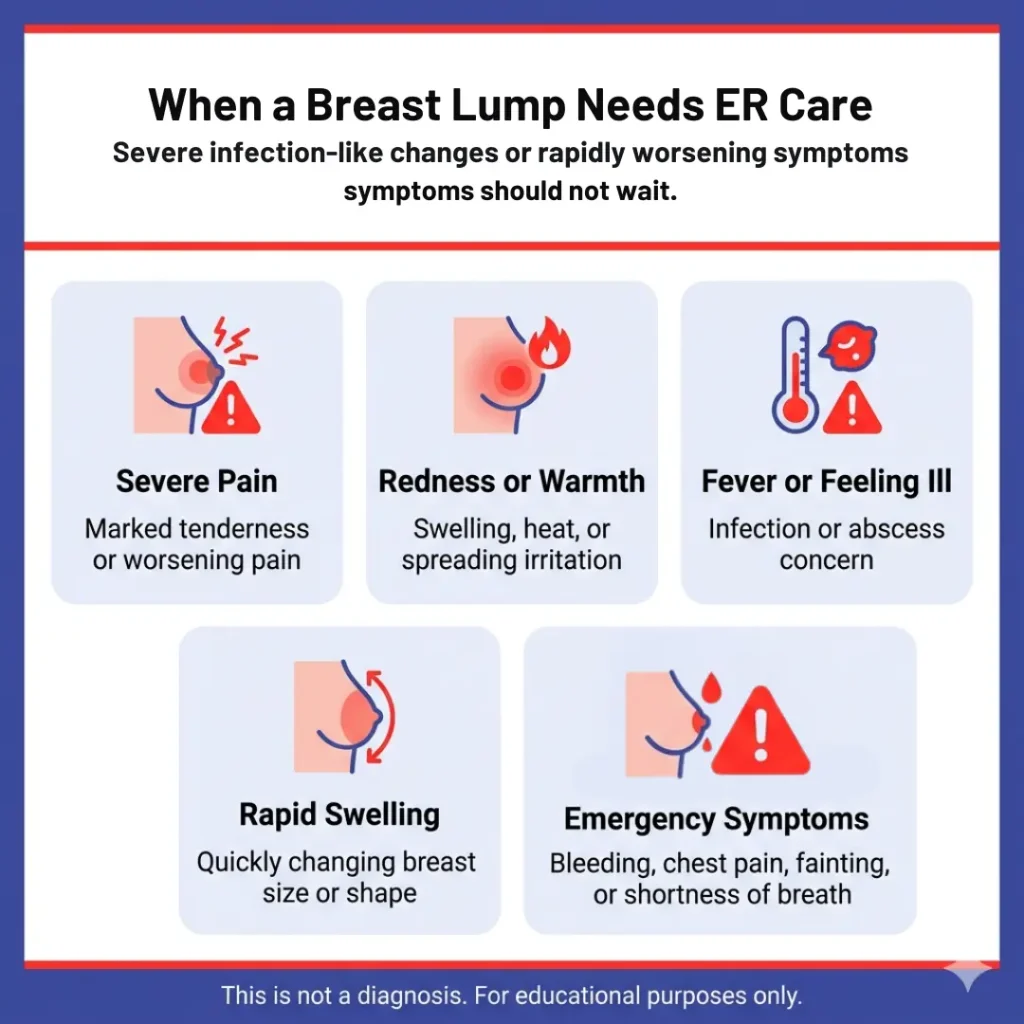
Many breast lumps can be evaluated through a primary care provider, OB-GYN, breast specialist, or imaging center. But some symptoms may need urgent or emergency care, especially when they are severe, rapidly worsening, or paired with signs of infection or another serious problem.
Severe pain, redness, warmth, or fever
A painful breast lump with redness, warmth, swelling, or fever may suggest infection or abscess. This is especially important if symptoms are worsening, the area is spreading, or you feel sick.
Emergency evaluation may be appropriate when pain is severe, fever is present, or symptoms are progressing quickly.
Rapid swelling or worsening breast changes
Rapidly increasing swelling, spreading redness, severe tenderness, or feeling very ill should not be ignored. These symptoms may need same-day evaluation to determine whether urgent treatment is needed.
Nipple bleeding or concerning discharge with other symptoms
Nipple bleeding, unusual discharge, or nipple changes should be checked, especially when paired with a new lump, pain, swelling, fever, redness, or skin changes.
Not all nipple discharge is an emergency, but bleeding or discharge with other concerning symptoms deserves prompt medical attention.
Chest pain, shortness of breath, fainting, or severe weakness
Chest pain, shortness of breath, fainting, or severe weakness needs emergency care regardless of whether a breast lump is also present. These symptoms may point to a medical issue outside the breast and should be evaluated right away.
What to Expect When a Breast Lump Is Evaluated
A breast lump evaluation is usually focused on understanding what changed, what symptoms are present, and what testing or follow-up may be needed. The exact process depends on your age, medical history, symptoms, exam findings, and the type of lump.
Medical history and physical exam
A provider may ask when you first noticed the lump, whether it has changed, whether it hurts, and whether symptoms change with your menstrual cycle. They may also ask about pregnancy or breastfeeding, hormonal medications, family history, prior breast imaging, nipple symptoms, fever, recent injury, or skin changes.
A physical exam can help identify the location, size, tenderness, movement, and surrounding changes, but it usually cannot confirm the exact cause by itself.
Imaging such as mammogram or ultrasound
Depending on your age, symptoms, and exam findings, imaging may be recommended. This may include a breast ultrasound, mammogram, or other imaging when appropriate.
Imaging helps providers better understand whether a lump appears fluid-filled, solid, inflamed, or otherwise concerning. The right imaging choice depends on the situation.
Follow-up or biopsy when needed
Some breast lump findings need monitoring, specialist referral, or biopsy to confirm what the lump is. A biopsy is not always needed, but when it is recommended, it is usually because imaging or exam findings require a more definite answer.
The important point is that evaluation helps guide the next step. It does not always mean something serious is found.
What Not to Assume About a Breast Lump
When you find a breast lump, it is natural to look for reassurance quickly. But certain assumptions can delay care or create unnecessary fear.
- Do not assume a painless lump is harmless. A lump can be important even if it does not hurt.
- Do not assume every painful lump is cancer. Painful lumps often have non-cancer causes, including cysts, infection, inflammation, or hormonal changes.
- Do not rely on touch alone to diagnose yourself. The way a lump feels can provide clues, but it cannot confirm whether the lump is benign or cancerous.
- Do not ignore a lump because you are young. Breast cancer is less common in younger people, but young age does not make evaluation unnecessary when a lump is new or changing.
- Do not delay care if the lump is changing, hard, fixed, or paired with skin or nipple changes.
- Do not try to squeeze, drain, or treat a breast lump at home. This can worsen irritation, infection, pain, or swelling. If a lump appears infected or is draining, it should be evaluated by a medical provider.
How to Track Breast Lump Changes Before Your Visit
Tracking details can help your provider understand what has been happening. This should not be used as a reason to delay care if symptoms are urgent, but it can be helpful while preparing for your appointment.
Write down when you first noticed the lump and whether it is growing, shrinking, or staying the same. Notice whether it feels hard, soft, movable, or fixed. Pay attention to whether it is painful or tender.
Also note any redness, warmth, swelling, nipple discharge, bleeding, dimpling, skin thickening, or other skin changes. If you have menstrual cycles, pay attention to whether the lump changes before or after your period.
If possible, bring information about family history, prior breast imaging, previous breast lumps, medications, pregnancy, breastfeeding, or recent injury. These details can help guide the evaluation.
If you are in Angleton or a nearby community and a breast lump is paired with severe pain, redness, warmth, fever, nipple bleeding, rapid swelling, chest pain, shortness of breath, fainting, or symptoms that are quickly worsening, Angleton ER provides 24/7 emergency care. Our emergency team can evaluate urgent symptoms, perform appropriate lab testing or imaging when needed, and help determine whether your condition needs immediate treatment, stabilization, or follow-up with the right provider.
Frequently Asked Questions
What does a breast cancer lump usually feel like?
A breast cancer lump may sometimes feel hard, firm, fixed, irregular, or different from the surrounding breast tissue. However, you cannot diagnose breast cancer by touch alone. Many non-cancer lumps can also feel firm or unusual, so a new or changing lump should be evaluated by a medical provider.
Can a breast cancer lump be painful?
Yes, a breast cancer lump can sometimes be painful, but many breast cancers do not cause pain early on. Pain can also come from cysts, hormonal changes, infection, inflammation, or injury. A painful lump should be checked if it is new, persistent, worsening, or paired with redness, fever, swelling, or nipple changes.
Is a hard lump in the breast always cancer?
No. A hard breast lump is not always cancer. Some benign conditions can feel firm or hard. Still, a hard lump should not be ignored, especially if it is new, growing, fixed, or different from the rest of your breast tissue.
Should I worry about a breast lump that moves?
A movable lump is often less concerning than a fixed lump, but it still may need evaluation if it is new, persistent, painful, growing, or unusual for you. Movement alone does not prove that a lump is harmless.
Can a painless breast lump still be serious?
Yes. A painless breast lump can still be serious, especially if it is new, hard, fixed, growing, or paired with skin or nipple changes. Do not use pain as the only sign of whether a lump needs attention.
When should a breast lump be checked by a doctor?
A breast lump should be checked if it is new, does not go away, grows, changes, feels hard or fixed, or appears with nipple discharge, bleeding, dimpling, redness, swelling, warmth, or skin changes. It is also wise to seek evaluation if the lump simply feels unusual or concerning to you.
Should I go to the ER for a breast lump?
A breast lump by itself may not always require an ER visit, especially if it is not painful, not rapidly changing, and not paired with urgent symptoms. However, emergency care may be appropriate if the lump is associated with severe pain, fever, redness, warmth, rapid swelling, nipple bleeding, feeling very ill, chest pain, shortness of breath, fainting, or severe weakness.
What symptoms with a breast lump need urgent care?
Urgent symptoms include severe breast pain, spreading redness, warmth, swelling, fever, nipple bleeding, concerning discharge with other symptoms, rapid changes in the breast, or feeling very ill. Chest pain, shortness of breath, fainting, or severe weakness should be treated as emergency symptoms regardless of the breast lump.