
When you are having serious symptoms and an emergency provider orders imaging, it is natural to wonder: Can this scan find cancer? The answer is sometimes, but not always in the way patients expect.
A CT scan, ultrasound, MRI, or other imaging test may show something concerning, such as a mass, nodule, enlarged lymph node, blockage, bleeding, swelling, or abnormal tissue. However, seeing an abnormality on imaging is not the same as confirming cancer. In many cases, imaging helps identify what needs attention next, but a final cancer diagnosis may require follow-up testing, comparison with prior imaging, specialist evaluation, or biopsy.
Can Imaging Find Cancer?
Imaging can sometimes find abnormalities that raise concern for cancer. For example, a scan may show a new mass in an organ, abnormal tissue growth, enlarged lymph nodes, unexplained fluid buildup, bleeding, or a blockage that needs more evaluation.
But imaging is only one part of the medical picture. A scan can show that something looks abnormal, but it often cannot tell exactly what the abnormality is without additional information.
Imaging can show abnormalities, not always the exact cause
Many different conditions can look abnormal on imaging. An infection, cyst, benign tumor, inflammation, injury, scar tissue, abscess, or cancer may all create findings that need interpretation.
That is why emergency providers and radiologists look at the scan in the context of your symptoms, exam findings, medical history, lab results, and the reason the imaging was ordered.
A normal scan does not always rule out cancer
A normal CT scan, ultrasound, or MRI does not always mean cancer is impossible. Some cancers may be too small, too early, or not well seen on a specific type of imaging test. Some areas of the body are also harder to evaluate depending on the test used.
A normal emergency scan is reassuring for the urgent question being evaluated, but it may not replace planned cancer screening or specialist follow-up when symptoms continue.
What ER Imaging Is Usually Used For
In the emergency room, imaging is usually ordered to answer urgent medical questions. The goal is often to find or rule out a dangerous condition that may need immediate care.
Emergency imaging is not the same as routine cancer screening or a complete oncology workup.
Emergency imaging focuses on urgent problems
An ER provider may order imaging for symptoms such as severe abdominal pain, chest symptoms, trouble breathing, trauma, severe headache, neurological changes, bleeding, signs of obstruction, or unexplained severe pain.
The imaging test chosen depends on what needs to be evaluated quickly. For example, the emergency team may need to look for bleeding, a bowel obstruction, appendicitis, kidney stones, pneumonia, stroke-related concerns, internal injury, or another urgent condition.
Cancer may be found incidentally
For example, a scan ordered for abdominal pain may show a mass, lesion, nodule, enlarged lymph node, or organ abnormality that was not the main reason for the visit. That does not automatically mean cancer, but it does mean the finding may need follow-up.
What a CT Scan Can and Cannot Show
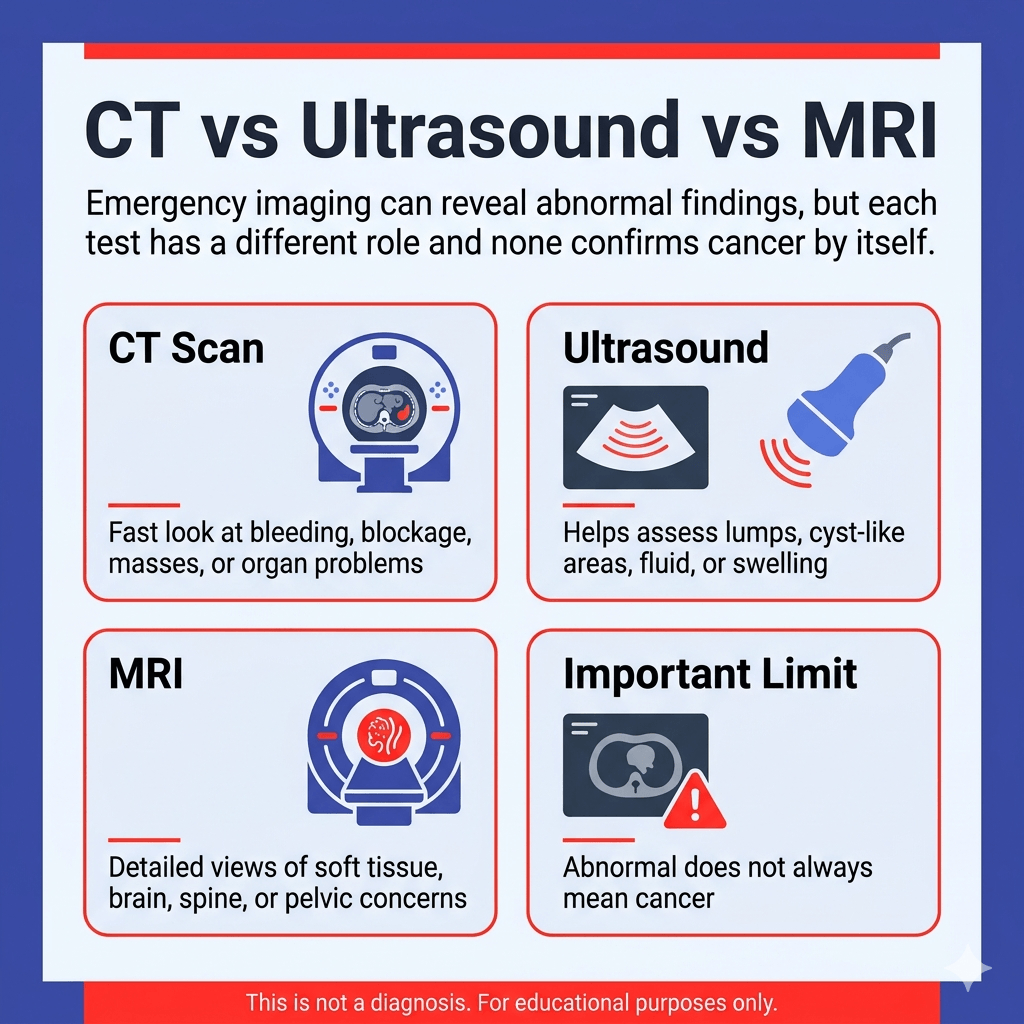
A CT scan can provide detailed cross-sectional images of many areas of the body. In emergency care, CT scans are commonly used when providers need fast information about internal structures.
What CT scans may show
A CT scan may show masses, organ abnormalities, enlarged lymph nodes, bleeding, blockages, fluid collections, inflammation, injuries, or signs that something needs further evaluation.
For patients worried about cancer, a CT scan may sometimes reveal a suspicious mass, nodule, or abnormal growth. It may also show whether an abnormality is causing an urgent problem, such as obstruction, bleeding, severe swelling, or organ compromise.
What CT scans cannot always confirm
A CT scan usually cannot confirm whether a mass is cancerous by itself. The scan may show size, location, shape, density, spread pattern, or relationship to nearby structures, but those details often need further interpretation.
Additional steps may include comparison with older scans, repeat imaging, MRI, ultrasound, specialist evaluation, or biopsy.
Why CT findings may need follow-up
Radiology reports may use words such as “mass,” “lesion,” “nodule,” “abnormality,” or “suspicious finding.” These words can sound frightening, but they do not always mean cancer.
They usually mean the finding needs to be interpreted in context and followed appropriately. The next step depends on the location, appearance, size, symptoms, and whether the finding appears urgent.
What an Ultrasound Can and Cannot Show
Ultrasound uses sound waves to create images of certain body structures. It can be helpful for specific symptoms and specific areas of the body.
What ultrasound may help evaluate
Ultrasound may help evaluate lumps, soft tissue swelling, fluid-filled areas, cyst-like structures, gallbladder concerns, pelvic symptoms, abdominal concerns, and certain organ abnormalities.
It may also help identify whether something appears fluid-filled, solid-appearing, inflamed, swollen, or unclear.
Why ultrasound has limits
Ultrasound depends on the body area being examined, how deep the finding is, the type of tissue involved, patient body habitus, and what the provider is trying to evaluate.
Some areas are easier to see with ultrasound than others. In some cases, ultrasound may not provide enough detail, and another imaging test may be recommended.
Ultrasound may suggest whether something needs more testing
Ultrasound can sometimes help distinguish patterns, such as a simple cyst-like area versus a more complex or solid-appearing structure. However, ultrasound does not automatically confirm cancer.
If the ultrasound shows something concerning or unclear, follow-up imaging or specialist evaluation may be needed.
What an MRI Can and Cannot Show
MRI can provide detailed images of certain tissues. It may be useful in evaluating specific soft tissue, brain, spine, pelvic, joint, or organ concerns depending on the clinical situation.
MRI can give detailed views of certain tissues
MRI may show details that are not as clear on other imaging tests. It can be especially useful for certain neurological, spine, pelvic, soft tissue, and organ-related concerns.
For some abnormalities, MRI may help providers better understand the size, location, and characteristics of a finding.
MRI is not always the first emergency test
In the emergency setting, MRI is not always the first test ordered. The right imaging choice depends on symptoms, urgency, availability, safety considerations, and what needs to be ruled out quickly.
For certain urgent conditions, CT, ultrasound, X-ray, or lab testing may be more appropriate as the first step.
MRI findings may still require specialist follow-up
Even when MRI provides detailed images, it may not provide a final cancer diagnosis by itself. A concerning MRI result may still require follow-up imaging, specialist review, biopsy, or pathology.
Can Imaging Diagnose Cancer by Itself?
Imaging can raise concern for cancer, help guide next steps, and show where an abnormality is located. It may also help providers understand whether a finding is causing an urgent problem.
But many cancer diagnoses require tissue confirmation through biopsy and pathology.
Suspicious does not always mean cancer
Radiology language can sound alarming. Words like “suspicious,” “mass,” “lesion,” or “nodule” can create understandable anxiety.
However, suspicious does not always mean cancer. It means the finding needs proper medical interpretation and follow-up based on the full clinical picture.
Biopsy or pathology may be needed
When cancer is suspected, a biopsy or tissue evaluation is often needed to confirm the diagnosis. Pathology looks at cells or tissue more directly, which imaging alone usually cannot do.
This is why an ER scan may identify a concerning finding but still not provide a final cancer diagnosis.
Follow-up timing depends on the finding
Some imaging findings require urgent evaluation. Others may need scheduled outpatient imaging, repeat scans, or referral to a specialist.
The timing depends on the finding itself, your symptoms, your overall health, and whether the abnormality appears to be causing an immediate problem.
What Happens If an ER Scan Finds a Mass, Nodule, or Lesion?
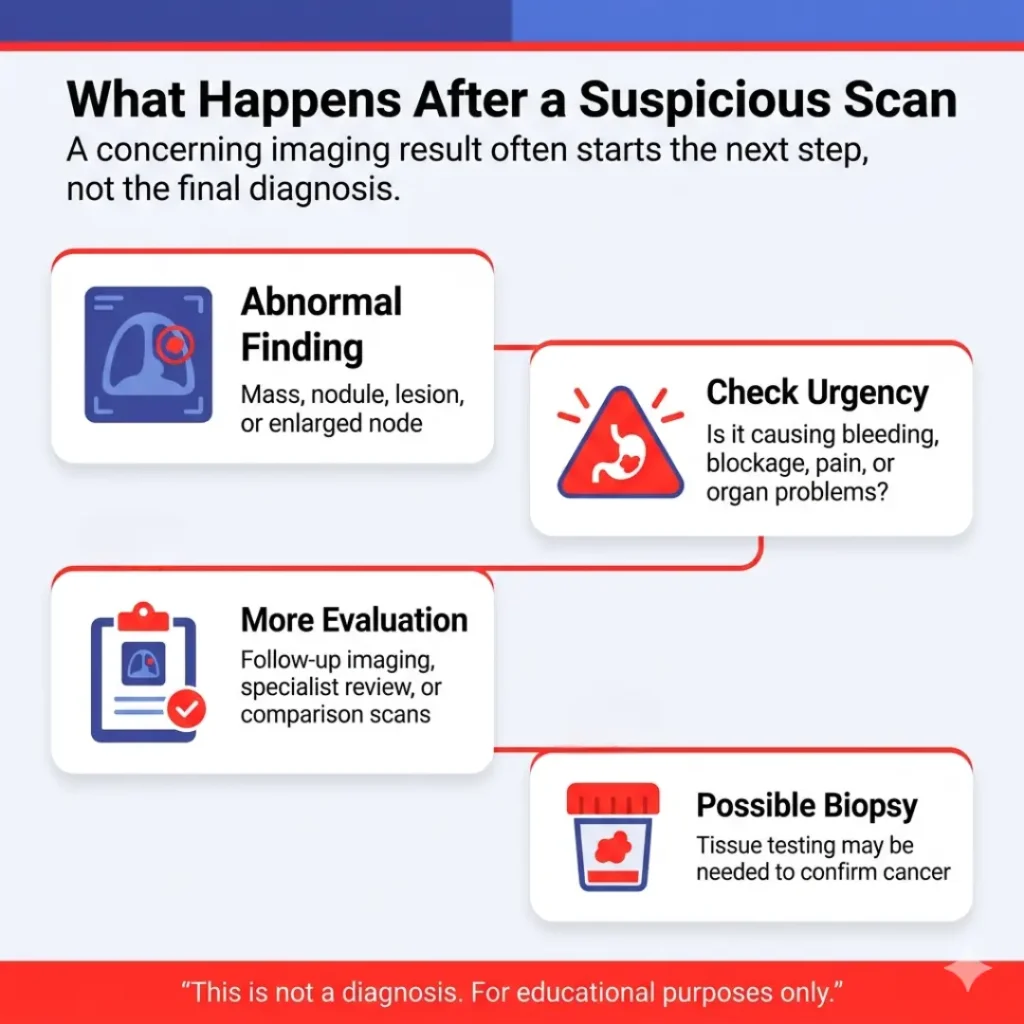
If an ER scan finds a mass, nodule, lesion, or other abnormality, the emergency team’s first concern is whether it is causing a dangerous problem right now.
The ER team evaluates whether the finding is urgent
The immediate question is whether the abnormality is linked to bleeding, obstruction, severe pain, infection, breathing problems, organ compromise, or another urgent condition.
If emergency treatment is needed, the team will focus on stabilizing the immediate issue. If the finding does not require emergency treatment, follow-up may still be very important.
You may need follow-up after discharge
Depending on the location and type of finding, follow-up may involve a primary care doctor, oncology, gastroenterology, pulmonology, surgery, gynecology, urology, or another specialist.
The ER may recommend follow-up imaging, outpatient testing, or further evaluation based on the radiology report and your symptoms.
Keep a copy of your imaging report
Keep your discharge paperwork and imaging report details. The next provider may need to review the exact wording of the finding and the recommended follow-up.
If possible, ask who should receive the report and how soon you should schedule your next appointment.
Symptoms That May Lead to Imaging in the ER
Patients do not usually come to the ER for “cancer imaging.” They come because something feels severe, sudden, worsening, or unsafe to ignore.
Symptoms that may lead to imaging in the ER include:
- Severe or worsening abdominal pain
- Chest pain or trouble breathing
- Severe headache or neurological symptoms
- Unexplained severe pain
- Vomiting, dehydration, or possible obstruction symptoms
- Significant swelling or a painful lump
- Trauma with concerning symptoms
- Blood in vomit, stool, or urine
- Heavy bleeding or severe bleeding symptoms
The imaging test chosen depends on your symptoms, physical exam, medical history, lab results, and what the emergency team needs to evaluate.
When Cancer Screening or Outpatient Imaging May Be More Appropriate
Not every concern about cancer belongs in the ER. Some concerns are better evaluated through planned outpatient care, especially if symptoms are stable and not immediately dangerous.
Screening is different from emergency imaging
Cancer screening is usually planned based on age, risk factors, symptoms, family history, medical history, and guideline-based recommendations.
Screening tests are designed to look for certain cancers before they cause major symptoms. Emergency imaging is different. It is usually ordered to evaluate urgent symptoms and guide immediate care.
Stable symptoms may need scheduled follow-up
Stable, non-emergency concerns may be better handled through a primary care doctor or specialist. They can order the right imaging, compare results over time, coordinate lab work, and arrange specialty referrals when needed.
This kind of planned workup may provide a more complete evaluation than an emergency visit can.
Do not ignore concerning symptoms just because they are not an emergency
Even if symptoms do not require emergency care, they should not be ignored if they are persistent, unexplained, worsening, or changing.
Unexplained weight loss, ongoing pain, unusual bleeding, a growing lump, persistent cough, or symptoms that keep returning should be discussed with a medical provider.
Questions to Ask After an Abnormal Imaging Result
If you are told that imaging showed something abnormal, it is reasonable to ask clear questions before you leave.
Helpful questions include:
- What did the imaging show?
- Is the finding urgent?
- Does it look like a cyst, mass, nodule, inflammation, infection, or something unclear?
- Do I need another imaging test?
- Do I need a biopsy or specialist referral?
- How soon should I follow up?
- What symptoms mean I should return to the ER?
- Who should receive the imaging report?
These questions can help you understand the difference between an emergency concern and a follow-up concern.
What Imaging Cannot Replace
Imaging is an important tool, but it does not replace the full medical process. A scan cannot replace a detailed medical history, physical exam, appropriate cancer screening, biopsy or pathology when tissue confirmation is needed, specialist interpretation, or monitoring changes over time when recommended.
The most important step after an abnormal imaging result is understanding what the finding means, whether it is urgent, and what follow-up is needed.
If you are in Angleton or a nearby community and you have severe abdominal pain, chest pain, trouble breathing, sudden weakness, heavy bleeding, severe swelling, or symptoms that are rapidly worsening, Angleton ER provides 24/7 emergency care. Our emergency team can evaluate urgent symptoms, perform appropriate emergency imaging and lab testing when needed, and help determine whether your condition requires immediate treatment, stabilization, or follow-up with another provider.
Frequently Asked Questions
Can a CT scan detect cancer?
A CT scan can sometimes show a mass, nodule, enlarged lymph node, or organ abnormality that raises concern for cancer. However, a CT scan usually cannot confirm cancer by itself. Follow-up imaging, specialist evaluation, or biopsy may be needed.
Can an ultrasound show cancer?
Ultrasound may show abnormal areas such as lumps, cyst-like structures, fluid collections, or solid-appearing masses. It can help determine whether something needs more testing, but it does not automatically confirm cancer.
Can an MRI diagnose cancer?
MRI can provide detailed images of certain tissues and may show findings that are concerning for cancer. However, MRI findings often still need specialist interpretation and may require biopsy or additional testing before a diagnosis is confirmed.
Does a normal CT scan mean I do not have cancer?
Not always. A normal CT scan may be reassuring for the urgent issue being evaluated, but some cancers may be too small, too early, or not visible on that specific test. Persistent or unexplained symptoms should still be followed up with a medical provider.
What does it mean if imaging shows a mass or lesion?
A mass or lesion means the scan found an abnormal area. It does not automatically mean cancer. Some masses or lesions may be benign, inflammatory, infectious, cystic, or unclear. The next step depends on the appearance, location, symptoms, and radiology recommendations.
Can the ER diagnose cancer from imaging?
The ER may identify a suspicious finding and help determine whether it is causing an urgent problem. However, cancer is usually not definitively diagnosed from emergency imaging alone. Confirmation often requires follow-up evaluation, biopsy, or pathology.
Why would I need a biopsy after imaging?
A biopsy allows tissue or cells to be examined more directly. Imaging can show where an abnormality is and what it looks like, but biopsy or pathology may be needed to confirm whether the finding is cancerous.
What should I do if an ER scan finds something suspicious?
Ask what the scan showed, whether the finding is urgent, and how soon you need follow-up. Keep a copy of your discharge paperwork and imaging report details. Schedule follow-up with the recommended provider, such as primary care or a specialist.
Is ER imaging the same as cancer screening?
No. ER imaging is usually performed to evaluate urgent symptoms and guide immediate care. Cancer screening is typically planned based on age, risk factors, medical history, and screening recommendations.