
If you searched “how to treat congestive heart failure,” there’s a good chance you’re not looking for trivia. You’re looking for something steadier than internet noise — a clear plan, in plain language, so you can breathe a little easier (sometimes literally).
Here’s what we tell patients in real life:
- CHF is serious, but it’s often treatable and manageable.
- Treatment isn’t one magic fix. It’s usually a combination of the right meds, the right daily habits, and catching flare-ups early.
- If symptoms feel like they’re getting worse fast, don’t try to “tough it out.” That’s the moment for evaluation.
Educational only. This is not medical advice or a diagnosis. If symptoms are severe, rapidly worsening, or you’re concerned, seek in-person evaluation.
What “treating CHF” actually means
“Congestive heart failure” doesn’t mean your heart “stopped.” It means your heart isn’t keeping up with your body’s needs the way it should, and your body may hold onto fluid. That fluid backup is what drives a lot of the symptoms people notice.
In plain English: the heart is still working, but it can’t pump blood as effectively as it needs to. When the pump falls behind, blood backs up—usually into the lungs, legs, and feet. Imagine it like a shipping department that’s always running behind: packages (in this case, fluid) pile up where they shouldn’t, causing congestion, swelling, and the classic shortness of breath. This is why people with CHF often notice swelling in their ankles, getting winded easily, or feeling unusually tired.
When we talk about CHF treatment, we’re usually targeting two goals:
- Reduce congestion (help you breathe easier, reduce swelling, improve stamina)
- Reduce strain on the heart over time (so symptoms flare less often and day-to-day life is more stable)
A quick anonymous scenario
A person from Brazoria County tells us:
- “I get winded walking from the car.”
- “I can’t lie flat comfortably.”
- “My legs look puffy by evening.”
- “I thought it was stress… but it’s getting worse.”
They’re not trying to become their own cardiologist. They’re trying to answer:
“Is this urgent — and what can I do next?”
The Stages of Congestive Heart Failure (CHF)
You might hear about “stages” when it comes to heart failure. This isn’t just medical jargon—it helps to make sense of where things stand and what steps matter most. There are four main stages, usually referred to as A, B, C, and D.
Here’s how it breaks down:
- Stage A (High Risk, No Symptoms Yet):
Think of this as the “pre-game.” You don’t have heart failure, but you’re at higher risk. Maybe you have high blood pressure, diabetes, a strong family history of heart issues, or past things like chemo that can nudge the heart in the wrong direction.
What matters here? Prevention—managing blood pressure, blood sugar, and backing away from habits that strain the heart. - Stage B (Structural Changes, Still No Symptoms):
At this point, the heart may show changes on imaging (an enlarged chamber, or the pump isn’t quite as strong), even if you still feel fine. Think of it as the quiet before the storm—your heart is under the hood, not keeping pace, but you might not notice a thing.
Priorities here: Medications may enter the picture, along with the same healthy lifestyle tweaks. - Stage C (Symptoms Show Up):
This is usually when most people realize something’s wrong. You’ve either felt symptoms—breathlessness, swelling, fatigue—or you’ve had them before. At this stage, CHF management ramps up: regular meds, daily habits, and quick attention to warning signs. - Stage D (Advanced Heart Failure):
Symptoms are severe, stick around despite treatment, and start making daily life hard. This is the “hard slog” stage, sometimes called advanced or end-stage. Here’s where specialty treatments, and sometimes advanced therapies (like mechanical pumps or transplant evaluation), are considered.
Knowing your stage makes it easier to plan next steps and recognize if things are improving, holding steady, or need another look. In any stage, catching symptoms early is always worth it.”
Symptoms people notice
CHF symptoms can be subtle at first, and that’s part of what makes it stressful.
Common ways people describe it:
- Shortness of breath
- with activity, when lying down, or waking up breathless
- Swelling
- ankles/feet/legs, sometimes hands or belly “bloating”
- Fatigue that doesn’t match your day
- “I feel wiped out doing normal stuff”
- Cough or chest congestion
- especially if fluid is backing up toward the lungs
- Rapid weight change
- not “fat gain,” but fluid changes (this is why clinicians often ask you to watch trends)
These symptoms can overlap with other conditions, so the goal isn’t self-diagnosis — it’s recognizing when something needs a real evaluation.
Causes & who is at risk
CHF usually develops because the heart has been under strain or has been injured over time — and sometimes a new event “tips it over.”
Common contributors include things like:
- Long-term high blood pressure
- Coronary artery disease (reduced blood flow to heart muscle)
- Prior heart attack or heart muscle weakness
- Valve problems
- Irregular heart rhythms
- Uncontrolled diabetes, kidney disease, lung disease, and other chronic conditions that raise overall strain
But it’s rarely just one thing. CHF often shows up as the “final common pathway” when several medical issues pile up, making it harder for the heart to do its job.
Other medical conditions matter, too
It’s especially important to manage any underlying conditions that can drive CHF or make it worse, such as:
- Diabetes
- Kidney disease
- Anemia
- High blood pressure
- Thyroid disease
- Asthma or chronic lung disease
- High cholesterol
- Obesity
- Atrial fibrillation (a common rhythm issue)
Tuning up these related problems can have a big impact on how you feel, how stable your heart failure is, and what your daily life looks like.
What can tip things over?
And then there are triggers that can make symptoms suddenly worse (even in someone already diagnosed), such as:
- infections and illnesses
- missed meds or medication changes
- fluid shifts
- worsening blood pressure control
- new rhythm problems
If CHF is on the table, we don’t just ask “do you have heart failure?”
We ask: “What’s driving it — and what’s making it worse right now?”
Shifting the odds: steps that actually help prevent CHF
While none of us can change our genetic hand — age, family history, and background still matter — there are practical things people can do to stack the deck in their favor when it comes to heart health.
The biggest wins, according to both research and what we see in real-life clinics:
- Keep your numbers in range: Staying on top of blood pressure, blood sugar, and cholesterol helps prevent the underlying damage that sets the stage for CHF.
- Eat with your heart in mind: Think less “fad diet,” more Mediterranean-style — plenty of vegetables, fruit, whole grains, lean proteins, and less salt.
- Stay active (in any way that fits): You don’t need marathon medals. Even regular walking, cycling, or swimming makes a real difference.
- Skip the smokes: Avoiding tobacco in all forms is one of the most powerful things you can do. If you’re struggling, talk to a clinician about ways to quit.
- If you drink, keep it moderate or less: Heavy alcohol use stresses the heart. Dry months aren’t just for social media — your heart will thank you.
- Be up front with your medical team: Managing conditions like diabetes, kidney disease, irregular heart rhythms, and sleep apnea can all help lower your risk over time.
- Stress less (easier said than done): Chronic stress raises heart strain. Whatever helps you decompress — walking, hobbies, time with friends — isn’t just “nice,” it’s protective.
No one is perfect on all fronts, but each step matters. And if you’re not sure where your heart risks stand, checking in with a clinician can clarify the next best moves for you.
Understanding the Stages of CHF
Congestive heart failure doesn’t hit everyone in the same way, and it doesn’t unfold overnight. Instead, it’s mapped out in four distinct “stages”—useful for doctors, patients, and families to better understand where things stand, what to expect, and how to focus efforts.
Here’s how professionals break it down:
Stage A: At Risk, No Damage (Yet)
Stage A is an early warning zone. You don’t have symptoms, and your heart itself still works as it should. But the groundwork is there—maybe your blood pressure or blood sugar runs high, you’ve had a heart event, or there’s a family history working against you. These are the folks who are on the radar because their risk is higher than average, but their heart’s structure is (so far) still normal.
Common reasons someone is considered “Stage A” include:
- Long-standing high blood pressure
- Diabetes
- A history of heavy drinking or metabolic syndrome
- Family history of certain heart muscle problems
- Exposures like chemotherapy known to strain the heart
Stage B: Silent Structural Changes
In Stage B, the heart itself is starting to show changes—like a weakened left ventricle (the chamber that pumps blood out to the body) or other structural shifts—but you’re still not feeling the classic symptoms of CHF. This is “pre-heart failure” in a literal sense: damage has happened, but the body is compensating well enough that you may notice nothing at all. Most people find out they’re here because of imaging tests or exams for something else.
Stage C: Symptoms Are Now on the Table
Stage C is when CHF moves out of the shadows and into everyday life. You’ve either had—or are currently dealing with—symptoms such as shortness of breath, leg swelling, or needing to prop yourself up to sleep. This is where most people are first formally diagnosed and where treatment takes center stage to improve quality of life and prevent flare-ups.
Stage D: Advanced CHF — More Support Needed
At Stage D, the heart is struggling despite medications and lifestyle shifts. Symptoms become hard to control—showing up with minimal activity, or even at rest. This stage often leads to conversations about advanced treatments, like specialized pumps, heart transplant, or comfort-focused care.
The goal, at every stage, is to catch problems early and slow the cycle—whether you’re just at risk or navigating more advanced disease. Each step is a chance to take back a little control.
What are the types of congestive heart failure?
Not all heart failure is the same. In fact, CHF can show up in a few different “flavors” depending on which part of the heart is underperforming and what’s causing the trouble. The most common types you’ll hear about in a real-world cardiology clinic include:
- Left-sided heart failure: This is the most common and means the left side of your heart (the main pumping chamber) isn’t moving blood forward as strongly as it should. As a result, fluid tends to back up toward the lungs, which can lead to shortness of breath or coughing.
- Right-sided heart failure: Sometimes the right side of the heart struggles, often as a consequence of left-sided failure. This tends to cause fluid buildup in the legs, ankles, or belly.
- High-output heart failure: Much less common, this happens when the heart is working harder than usual (for example, due to some chronic medical conditions) but still can’t meet the body’s increased demands.
Most people with CHF have one of the first two types, or a mix of both. A small number fall into the high-output category, which is a different ballgame and much rarer.
How common is congestive heart failure?
Heart failure is a lot more common than most people expect. In the U.S. alone, millions of adults are living with some form of CHF — and it’s one of the main reasons folks over 65 land in the hospital. It doesn’t matter if you’re living in Freeport or Fifth Ward; heart failure isn’t rare, and it doesn’t only happen to “other people.”
In other words: If you or a loved one is facing CHF, you’re in big company, and you’re definitely not alone.”
How CHF is diagnosed (the tests that clarify what’s going on)
CHF isn’t diagnosed from one single clue. It’s usually a combination of:
- your symptoms and medical history
- a physical exam (listening to lungs/heart, checking swelling, oxygen status, etc.)
- tests that help confirm heart strain and fluid overload, and rule out other causes
- EKG/ECG (rhythm and heart strain clues)
- Blood tests
- clinicians may check markers that rise with heart strain and see how kidneys/liver are doing
- Chest X-ray
- can show signs of fluid in the lungs or other chest issues
- Echocardiogram (heart ultrasound)
- helps evaluate how the heart is pumping and filling
- Additional testing
- sometimes stress testing or other imaging, depending on what’s suspected
If you’re reading this because symptoms are changing quickly, the key point is:
Don’t gamble on guessing. CHF and several other conditions can feel similar early on.
Why it matters: Possible complications clinicians are watching for
Part of the reason for thorough testing is that CHF can affect much more than just the heart. Your care team is watching for complications that can sneak up or overlap with other conditions, such as:
- Irregular heartbeat (arrhythmia)
- Sudden cardiac arrest
- Heart valve problems
- Fluid buildup in the lungs (pulmonary edema)
- Pulmonary hypertension (extra pressure in the lung arteries)
- Kidney damage
- Liver damage
- Malnutrition (from fluid retention or heart’s effect on digestion)
These complications aren’t inevitable, but they’re part of why clinicians don’t just “watch and wait” if symptoms are changing. Catching CHF (or whatever’s causing your symptoms) early helps stack the odds in your favor—by stopping further damage before it snowballs.
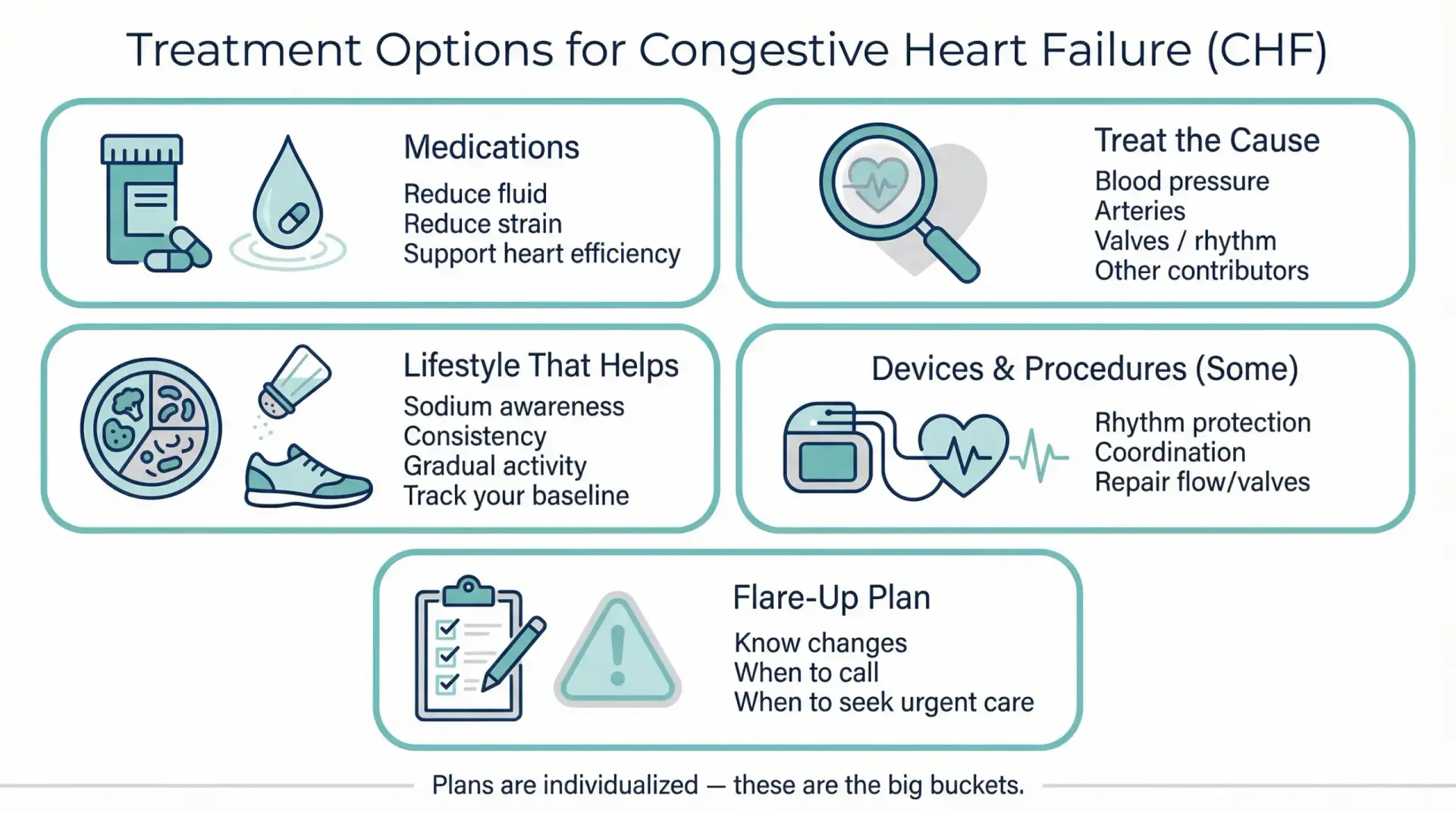
Treatment options for congestive heart failure (the plan that actually helps)
Treatment is individualized — but the “big buckets” are consistent.
How CHF Treatment Changes by Stage
Let’s break down how the approach to congestive heart failure (CHF) shifts as the condition progresses—because a “one-size-fits-all” plan just isn’t realistic here. The stage of CHF (A through D) guides both the intensity and the mix of strategies your care team will recommend.
Early Stages: Prevention and Risk Reduction (Stages A & B)
For folks at risk or with very early changes (Stages A and B), the main goals are to rein in risk factors and keep the heart as healthy as possible.
Key steps usually include:
- Daily movement — think regular walks, not ultramarathons.
- Quitting tobacco if you use it (no magic here, just honesty).
- Steering clear of recreational drugs and limiting alcohol.
- Tackling high blood pressure and cholesterol, often with both lifestyle tweaks and prescribed meds.
- For those with conditions like diabetes, coronary artery disease, or a history of heart attack, certain medications that ease strain on the heart muscle may be added early.
If a problem shows up with heart structure or rhythm, or you’ve had a heart attack, your provider might recommend things like a beta-blocker or, in some cases, surgery or procedures to fix valve or artery issues.
Middle Stage: Symptom Management & Close Monitoring (Stage C)
If you’re at the point where symptoms like swelling, breathlessness, or fatigue start appearing, the plan steps up a notch:
- All the basics from earlier stages—still non-negotiable.
- A stronger mix of cardiac meds, tailored to your symptoms and underlying heart muscle function. This may include beta-blockers, diuretics (“water pills”), aldosterone antagonists, and more.
- Some folks benefit from newer medications that support the heart’s pumping ability or ease hormonal imbalances that drive symptoms.
- Salt restriction, daily weight tracking, and sometimes keeping an eye on fluid intake.
- Technology may play a role—like a pacemaker or an implantable defibrillator for certain rhythm or pumping issues.
If you’re part of a group at higher risk (for example, some African-American patients), combinations like hydralazine and nitrates could be added if standard therapies aren’t enough.
Advanced Stage: Specialized Therapies (Stage D)
When CHF gets severe or symptoms persist despite full-court-press treatment, more advanced options come into play:
- All the foundational care still applies—no dropping the basics.
- Assessment for a heart transplant or heart pump (ventricular assist device) may be on the table.
- Some people may require continuous IV medications to support circulation.
- Palliative or hospice care becomes an important conversation—focusing on comfort and quality of life.
CHF with Preserved Ejection Fraction (HFpEF)
Not everyone with CHF has a weakened pump. For those where the heart’s squeeze looks “normal” on scans (HFpEF), the focus is on:
- Managing blood pressure, diabetes, kidney disease, lung issues, or anything else that puts extra strain on the heart.
- Using diuretics to help reduce swelling and ease breathing.
- Sticking to the foundational measures: active lifestyle, salt control, medication consistency.
Don’t Forget: Treating What Else Is Going On
No matter the stage, addressing other chronic conditions—think diabetes, kidney disease, anemia, lung or thyroid problems—is just as critical. It’s often these co-pilots that influence how well CHF stays under control.
So, while the tools in the CHF toolbox are many, they’re pulled out in combinations that fit your specific stage and situation. This is why ongoing follow-up is so key: the right move now might look very different than it did six months (or six years) ago.
Treatment options: Tailoring the plan to heart function
The approach to treating congestive heart failure (CHF) can depend on whether the main issue is a weakened heart muscle (reduced ejection fraction, or HFrEF) or if the heart is pumping well but struggling to fill (preserved ejection fraction, or HFpEF). The broad strokes stay the same—relieve symptoms, slow progression, and address the root causes—but there are a few added wrinkles worth knowing about.
If the heart’s pumping is reduced (HFrEF)
In addition to the foundational steps and medications above, people with HFrEF often benefit from:
- Beta blockers, which help the heart beat more efficiently and can actually lengthen life in many people.
- Mineralocorticoid receptor antagonists (like spironolactone or eplerenone) to address hormone pathways that ramp up strain.
- SGLT2 inhibitors—a newer class of medications originally for diabetes, now shown to help heart failure outcomes (even for those without diabetes).
- Special medication combinations (such as hydralazine and nitrates), particularly for certain groups who may not respond as well to standard treatments.
- Sometimes, medications to slow the heart rate if it’s persistently high and symptoms continue.
- Diuretics (“water pills”) if fluid buildup is making symptoms worse.
- Daily weight tracking to quickly spot fluid shifts—let your medical team know if your weight jumps more than a few pounds in a couple of days.
- In select cases, device therapies may be considered:
- Cardiac resynchronization (a type of pacemaker for some with abnormal heart rhythms)
- Implantable defibrillators to help prevent sudden cardiac events
Even if you start feeling better with treatment, those therapies often remain long-term to keep symptoms from rebounding.
If the main issue is preserved pumping (HFpEF)
For people whose hearts still pump strongly but have trouble filling (HFpEF), the focus shifts a bit:
- Managing related medical conditions—like atrial fibrillation, high blood pressure, diabetes, obesity, kidney disease, and lung diseases—is crucial.
- Diuretics are frequently used to control symptoms from fluid overload.
- Medications are tailored to treat any other contributing conditions, rather than a one-size-fits-all heart failure drug.
For advanced heart failure
Some people progress despite all of the above. At this stage, options may expand to:
- Evaluations for advanced therapies, such as ventricular assist devices (mechanical pumps for the heart), or even a heart transplant
- Infusions of specialized medications (inotropic drugs)
- Surgery when appropriate
- Focused symptom management, including palliative care, to keep quality of life as high as possible
And throughout all of this, tackling other health concerns—whether that’s treating anemia, keeping blood pressure in range, or addressing thyroid or lung conditions—remains an essential part of keeping heart failure from taking over your daily life.
Medications (often more than one, for different reasons)
CHF treatment frequently involves a combination of medicines because each class targets a different part of the problem.
Depending on your situation, clinicians may use medications that help:
- reduce extra fluid (to relieve congestion and swelling)
- relax blood vessels / reduce strain on the heart
- slow heart rate and improve heart efficiency
- stabilize hormone pathways that worsen CHF over time
- support heart and kidney function in ways that reduce hospitalizations for some patients
Two practical notes we repeat a lot:
- Do not start/stop CHF meds on your own. Even “small changes” can matter.
- If side effects show up, don’t just quit. Tell your clinician — there are often alternatives.
A quick word on side effects and complications:
While these medications are essential, no treatment is risk-free. Some common complications of CHF treatments can include:
- Low blood pressure (hypotension): Sometimes meds can make your blood pressure drop too much, leading to dizziness or fainting.
- Worsening kidney function: The very drugs that protect your heart can sometimes put added strain on your kidneys.
- Infections: Frequent hospital visits, especially those involving IV lines, can occasionally lead to infections.
The bottom line: side effects or complications aren’t a reason to go it alone or give up. They’re a signal to check in with your care team, who can often adjust your meds, swap options, or troubleshoot what’s happening.
Treat the underlying cause (this is where progress happens)
CHF management is much stronger when we address what’s driving it. That could mean treating:
- blood pressure issues
- blocked coronary arteries
- valve problems
- rhythm problems (like atrial fibrillation)
- thyroid issues, kidney strain, or other contributors
This is one reason we don’t love “one-size-fits-all” internet answers.
The best CHF treatment depends on what caused it.
Lifestyle changes that actually matter (without turning your life into a punishment)
Lifestyle isn’t about perfection — it’s about reducing the most common forces that worsen CHF.
Often-helpful habits include:
- Sodium awareness
CHF and salt don’t get along for many people; processed foods are a common issue. People with congestive heart failure may need to limit how much salt and/or fluid they consume each day. Your provider can give you guidelines for this.
Staying mindful of sodium isn’t always about skipping the salt shaker—some of the sneakiest offenders are canned soups, frozen meals, deli meats, and those “just add water” boxed dinners. Reading nutrition labels and checking serving sizes can go a long way. And, if you’re ever in doubt about how much is too much, your care team can help tailor a plan that works for your situation.
- Medication consistency
the “best” plan doesn’t help if it’s taken randomly
- Activity that’s appropriate for your symptoms
many people do better with gradual, consistent movement than with overdoing it then crashing
- Monitoring your baseline
noticing earlier when swelling, breathing, or stamina is changing
If you’ve never lived with CHF symptoms, it’s easy to underestimate how real it is. We don’t.
We’d rather help you build a sustainable plan than scare you into doing nothing.
Devices and procedures (for some patients, not all)
Some people benefit from implanted devices or procedures when CHF is more advanced or when rhythm risk is higher.
Depending on your case, this can include:
- devices that correct dangerous rhythms
- devices that help coordinate how the heart beats
- procedures that repair structural problems (like valves) or improve blood flow
You don’t need to memorize device names to understand the point:
For some patients, “treating CHF” includes more than meds — and that’s not a failure. It’s a strategy.
“Flare-up” planning (this is how many ER visits are prevented)
A lot of CHF ER visits happen because symptoms quietly worsen… until they don’t feel quiet anymore.
A flare-up plan usually means:
- knowing what symptom changes matter for you
- knowing when you should call your clinician
- knowing when you should seek urgent evaluation instead of waiting
When should you reach out to your provider?
If you notice new symptoms or your heart failure symptoms are getting worse, don’t wait it out—let your provider know. Classic red flags worth a call:
- Shortness of breath when you’re at rest (not just with activity)
- Swelling in your legs or belly that’s new or noticeably worse
- Sudden, unexplained weight gain
- Constant tiredness that’s different from your usual baseline
Which brings us to the part we never soften:
Prevention: lowering the chance of CHF flare-ups
CHF isn’t always preventable once it’s established — but flare-ups are often reducible.
Things that commonly help reduce “backslides”:
- taking medications as prescribed
- keeping follow-up appointments (even when you feel “okay”)
- addressing blood pressure, diabetes, kidney strain, and rhythm problems consistently
- avoiding extreme swings in daily habits (overdoing activity, major diet swings, missed meds)
- treating infections early (because illness can trigger worsening symptoms)
The goal isn’t “never have a bad day.”
The goal is: fewer emergencies, more stability, and earlier action when things change.
Warning symptoms that shouldn’t wait (when ER evaluation is reasonable)
If CHF is possible — or already diagnosed — these are warning symptoms that shouldn’t wait:
- Severe or rapidly worsening shortness of breath, especially at rest
- New or worsening chest pain, pressure, or tightness
- Fainting, near-fainting, new confusion, or severe weakness
- Bluish lips/face or obvious breathing distress
- A very fast or irregular heartbeat and you feel unwell
- Symptoms escalating quickly or feeling different from your usual baseline
If you’re experiencing symptoms like these and you’re in or near Angleton (or elsewhere in Brazoria County), it’s reasonable to get evaluated.
If your breathing is changing, swelling is worsening, or you feel like something is sliding the wrong direction — and you’re in/near Angleton — it’s reasonable to be checked. Our team at Angleton ER is open 24/7, with board-certified physicians and on-site diagnostics (lab testing and imaging) available when needed.
Educational only. This is not medical advice or a diagnosis. If symptoms are severe, rapidly worsening, or you’re concerned, seek in-person evaluation.
Frequently Asked Questions
Is congestive heart failure treatable?
Yes — CHF is often treatable and manageable, especially when the underlying cause is addressed and symptoms are monitored early. Treatment is usually a combination of medications, daily habits, and follow-up care.
How do you treat congestive heart failure?
Most CHF treatment plans include:
medications to reduce fluid and strain on the heart
treating the root cause (blood pressure, blocked arteries, valve issues, rhythm problems, etc.)
lifestyle changes that support stability
sometimes devices or procedures, depending on severity and risk
What is the best treatment for congestive heart failure?
There isn’t one “best” universal treatment. The best plan is the one matched to your type of heart failure and what caused it, and adjusted based on how you respond.
Can heart failure be reversed?
Sometimes heart function and symptoms can improve significantly, especially if the underlying cause is treatable and the plan is followed closely. But avoid anyone promising a guaranteed “reversal” online — CHF is too individualized for that.
When should someone with CHF go to the ER?
If symptoms are severe, rapidly worsening, or include warning symptoms that shouldn’t wait (like severe shortness of breath, chest pain, fainting, confusion, blue lips/face, or feeling seriously unwell), urgent evaluation is appropriate.